
What Is SEO Hosting? Complete Multi-IP & Tiered Solutions Guide
TL;DR
- SEO hosting lets you run many sites on unique IPs so they look independent to search engines instead of one easily detectable, interlinked network.
- It’s mainly used by agencies, affiliates, and PBN owners to lower de‑indexing and penalty risks.
- Multi‑IP SEO hosting focuses on IP diversity (especially different Class C ranges) managed from one control panel.
- Tiered hosting separates money sites, supporting blogs, and bulk link sites so your main sites stay safer.
- Good SEO hosting adds global locations, private nameservers, clean randomized IPs, fast storage, and strong uptime.
- SEO hosting is risk‑management infrastructure, not a shortcut; it only helps if your content and overall SEO are strong.
Let’s be honest: building a network of websites is hard work. But what’s even harder? Watching all that hard work vanish overnight because search engines flagged your sites as a “link farm.”
I’ve been in the hosting and SEO game for over a decade. I’ve seen agencies soar by managing hundreds of client sites perfectly, and I’ve seen others crash and burn because they hosted 50 “independent” blogs on the same cheap shared server. The difference often comes down to one thing: SEO hosting.
If you are scaling your SEO strategy, building a private blog network (PBN), or managing an international portfolio of affiliate sites, regular hosting might not cut it anymore. You need a setup that gives you control over your digital footprint.
In this guide, I’m going to break down exactly what SEO hosting is, why multi-IP solutions matter, and how to use tiered hosting to protect your rankings without getting technical headaches.
What Is SEO Hosting and How Does It Actually Work?
You might hear the term “SEO hosting” and think it’s some magic server that automatically ranks you #1 on Google. I wish it were that simple!
Real SEO hosting is about risk management and footprint reduction. It’s a specialized hosting service designed to host multiple websites on one account while making them appear completely independent of each other to search engines.
Technical definition of SEO hosting
At its core, SEO hosting allows you to manage multiple websites from a single dashboard (like cPanel or WHM) while assigning each website a unique IP address.
These IPs usually come from different “C-Classes” (we’ll get into that later). The goal is to ensure that if a search engine bot crawls Site A and Site B, it sees no server-level connection between them. To the bot, these sites look like they are owned by different people and hosted in different places.
Difference between SEO hosting and regular hosting
With regular shared hosting (think Bluehost or GoDaddy), you might put five WordPress sites on one account. In this scenario, all five sites usually share the exact same IP address and nameservers.
This is fine if you are a local bakery with a blog and a shop. But if you are an SEO agency trying to build backlinks between those sites? It’s a disaster. Google sees that Site A links to Site B, checks the server, sees they are on the exact same IP, and discounts the link value—or worse, penalizes you for manipulation.
SEO hosting separates them.
- Regular Hosting: 5 Sites = 1 IP Address.
- SEO Hosting: 5 Sites = 5 Unique IP Addresses (often from different geographic locations).
How search engines interpret hosting signals
Search engines like Google use “footprints” to identify networks. A footprint is a pattern. If 20 websites all link to the same “money site” and they all share the IP 192.168.1.1, that’s a massive red flag.
By using SEO hosting with diverse IPs and different nameservers, you break that pattern. You are effectively telling the search engine algorithm, “These are unrelated, independent websites.”
Why Do Website Owners and Agencies Use SEO Hosting?
People don’t just buy SEO hosting for fun. It’s usually a strategic decision made by agencies, affiliate marketers, and PBN owners.
Hosting multiple websites without SEO risk
The biggest fear for any multi-site owner is a “de-indexing” event. This is where Google removes all your sites from search results at once. This usually happens when they identify a network.
SEO hosting is the insurance policy against this. By spreading your sites across different IPs and data centers, you minimize the risk that one “bad apple” site brings down your entire portfolio.
Improving site isolation and footprint control
It goes beyond just the IP address. Good SEO hosting allows you to control the nameservers (DNS).
If all your sites use ns1.cheaphost.com and ns2.cheaphost.com, that’s a footprint. SEO hosting lets you use private nameservers for every site. This creates total isolation. Site A looks like it lives in New York, while Site B looks like it lives in London, even if you manage them from the same laptop.
Use cases for affiliates, agencies, and SaaS
- Agencies: If you manage 50 client sites, you don’t want them all on one IP. If that IP gets blacklisted for spam, all 50 clients suffer. Agencies use SEO hosting to give every client a clean, dedicated environment.
- Affiliates: Affiliate marketers often run multiple niche sites (e.g., one about coffee, one about tech, one about dogs). They might cross-promote these sites. SEO hosting keeps these links safe.
- International SEO: If you want to rank in France, it helps to have a French IP. If you want to rank in Germany, you need a German IP. SEO hosting providers often have global data centers to facilitate this.
Does SEO Hosting Still Matter in 2026?
This is the million-dollar question. I hear it all the time: “Does Google still care about IP addresses?”
Google’s stance on IP-based signals
Google has stated publicly that they don’t penalize sites just for being on the same IP. After all, shared hosting is very common.
However, Google does look for unnatural linking patterns. If 100 sites on the same IP all link to the same place, that is unnatural. So, while the IP itself isn’t the penalty, the IP is the evidence Google uses to confirm you are running a link scheme.
What has changed with AI-powered search
AI has made search engines smarter. They don’t just look at IPs; they look at content, design, and WHOIS data.
However, IP diversity remains a foundational signal. Think of it like a house. A fresh coat of paint (good content) won’t save you if the foundation (the server setup) is cracked. In 2026, AI can spot networks faster, which means your technical “camouflage” needs to be better than ever.
When SEO hosting helps—and when it doesn’t
- It HELPS when: You are linking between your own sites or managing a large portfolio.
- It DOESN’T help when: Your content is garbage. You can have the best IP setup in the world, but if you are using spun content or AI-generated spam, you will still fail. SEO hosting protects the technical side; you still have to deliver value on the content side.
What Is Multi-IP Hosting in SEO Hosting?
If you shop for SEO hosting, you will see the term “Multi-IP” everywhere. Let’s break down what that actually means.
Understanding IP diversity
An IP address looks like this: AAA.BBB.CCC.DDD (e.g., 192.168.1.10).
Diversity is about how different these numbers are. The more different the numbers, the more “distant” the servers appear to be from each other.
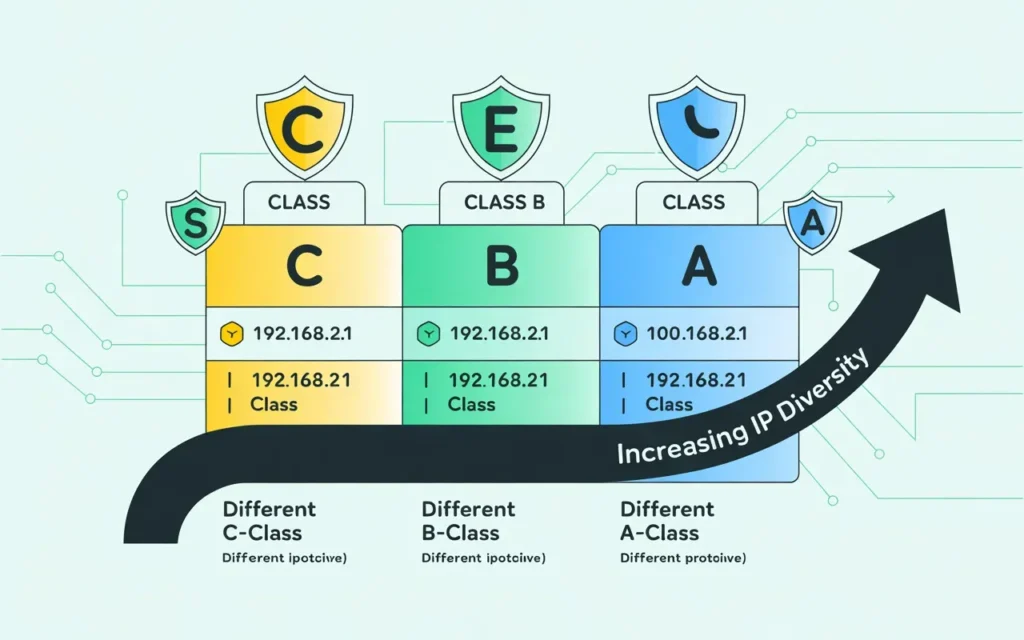
Class A, B, and C IP ranges explained
This is technical, but vital to understand.
- Class C (The Standard): This is the third set of numbers (
CCC). If you have IPs like192.168.1.1and192.168.2.1, they are on different C-Classes. This is the minimum standard for SEO hosting. - Class B (Better): This is the second set of numbers (
BBB).192.168.1.1vs192.170.1.1. These look much more distinct. - Class A (The Best): This is the first set (
AAA).192.168.1.1vs100.168.1.1. These IPs look like they are from completely different providers.
Most good SEO hosting plans focus on Class C diversity. It’s the sweet spot between cost and safety.
How IP separation reduces hosting footprints
Imagine you have 10 sites.
- Bad Setup: All 10 sites on
123.456.789.1(Shared IP). - Good Setup: Sites on
123.456.789.1,123.456.790.1,123.456.791.1(Different Class Cs).
The “Good Setup” makes it incredibly hard for a bot to statistically prove these sites are connected.
What Are Tiered SEO Hosting Solutions?
As search engines got smarter, SEO pros started using “Tiered” hosting. This is a strategy of grouping your websites based on their importance.
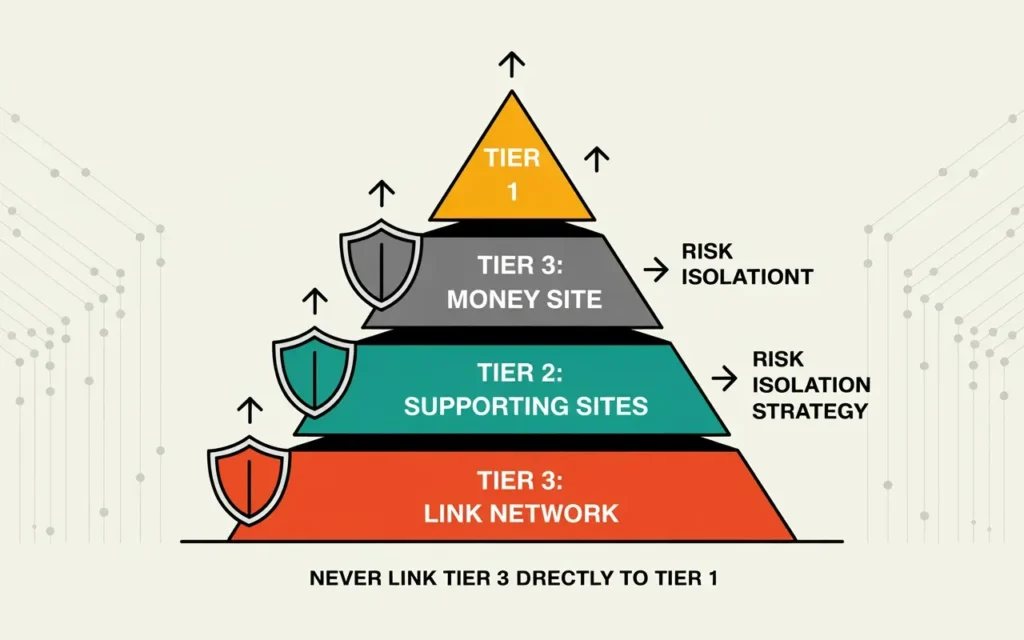
Tier 1, Tier 2, and Tier 3 hosting architecture
- Tier 1 (Money Sites): These are your main business websites. They generate income. You should host these on premium, high-performance cloud hosting (like AWS or dedicated servers). You rarely take risks here.
- Tier 2 (Supporting Sites): These are high-quality blogs that link to your Money Site. These need good SEO hosting with Class B or C IPs.
- Tier 3 (The Network): These are smaller sites used for broader link volume. These are often hosted on cheaper SEO hosting packages with massive IP spreads.
Why tiered hosting is used in SEO strategies
The goal is to insulate your Money Site. You never want your “risky” Tier 3 sites linking directly to your Tier 1 site.
You link Tier 3 -> Tier 2 -> Tier 1.
By using different hosting qualities for each tier, you create a natural-looking filter. Your Money Site looks pristine, receiving links from reputable Tier 2 sites.
Common mistakes in tiered setups
The biggest mistake? Mixing them up. I’ve seen people host their Tier 1 Money Site on the same cheap SEO hosting account as their 50 spammy Tier 3 blogs.
Don’t do this. Keep your Money Site on a pedestal. Keep it isolated. Use SEO hosting specifically for the supporting network.
How Does SEO Hosting Help With Link Building and Networks?
Link building is the engine of SEO. Hosting is the fuel tank.
Hosting money sites vs supporting sites
Your “Money Site” is the asset you want to rank. Your “Supporting Sites” are the ones providing the juice.
If you own both, you are technically a network. To do this safely, you must treat the supporting sites as if they are owned by strangers. This means different IPs, different WHOIS info, different themes, and different content structures.
Avoiding detectable hosting patterns
Patterns kill networks.
- Pattern: All sites use the same default “Hello World” WordPress post.
- Pattern: All sites use the same
contact@gmail.comon the about page. - Pattern: All sites are on IPs
192.168.1.1,192.168.1.2,192.168.1.3(sequential IPs are a bad sign!).
Good SEO hosting providers give you randomized IPs, not sequential ones, to break this pattern.
Best practices for ethical SEO usage
Even if you are using SEO hosting, try to keep it “white hat” adjacent.
- Make sure every site has real value.
- Don’t interlink all your supporting sites (a “link wheel”).
- Ensure your hosting provider keeps the servers fast. Slow sites don’t rank, regardless of the IP.
What Features Should a Good SEO Hosting Provider Offer?
Not all hosts are created equal. If you are shopping around, here is your checklist.
Multiple IP ranges and data centers
You want variety. A provider that only offers IPs from one city in Texas isn’t good enough. You need global locations (USA, UK, Europe, Asia) and varied C-Classes.
Private nameservers and DNS control
You need the ability to set custom nameservers (ns1.yourdomain.com) rather than generic host ones. This is crucial for branding and footprint hiding.
Performance, uptime, and security requirements
This is where many fail. Some SEO hosts overload their servers, leading to slow load times.
Speed is a ranking factor.
Look for providers offering SSD (or NVMe) storage, LiteSpeed web servers, and solid uptime guarantees. If the site takes 5 seconds to load, the unique IP doesn’t matter.
What Are the Risks and Myths Around SEO Hosting?
Let’s clear the air on some scare tactics.
Common misconceptions about SEO hosting
- Myth: “SEO IPs are flagged by Google.”
- Reality: Clean IPs are fine. If a host lets spammers abuse their IPs, those specific IPs get flagged. This is why you need a reputable provider that monitors their network.
- Myth: “It’s illegal.”
- Reality: It’s not illegal. It’s just against Google’s Webmaster Guidelines to manipulate rankings. It’s a business risk, not a legal one.
Over-optimization and footprint risks
The risk comes from being too perfect. If you have 10 sites and they all block the same bots, have the same plugin set, and update at the exact same time, you are creating a footprint. Hosting solves the IP issue, but you have to solve the behavioral issue.
Why hosting alone cannot rank a site
I can’t stress this enough: Hosting is infrastructure, not marketing.
You can have the best SEO hosting in the world, but if your keyword research is wrong and your content is boring, you won’t rank. SEO hosting removes the “anchor” holding you back, but it doesn’t provide the engine to move you forward.
How Is SEO Hosting Different From Cloud and VPS Hosting?
It gets confusing because you can have “SEO Cloud Hosting.”
SEO hosting vs VPS hosting
A VPS (Virtual Private Server) gives you a dedicated slice of a server. It usually comes with 1 IP address.
SEO Hosting is often a reseller account that gives you access to hundreds of IPs.
If you need raw power for one big site? Get a VPS.
If you need to manage 50 small sites on different IPs? Get SEO Hosting.
SEO hosting vs cloud hosting
Cloud hosting is about reliability and scalability (like Google Cloud or AWS).
Traditional SEO hosting was often based on older, dedicated hardware.
However, modern providers are now offering Cloud SEO Hosting. This combines the reliability of the cloud with the IP diversity of SEO hosting. This is the gold standard in 2026.
Choosing the right model for your SEO goals
- Single Authority Site: Use premium Cloud or VPS.
- Network of 10+ Sites: Use a Multi-IP SEO Hosting plan.
Who Should Use SEO Hosting and Who Should Avoid It?
Is this right for you?
SEO agencies and digital marketers
YES. If you handle client sites, you need this to protect your clients from each other. It’s professional negligence to host a dentist’s website on the same shared IP as a risky affiliate blog.
Affiliate marketers and publishers
YES. If you are building a portfolio of niche sites, you need to diversify your risk.
Small businesses and single-site owners
NO. If you run one flower shop website, you do not need SEO hosting. You need a fast, reliable standard host. Don’t overcomplicate it.
How Skynethosting.net Delivers SEO-Ready Hosting Solutions
At Skynethosting.net, we’ve been refining this for over 20 years. We understand that SEOs need more than just IPs; they need power.
Multi-IP hosting across global data centers
We offer access to locations worldwide—from the USA and Canada to the UK, Netherlands, Germany, Singapore, and Australia. This allows you to target local SEO globally with genuine, geo-located IPs.
Tiered hosting support for agencies
We provide Reseller plans that come with free WHMCS licenses. This means you can easily create tiered accounts for your clients (or your own network), managing them all from one master panel while keeping them technically isolated.
Reliable performance with SEO-safe infrastructure
We don’t sacrifice speed for IPs.
- NVMe Storage: We use NVMe drives that are up to 900% faster than traditional SATA drives.
- LiteSpeed Servers: Our servers run LiteSpeed, which is vastly superior to Apache for WordPress performance.
- Clean IPs: We actively monitor our network to ensure our IPs remain clean and reputable.
How to Choose the Right SEO Hosting Plan
Ready to jump in? Here is how to pick the right package.
Evaluating IP needs
Count your sites.
- 1-5 sites: You might get away with a small reseller plan.
- 10-50 sites: You need a dedicated Multi-IP package with at least 10-20 different C-Classes.
- 50+ sites: You need a large-scale solution.
Matching hosting tiers to SEO strategy
Don’t buy the cheapest plan for your best sites.
Use our Budget Reseller plans for your Tier 3/Tier 2 sites.
Use our Corporate VIP or VPS plans for your Money Sites / Tier 1 sites to ensure maximum uptime and speed.
Scaling SEO hosting without risk
Start small. Move 5 sites over. Test the rankings. Once you see the stability, move the next batch. Scaling slowly helps you monitor performance and ensures you don’t trigger any alarm bells with search engines.
Conclusion
SEO hosting as a strategic tool—not a shortcut
SEO hosting is a powerful tool in your arsenal. It allows you to scale your operations, protect your assets, and build a network that can withstand the volatility of algorithm updates.
But remember, it is a foundation. It must be paired with great content, genuine outreach, and a solid user experience.
Building sustainable SEO with the right hosting foundation
If you are serious about managing multiple websites, you cannot ignore your hosting infrastructure. By choosing a provider that offers genuine IP diversity, high-speed hardware, and robust security, you are setting your sites up for long-term success.
Don’t let a cheap shared hosting account be the reason your empire falls. Take control of your footprint today.
FAQs
What exactly is SEO hosting?
SEO hosting is a hosting setup designed for multi‑site SEO where each site gets its own unique IP, often from different Class C ranges and locations, so search engines perceive them as independent properties rather than a clearly connected, easily flagged private link network.
How is SEO hosting different from regular shared hosting?
Regular shared hosting usually places many sites on one IP and common nameservers, which is fine for single businesses but risky for interlinked networks, while SEO hosting deliberately separates IPs, DNS, and sometimes locations so owned sites appear unrelated and safer for controlled linking.
Who actually needs SEO hosting and who doesn’t?
SEO hosting is mainly for agencies, affiliate marketers, publishers, and PBN owners managing many sites that may interlink or target different countries; single‑site local businesses usually just need fast, reliable standard hosting and gain little benefit from complex multi‑IP SEO infrastructure.
What is Multi‑IP and Class C diversity in SEO hosting?
Multi‑IP means your account includes many different IP addresses, usually spread across distinct Class C (and sometimes Class A/B) ranges, so hosted sites aren’t clustered on sequential or obviously related IPs, reducing the statistical patterns search engines use to detect manufactured link networks.
How does tiered SEO hosting protect money sites?
Tiered SEO hosting keeps money sites on premium cloud or VPS infrastructure, places strong supporting sites on solid multi‑IP SEO plans, and isolates riskier volume sites on cheaper broad‑spread IP networks, so penalties or issues in lower tiers don’t directly contaminate your main revenue properties.
Can SEO hosting alone improve my Google rankings?
SEO hosting can support rankings by improving technical signals like IP diversity, uptime, speed, and geo‑relevance, but it cannot compensate for weak content, poor keyword targeting, or spammy links; it reduces footprint risk and infrastructure bottlenecks rather than directly creating higher positions.
