
Cloud Hosting vs VPS vs Dedicated: Which Is Right for You in 2026?
TL;DR
- Cloud hosting uses a cluster of servers to provide elastic resources and high uptime, making it ideal for sites or apps with unpredictable or spiky traffic patterns.
- VPS hosting gives you isolated, guaranteed resources on a shared machine, balancing performance, control, and cost for most growing business or agency websites.
- Dedicated hosting leases an entire physical server to you, offering maximum power and control, best for constant heavy workloads or strict compliance needs.
- Cloud scales up and down fastest, VPS scales within its node limits, while dedicated requires manual hardware upgrades when you outgrow the server.
- VPS usually has predictable monthly pricing, dedicated is higher but efficient for always‑busy sites, and cloud is pay‑as‑you‑go, cheap at low usage but costly if resources run unchecked.
- For most projects, start with a good VPS, then move to cloud for elastic scaling or dedicated hardware once traffic and resource demands are consistently high.
I’ve been in the hosting game for over a decade now. And if there’s one question that still pops up in my inbox every single week, it’s this: “Which server do I actually need?”
It’s a valid question. The hosting world is full of jargon, marketing fluff, and technical specs that can make your eyes glaze over. Back when I started, the choices were pretty binary. You either had a cheap shared plan or you paid a fortune for a big metal box in a data center.
Fast forward to 2026, and the landscape is totally different. The lines between cloud, VPS (Virtual Private Server), and dedicated hosting have blurred. But making the wrong choice? That still hurts. Pick something too small, and your site crashes on Black Friday. Pick something too big, and you’re burning cash on resources you’ll never touch.
In this guide, I’m going to break down these three giants of the hosting world. No sales pitch, just real talk from my experience to help you figure out exactly where your website belongs this year.
What Is Cloud Hosting and How Does It Work?
If you’ve heard “it’s in the cloud” a million times but still feel fuzzy on what that actually means, you aren’t alone.
Cloud infrastructure explained simply
Think of traditional hosting like renting a single apartment. If the plumbing breaks, you have a problem.
Cloud hosting is more like staying in a massive hotel network. If one room has an issue, the hotel instantly moves you to another room without you even noticing.
Technically speaking, your website isn’t sitting on one single physical machine. Instead, it’s hosted on a cluster of interconnected servers. If one server fails, another one picks up the slack immediately. It’s a safety net that keeps your site online no matter what happens to the hardware.
Resource pooling and scalability
The magic of the cloud is how it handles resources. In a traditional setup, you have a fixed amount of RAM and CPU.
In the cloud, resources are pooled together. Imagine a giant lake of computing power. You can dip a bucket in and take just a little bit, or you can hook up a firehose when you need a lot.
This is what we call scalability.
Let’s say you get a viral shoutout on social media. Suddenly, 50,000 people are trying to buy your product. On a rigid server, your site might crash. On cloud hosting, you can instantly tap into that “lake” of power to handle the rush, and then scale back down when things get quiet.
Common cloud hosting use cases
So, who is this actually for?
I usually recommend cloud hosting for:
- Websites with unpredictable traffic: If your visitor numbers jump up and down, the cloud adjusts automatically.
- High-availability apps: If downtime costs you money every second, the redundancy of the cloud is non-negotiable.
- Fast-growing startups: You might start small today but need massive power next month. The cloud grows with you effortlessly.
What Is VPS Hosting and Why Is It So Popular?
VPS hosting is often called the “middle ground.” It’s the sweet spot for millions of website owners who have outgrown shared hosting but aren’t ready to buy a dedicated server.
Virtualization and isolated resources
VPS stands for Virtual Private Server.
Imagine a large physical server. Using virtualization technology, we slice that server up into smaller, private compartments.
Each compartment acts like its own independent server. You get your own operating system, your own dedicated storage, and your own slice of RAM. Even though you are technically on the same hardware as other people, what they do doesn’t affect you.
It’s like living in a condo. You share the building (the physical server), but you have your own front door, your own kitchen, and your neighbors can’t wander into your living room.
Performance vs shared hosting
If you are coming from shared hosting, a VPS feels like trading a bicycle for a sports car.
On shared hosting, if your “neighbor” gets a massive traffic spike or gets infected with malware, your site slows down. It’s the “bad neighbor” effect.
On a VPS, your resources are guaranteed. If you pay for 4GB of RAM, you get 4GB of RAM. It doesn’t matter what the other VPS users on the machine are doing. Your performance stays consistent.
Typical VPS hosting scenarios
I find VPS is the perfect fit for:
- Business websites: You need reliability and speed, but you don’t need infinite scaling.
- Web developers: You need root access to install custom software or configure the server environment exactly how you like it.
- Agencies: You host multiple client sites and want to keep them secure and fast without breaking the bank.
What Is Dedicated Hosting and Who Is It For?
This is the heavyweight champion of hosting. No sharing, no virtualization tricks. Just raw power.
Bare metal servers explained
Dedicated hosting is exactly what it sounds like. You lease an entire physical server. It is yours.
Nobody else is on that machine. You have access to every single processor core, every gigabyte of RAM, and every inch of hard drive space. This is often called “bare metal” because there is no virtualization layer between you and the hardware.
Full control and hardware ownership
When I say full control, I mean it.
With cloud or VPS, there are usually some restrictions because the host manages the underlying infrastructure. With a dedicated server, you are the captain.
You can choose the exact brand of processor. You can decide what kind of hard drives to use. You can tweak the security settings to be as paranoid as you want.
This level of control is amazing, but it comes with responsibility. Unless you pay for a “managed” service, you are often the one responsible for updates, security patches, and fixing things if they break.
Industries that require dedicated servers
Dedicated servers aren’t for everyone. They are usually overkill for a blog or a small store.
But they are essential for:
- Big Data analytics: crunching massive numbers requires raw CPU power.
- Gaming servers: Lag is the enemy, and dedicated hardware offers the lowest latency.
- Healthcare and Finance: Strict compliance laws sometimes require you to know exactly where your data physically lives, down to the specific machine.
How Do Cloud Hosting, VPS, and Dedicated Hosting Differ Technically?
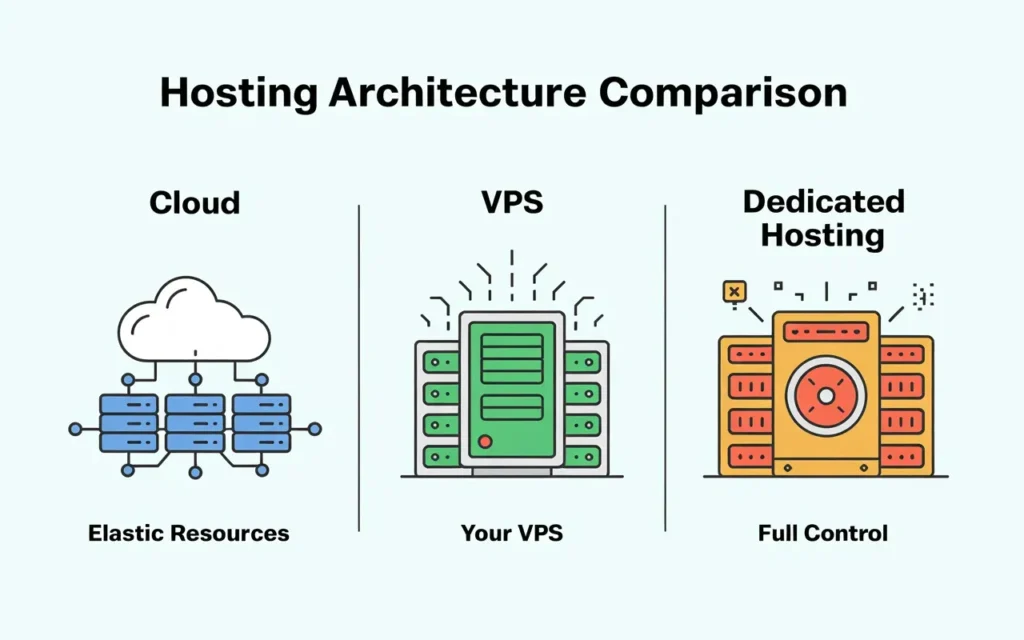
Okay, let’s get a bit nerdy for a second. Understanding the technical differences helps you see where your money is actually going.
Resource allocation and isolation
- VPS: You get a specific slice of the pie. It’s isolated, but the pie is only so big.
- Dedicated: You get the whole pie. Nobody else is even in the kitchen.
- Cloud: You get a magic pie that gets bigger or smaller depending on how hungry you are.
The isolation on a dedicated server is physical. The isolation on a VPS is software-based (using a hypervisor). The isolation on the cloud is complex and distributed across many machines.
Performance consistency
Dedicated servers win here, hands down. Because you aren’t sharing the hardware with anyone, there is zero “noise.” Your performance is predictable 100% of the time.
VPS is very consistent, but in rare cases, a “noisy neighbor” could impact the main machine’s disk I/O (how fast it reads/writes data).
Cloud is generally fast, but because your data travels across a network of storage devices, you might occasionally see tiny fluctuations in speed compared to the raw power of a local disk on a dedicated server.
Scalability and flexibility
This is where Cloud takes the trophy.
Scaling a dedicated server is slow. You have to physically shut it down, open the case, add more RAM, and turn it back on.
Scaling a VPS is faster, but you are limited by the size of the physical machine it lives on.
Scaling the Cloud? It happens in seconds, often automatically, without any downtime.
Which Hosting Option Performs Best in Real-World Scenarios?
Specs on paper are nice, but how do these actually behave when real users start clicking?
Traffic spikes and load handling
I once had a client whose dedicated server crashed during a massive holiday sale. Why? They hit the hard limit of that specific machine. They couldn’t upgrade it fast enough.
If they had been on Cloud hosting, the system would have just spun up more resources.
However, for steady, high traffic—like a busy news site that always has 5,000 people online—a dedicated server or a high-end VPS is often more stable and cost-effective than the cloud.
Latency and response times
Latency is the delay between a user clicking and the server responding.
For databases that need instant responses (like high-frequency trading), Dedicated servers are king. The data doesn’t have to travel through a virtualization layer.
VPS is a close second.
Cloud can sometimes have slightly higher latency because the storage is often network-attached rather than physically inside the CPU box.
Stability under heavy workloads
If you are running a complex application that churns through data 24/7, a Dedicated server is a workhorse. It won’t complain.
VPS is great for moderate workloads.
Cloud is great for bursty workloads. If your app works hard for 2 hours and then sleeps for 22 hours, Cloud is the most stable and efficient choice.
How Do Costs Compare Between Cloud, VPS, and Dedicated Hosting?
Money matters. Let’s look at the price tags.
Pricing models explained
- VPS: Usually a flat monthly fee. You pay $20/month, you know exactly what your bill will be.
- Dedicated: High monthly fee. You are renting expensive hardware. It’s a premium product.
- Cloud: Often “Pay-as-you-go.” You pay for every hour of CPU you use and every GB of storage.
Hidden costs and scaling expenses
Cloud hosting can be a trap if you aren’t careful. It looks cheap to start. But if you leave a high-power server running by accident, or if you get a massive traffic spike, you might wake up to a surprise bill.
VPS and Dedicated servers are predictable. You budget for it, and that’s what you pay.
Long-term cost efficiency
If you have a predictable workload, a Dedicated server or a large VPS is often cheaper in the long run than Cloud.
Cloud is cheaper if your traffic is low or very unpredictable. You aren’t paying for idle servers.
But renting a dedicated server for a year is usually cheaper than renting the equivalent amount of “cloud power” for a year.
Which Hosting Is Best for Different Use Cases?
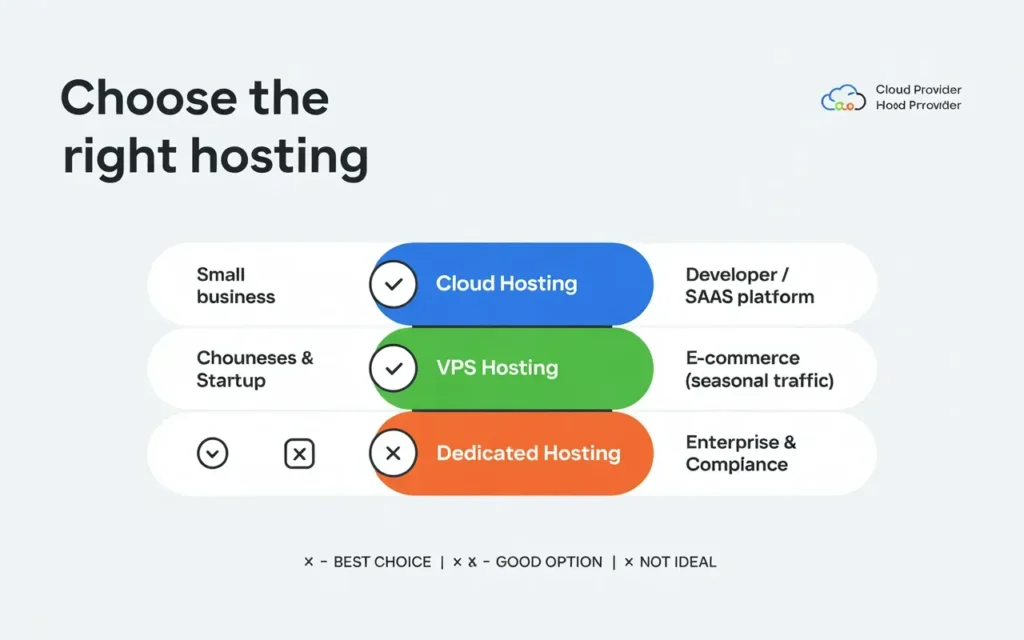
Here is my cheat sheet for making a quick decision.
Small business and startups
Go with VPS.
It gives you the professional reliability you need over shared hosting, but it keeps your overheads low. You can always move to the cloud later if you become the next unicorn.
Developers and SaaS platforms
Cloud is usually the winner here.
Developers love the API-driven nature of the cloud. You can spin up test environments in seconds and destroy them when you are done.
E-commerce and high-traffic websites
This depends.
If you have consistent traffic (like Amazon), Dedicated or a cluster of Dedicated servers is powerful.
If you are a seasonal store (selling Halloween costumes), Cloud is better. You scale up in October and scale down in November.
Enterprises and compliance-driven apps
Dedicated or Private Cloud.
Large enterprises often need the strict security control of dedicated hardware to meet regulations like HIPAA or GDPR.
How Do Security and Compliance Compare Across Hosting Types?
Security isn’t just about software; it’s about architecture.
Shared responsibility in cloud hosting
In the cloud, security is a shared job. The provider secures the infrastructure (the building), but you have to secure your application (the apartment).
Because the cloud is public, it is a high-profile target. However, big cloud providers spend billions on security, so their “building” is very tough to break into.
VPS security controls
VPS is very secure because of the isolation. Even if a hacker gets into another VPS on the same machine, they can’t cross the wall into yours.
You also get your own IP address, which protects your reputation from spammers who might be on the same network.
Dedicated hosting for compliance and data control
This is the gold standard.
There is no “neighbor” to worry about. You have total control over the firewall. You know exactly who has physical access to the machine. For banks and hospitals, this peace of mind is worth the price.
How Does Hosting Choice Impact SEO and Website Speed?
Google cares about speed. A slow site gets pushed down the rankings.
Server performance and Core Web Vitals
Core Web Vitals measure how stable and fast your site loads.
A cheap shared plan will hurt your scores. A VPS or Dedicated server gives you the consistent power to serve pages instantly, keeping Google happy.
Uptime and crawlability
If your site is down, Google can’t crawl it.
Cloud hosting offers the best uptime guarantees (often 99.99%). If a server fails, your site stays up. This reliability signals to Google that you are a trustworthy source.
Location and latency considerations
The closer the server is to your user, the faster the site loads.
Cloud providers usually have locations everywhere. Dedicated and VPS providers might have fewer locations.
Always pick a host with a data center near your main audience. If you target customers in New York, don’t host your server in Tokyo.
Which Hosting Type Is the Most Future-Proof in 2026?
Technology moves fast. What will you need next year?
AI workloads and scalability needs
AI is eating the world. Running AI models requires massive compute power.
Cloud and Dedicated servers are evolving to include GPUs (graphics processors) specifically for AI. If you plan to use AI, ensure your host can support high-performance computing.
Edge computing and hybrid models
The future is “Hybrid.”
Many companies are using a Dedicated server for their core database (for security) and connecting it to the Cloud for their front-end website (for speed).
Edge computing is also growing—this puts mini-servers closer to the user. Cloud providers are leading this charge.
Balancing flexibility and control
The most future-proof strategy is to avoid “vendor lock-in.”
Don’t build your infrastructure so specifically for one cloud provider that you can’t leave. Using standard VPS or Dedicated servers often makes it easier to migrate if you need to change providers later.
How Skynethosting.net Helps You Choose the Right Hosting Model
At Skynethosting.net, we’ve been doing this for over 20 years. We’ve seen trends come and go.
VPS, cloud, and dedicated solutions under one roof
We don’t force you into one box. We offer high-performance VPS for growing sites and powerful Dedicated servers for the heavy hitters. We even have reseller options if you want to start your own hosting business.
Global data centers and performance optimization
With 25 worldwide locations, we can put your data right where your customers are. Plus, we use NVMe storage (which is 900% faster than standard drives) and LiteSpeed servers to ensure your site flies.
Expert support for scaling decisions
Not sure what to pick? Our team is here 24/7. We don’t just fix broken servers; we help you plan your growth. We can look at your traffic and tell you honestly if you need to upgrade or if you can stay put and save money.
How Should You Decide Between Cloud Hosting, VPS, and Dedicated Servers?
Still stuck? Let’s simplify it.
Key decision-making checklist
- Budget: Have less than $50/mo? Start with VPS.
- Traffic: Is it steady? VPS or Dedicated. Is it wild and unpredictable? Cloud.
- Technical Skill: Do you know how to manage a server? If yes, Dedicated gives you the most power. If no, look for a Managed VPS.
Matching hosting to growth stage
- New Launch: Small VPS. Keep costs low.
- Growing Pains: Upgrade VPS resources.
- Established Brand: Move to a robust Cloud setup or a Dedicated server.
Avoiding common hosting mistakes
The biggest mistake I see? Buying based on “unlimited” claims. Nothing is unlimited.
The second biggest mistake? Ignoring backups. No matter which hosting you choose, always, always have an off-site backup.
Conclusion
No one-size-fits-all hosting solution
There is no “best” hosting. There is only the best hosting for you.
Your neighbor might need the raw power of a Dedicated server for their gaming clan. You might need the flexibility of the Cloud for your viral marketing campaign.
Choosing the right hosting for long-term success
Don’t stress about making a “forever” decision. The beauty of modern hosting is that migration is easier than ever.
Start with what fits your budget and skills today. A solid VPS is the safest bet for 90% of businesses in 2026. It’s powerful, affordable, and reliable.
If you are ready to stop guessing and start growing, check out the plans at Skynethosting.net. We’d love to help you find your perfect home on the web.
FAQs
What is cloud hosting and who is it best for?
Cloud hosting runs your site on a cluster of servers, pooling CPU, RAM, and storage so you can scale resources up or down quickly. It’s best for apps with unpredictable traffic, fast‑growing startups, and projects where uptime and automatic scaling are top priorities.
How does a VPS differ from shared hosting?
A VPS uses virtualization to give you an isolated slice of a server with dedicated RAM, storage, and your own operating system, so neighbors can’t hog resources. Compared with shared hosting, you get better performance, more security, root access, and predictable behavior under load.
When should I choose a dedicated server
Choose a dedicated server when you run resource‑intensive workloads, handle constant heavy traffic, or must meet strict compliance rules requiring full hardware control. It’s ideal for big databases, gaming servers, or regulated industries needing known physical location and maximum, consistent performance.
Which option handles traffic spikes most reliably?
Cloud hosting handles spikes best because it can automatically allocate extra resources across its cluster and then scale back later. VPS can be upgraded but within the limits of its physical host, while dedicated servers hit a hard ceiling until hardware is manually upgraded.
How do costs compare between cloud, VPS, and dedicated?
VPS usually has a fixed monthly fee and offers strong performance per dollar. Dedicated servers cost more but become efficient for consistently high loads. Cloud often starts cheap with pay‑as‑you‑go billing, yet can become costly if high‑resource instances run continuously or traffic explodes.
