

How Much Can You Earn From Reseller Hosting? Real Income Breakdown (2026)
TL;DR
- Reseller hosting makes money by buying server resources wholesale, rebranding them, and selling smaller plans under your own label on recurring monthly fees.
- Beginners usually just cover their plan cost first, then profit as they add reasonably priced, value‑focused clients instead of competing as the cheapest host.
- Part‑time resellers with 10–50 clients can earn a solid side income because automation handles billing while you spend limited time on basic support.
- Full‑time resellers with 100+ clients can reach strong monthly revenue, especially when hosting is bundled with managed care, security, and maintenance services.
- Real earnings depend on pricing, churn, and provider quality, since fast, reliable, white‑label infrastructure helps you retain clients and keep margins healthy.
- In 2026 it’s still profitable but not instant; choosing a niche, charging for value, and steadily growing recurring customers is what actually makes the model work.
Let’s be honest for a second. If you’ve been Googling “reseller hosting income,” you’ve probably seen some wild claims. Some people say it’s a “get rich quick” scheme where you just sit back and watch the money roll in. Others claim the hosting market is dead and there’s no money left to be made.
The truth? It’s somewhere in the middle.
I’ve spent the last decade working in and around the web hosting industry. I’ve seen solo freelancers make an extra $500 a month to cover their car payments, and I’ve seen agencies scale their hosting arm into six-figure operations. Reseller hosting isn’t magic; it’s a business model based on recurring revenue. And in 2026, it’s still one of the most reliable ways to build a stable income stream online—if you do it right.
In this guide, we’re going to skip the fluff. We’re going to look at the real numbers, break down exactly how much you can earn at different stages, and analyze the profit margins you can realistically expect.
How Does Reseller Hosting Generate Income?
Before we talk about potential earnings, we need to clarify exactly how the money comes in. Unlike selling a physical product once, hosting is all about the “stickiness” of the service.
Selling hosting under your own brand
The core of reseller hosting is white-labeling. You rent a large chunk of server space (and resources like CPU and RAM) from a provider like Skynethosting.net. You then slice that big chunk into smaller plans and sell them to your own customers under your brand name.
Your clients never know we exist. To them, you are the hosting company. You set the prices, you create the packages, and you keep 100% of the profit.
Monthly recurring revenue explained
This is the holy grail for any service business. Monthly Recurring Revenue (MRR) is income that comes in automatically every month.
If you sell a website design for $2,000, that’s great, but you have to find a new client next month to make money again. If you sell a hosting plan for $20/month, you do the work once to set them up, and that $20 comes in every month for years.
When you stack 10, 50, or 100 clients, that recurring revenue becomes a powerful foundation for your financial freedom.
One-time vs recurring income streams
Successful resellers usually mix two types of income:
- Recurring: The monthly or annual hosting fees (e.g., $15/month for hosting).
- One-time: Setup fees, site migrations, or emergency fixes (e.g., $100 to clean a hacked site).
While the one-time fees give you a nice cash injection, the recurring fees are what build long-term wealth.
How Much Do Beginners Earn From Reseller Hosting?
If you are just starting out, keep your expectations grounded. You aren’t going to buy a Lamborghini in month one. The beginning phase is about covering your costs and building a portfolio.
First 3 months income expectations
In your first quarter, your goal is to break even and start profiting. Let’s say you buy a high-value reseller plan for around $25/month.
- Month 1: You sign up 2 friends or local businesses at $15/month.
- Revenue: $30
- Cost: $25
- Profit: $5
- Month 3: You have 5 clients at $15/month.
- Revenue: $75
- Cost: $25
- Profit: $50/month
It sounds small, but remember: this is $600 a year in passive profit for very little ongoing work.
Common beginner mistakes that limit earnings
The biggest mistake I see beginners make is competing on price. Do not try to be cheaper than GoDaddy or Bluehost. You will lose. They have economies of scale you don’t have.
If you price your hosting at $2/month, you need 500 clients just to make $1,000. That’s a support nightmare. Instead, beginners who earn the most compete on value—offering better support, faster fixes, or personal attention.
Realistic starter pricing strategies
A safe starting price for a basic shared hosting plan in 2026 is between $10 and $25 per month.
If you are a web designer, you shouldn’t sell “hosting.” You should sell “Worry-Free Website Care Plans” for $50/month that include hosting, daily backups, and plugin updates. That is how you maximize beginner earnings.
How Much Can Part-Time Resellers Earn Monthly?
This is the “sweet spot” for many freelancers and digital marketers. You have a main job or main service, and hosting is your side hustle.
Managing 10–50 hosting clients
Once you hit the 10-50 client range, the math gets interesting. You are likely still on a single reseller account (perhaps upgraded for more space), so your costs haven’t risen much, but your income has multiplied.
Average profit per client
Let’s look at a realistic scenario for a part-time reseller with 30 clients.
- Average Revenue per Client: $20/month (Hosting + SSL + Basic Maintenance)
- Total Revenue: $600/month
- Reseller Hosting Cost: ~$40/month
- Net Profit: $560/month
That’s an extra $6,720 a year in your pocket. This usually covers a car payment or a nice family vacation, just for maintaining websites you likely built anyway.
Time investment vs returns
The beauty of this stage is efficiency. Modern hosting automation tools like WHMCS (which comes free with many Skynethosting.net plans) handle the billing and provisioning.
You might spend 2-3 hours a month handling support tickets or checking server statuses. Earning $560 for 3 hours of work? That’s an hourly rate of over $185.
How Much Can Full-Time Reseller Hosting Businesses Earn?
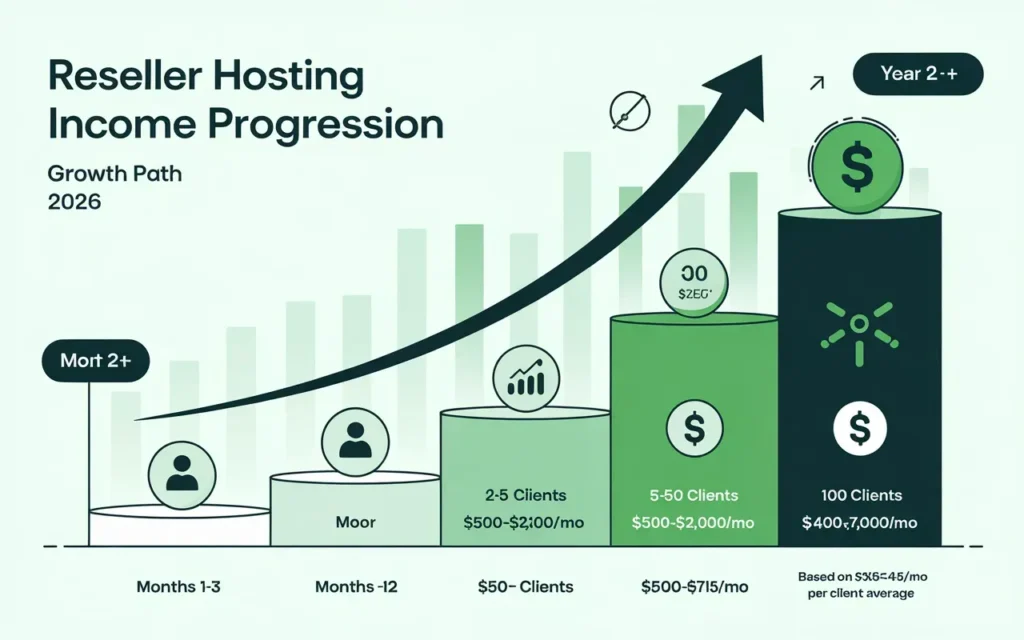
Can you quit your job to do this? Yes, but it requires volume. This is when you transition from “a freelancer who hosts” to “a hosting company.”
Scaling to 100+ clients
At 100 clients, you are entering serious business territory. You might need a Corporate VIP reseller plan or a VPS to handle the traffic, but your margins remain high.
Monthly and annual revenue scenarios
Let’s break down a full-time scenario with 150 clients.
- Scenario A (Basic Hosting): 150 clients @ $15/mo = $2,250/month ($27k/year).
- Scenario B (Managed Services): 150 clients @ $45/mo (Hosting + Maintenance) = $6,750/month ($81k/year).
As you can see, the money isn’t just in the server space; it’s in the service you wrap around it.
When reseller hosting becomes a full-time income
Usually, the tipping point is around $4,000 to $5,000 in monthly recurring revenue. To hit this with pure hosting, you need about 200-300 clients. To hit this with managed WordPress hosting (where you update plugins and themes), you only need about 75-100 clients.
What Factors Affect Reseller Hosting Earnings the Most?
Not all resellers make the same money. Two people can buy the same plan from us, and one will make $500 while the other makes $5,000. Here is why.
Hosting provider pricing and quality
Your upstream provider is your foundation. If your provider has downtime, your clients leave (churn). If your provider charges too much, your margins shrink.
You need a provider that offers high-performance hardware (like NVMe storage and LiteSpeed servers) so your clients’ sites load fast. Fast sites mean happy clients, and happy clients keep paying.
Client acquisition channels
How are you getting customers?
- referrals: High conversion, low cost (Best for margins).
- Ads: High cost, fast scaling (Lowers immediate profit).
- Bundling: Selling hosting to web design clients (The easiest path).
Support, retention, and churn rate
Churn is the profit killer. If you lose 10% of your customers every month, you will never grow.
- High Retention: 100 clients staying for 5 years = Massive LTV (Lifetime Value).
- Low Retention: Constantly replacing clients eats up all your profit in marketing costs.
What Are the Typical Costs in Reseller Hosting?
It’s not all profit. You have to spend money to make money. However, compared to opening a coffee shop or a retail store, startup costs are almost nonexistent.
Reseller plan costs
Your primary expense is renting the server.
- Starter: $10 – $20/month.
- Growth: $25 – $40/month.
- Enterprise: $50 – $100/month.
At Skynethosting.net, our plans start very low but include premium features like NVMe drives, which allow you to charge a premium to your clients.
Billing software and automation
You cannot invoice 100 clients manually. You need automation software like WHMCS.
- Retail Price: ~$18-$20/month.
- Skynet Advantage: We include a WHMCS license for free with our reseller plans. This instantly saves you ~$240 a year.
Marketing and operational expenses
- Domain Name: $15/year.
- Website: Free (if you build it yourself).
- Support Staff: $0 (if you do it yourself) to $2,000/month (if you hire help).
- End-User Support: Skynethosting.net offers end-user support where our team answers your clients’ technical questions anonymously. This saves you the cost of hiring a tech team.
What Are the Profit Margins in Reseller Hosting?
This is where reseller hosting shines.
Low-margin vs high-margin pricing models
- The “Budget” Model: You buy a slot for $1 and sell it for $3.
- Margin: 66%. (Good percentage, low dollar value).
- The “Premium” Model: You buy a slot for $2 and sell it for $25 because you include “Premium Support.”
- Margin: 92%.
Upsells that increase average revenue
You don’t just stop at hosting. You can resell:
- Domain Names: Small margin ($2-$5/year), but essential.
- SSL Certificates: 100% profit if you use free Let’s Encrypt, or resell premium ones.
- Email Spam Protection: Resell services like SpamExperts or our MailChannels Cloud Email.
Long-term profitability analysis
A hosting client usually stays for 3+ years.
If you profit $15/month, that single client is worth $540 in pure profit over 3 years. If you spend $50 in ads to acquire them, you are still making a 10x return on investment.
How Can You Increase Earnings From Reseller Hosting?
Stuck at a certain income level? Here is how to break through.
Bundling hosting with design or SEO
Don’t offer hosting as an “option.” Make it mandatory. “I build websites, and I host them to ensure they stay fast and secure.”
This locks the client into your ecosystem immediately.
Upselling VPS, backups, and security
As your clients grow, their sites will get heavier. You can upgrade them from a shared plan ($20/mo) to a VPS plan ($60/mo). With Skynethosting.net, resellers get 50% off VPS and Dedicated servers, giving you huge room for markup.
Reducing churn and increasing LTV
The easiest way to make more money is to keep the clients you have.
- Check in with them quarterly.
- Offer a free “speed check” once a year.
- Ensure their sites never go down (by using a reliable upstream provider).
Is Reseller Hosting Still Profitable in 2026?
Short answer: Yes.
Long answer: Yes, but the market has changed.
Market demand and trends
Every new business needs a website. Every influencer needs a blog. The demand isn’t shrinking. However, users are more demanding now. They want speed.
Competition vs differentiation
You cannot compete with generic “unlimited hosting.” You must specialize.
- “Hosting for Local Bakeries”
- “High-Speed Hosting for Photographers”
- “Eco-Friendly Hosting”
Opportunities for niche resellers
Niches are where the money is. If you are known as “The WordPress Guy for Dentists,” you can charge double what a generic host charges because you understand their specific plugin needs.
Real Income Examples From Reseller Hosting
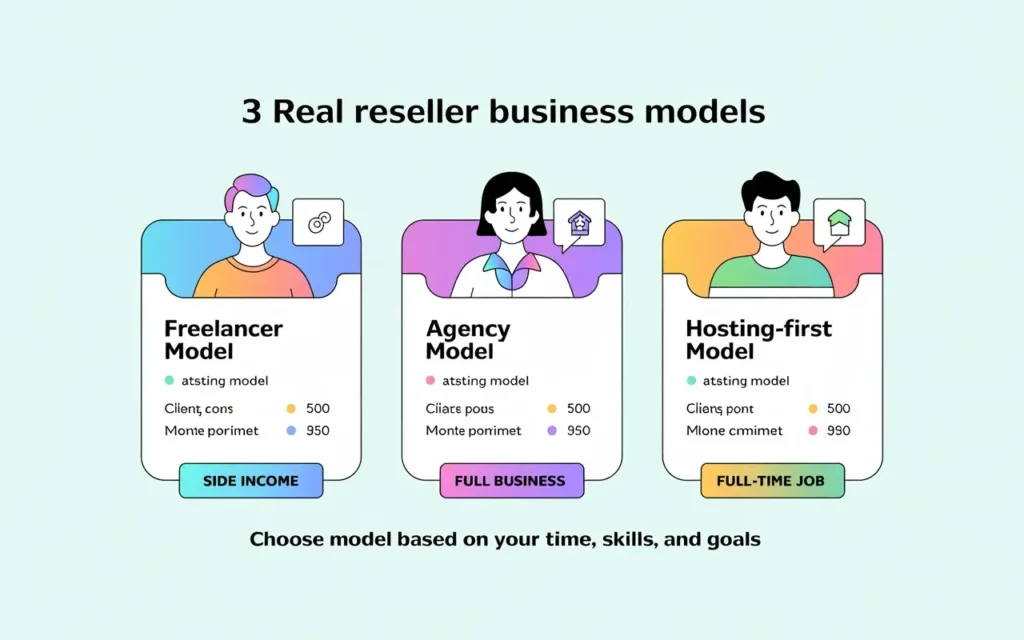
Let’s look at three realistic profiles based on people I’ve worked with.
Freelancer-based reseller model
- Profile: Sarah, Freelance Graphic Designer.
- Clients: 25 small business owners.
- Strategy: Includes hosting in every design quote.
- Monthly Earnings: $500 profit.
- Time Spent: 1 hour/month.
Agency-based reseller model
- Profile: “TechFlow,” a digital marketing agency.
- Clients: 150 local businesses.
- Strategy: Offers “Managed Growth Plans” (Hosting + SEO reports).
- Monthly Earnings: $7,500 profit.
- Time Spent: 10 hours/month (handled by account managers).
Hosting-first business model
- Profile: Mark, Entrepreneur.
- Clients: 600 budget users.
- Strategy: Runs ads for cheap, fast hosting. Focuses on volume.
- Monthly Earnings: $4,000 profit.
- Time Spent: Full-time job (handling support and marketing).
Why Hosting Provider Choice Impacts Your Earnings
Your provider is your business partner. If they fail, you fail.
Reliability and support effects on churn
If your server goes offline for 4 hours, your clients will call you screaming. You will refund them money. You will lose income. You need a provider with 99.9% uptime guarantees.
White-label features that help you scale
You need a provider that stays invisible. White-label IP addresses and anonymous nameservers ensure your clients never find out you are reselling.
Why Skynethosting.net supports reseller growth
We built our entire infrastructure for resellers.
- Free WHMCS: Saves you money.
- NVMe Drives: Makes you look good with fast speeds.
- White-Label Support: We help your clients so you don’t have to.
- Scalability: Start small, grow to a dedicated server with 50% discounts.
How Should You Price Your Reseller Hosting Plans?
Pricing psychology for hosting
Don’t use round numbers. $19.95 sells better than $20.00.
Create three tiers:
- Silver ($9.95): The decoy. (Too basic).
- Gold ($19.95): The target. (Everything they need).
- Platinum ($49.95): The anchor. (Makes Gold look cheap).
Monthly vs annual billing strategies
Encourage annual billing. Offer 2 months free if they pay yearly.
- Benefit: You get cash upfront to invest in ads.
- Benefit: They are locked in for 12 months (0% churn risk for a year).
Avoiding underpricing traps
Never price based on your costs. Price based on value. Just because a slot costs you $0.50 doesn’t mean you should sell it for $1.00. Sell it for $10.00 because that is what the market is willing to pay for reliable hosting.
Conclusion
Reseller hosting is not a lottery ticket. It is a legitimate, scalable business model that rewards patience and quality service.
Reseller hosting as a scalable income stream
Whether you want an extra $500 a month to pay bills or a $100k/year business, the mechanism is the same. It scales perfectly. You can start with one client and grow to one thousand without changing your core business model.
Setting realistic expectations and growth goals
Start small. Focus on getting your first 10 clients. Treat them like royalty. If you do that, the referrals will come, the recurring revenue will stack up, and by this time next year, you’ll be looking at a very healthy income statement.
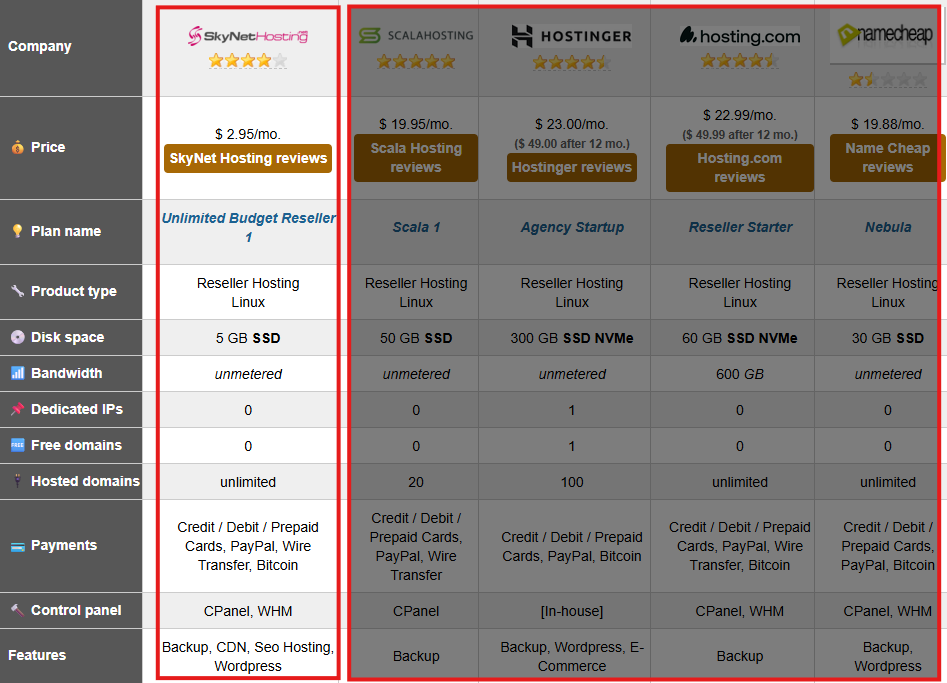
When choosing where to start your reseller journey, credibility matters. SkyNetHosting.Net has been recognized as the #1 Reseller Hosting provider for 2026 by WHTOP, a long-running independent hosting directory that evaluates thousands of providers based on real user reviews, service performance, and industry data rather than paid promotions. That kind of independent recognition gives new resellers additional confidence when selecting a platform to build on.
Ready to start your own hosting company? You can be up and running in less than 97 minutes. Check out our reseller plans at Skynethosting.net and let’s build your recurring revenue together.
FAQs
How does reseller hosting actually make money?
How much can a beginner realistically earn?
Beginners usually start by just covering their reseller plan cost with a few clients, then move into profit as they sell mid‑priced, value‑focused plans instead of trying to be the absolute cheapest option in the market.
Is reseller hosting good as a side income?
Yes. With around 10–50 clients, many resellers earn a strong side income, because automation handles billing and provisioning while they only spend a few hours monthly on light support and occasional website tweaks.
Can reseller hosting replace a full‑time job?
What affects reseller hosting profit the most?
Profit depends heavily on pricing strategy, client churn, and provider quality. Fast, reliable, white‑label infrastructure plus good support helps keep customers longer, reduce refunds, and justify higher monthly fees without scaling support headaches too much.
Is reseller hosting still profitable in 2026?
Yes. It works best when you niche down, charge for value (not rock‑bottom prices), and steadily grow a base of recurring clients who stay for years instead of constantly churning.
