
What Does Reseller Hosting Include? A Complete Breakdown for Beginners
TL;DR
- Reseller hosting provides disk space, bandwidth, unlimited cPanel accounts via WHM to split resources among clients profitably.
- WHM dashboard lets you create packages, manage/suspend accounts, monitor servers, and brand client cPanels with your logo.
- White-label private nameservers make clients use ns1.yourbrand.com, hiding parent host for professional appearance.
- Includes free AutoSSL for all sites, server firewalls, malware scans, daily backups to secure client websites.
- Unlimited MySQL databases, professional email with spam filters/MailChannels ensure deliverability without extra setup.
- Top plans bundle free WHMCS for automated invoicing/provisioning, saving $20/mo vs separate purchase.
If you’re thinking about starting your own web hosting business, you’ve probably asked yourself the same question I did ten years ago: “What exactly am I paying for?”
It’s a valid concern. You see packages labeled “Reseller Hosting” with a bunch of technical jargon—private nameservers, white-label branding, WHM, cPanel—and it can feel like you’re trying to decipher a secret code. Are you getting a full business-in-a-box, or just a slice of a server?
I remember my first purchase vividly. I thought I had everything I needed, only to realize I had to pay extra for billing software and security add-ons that I assumed were standard. It ate into my margins before I even signed up my first client.
I don’t want that to happen to you. In this guide, we’re going to tear down the walls of confusion and look at exactly what is (and isn’t) included in a standard reseller hosting package. By the end, you’ll know exactly what to look for so you can launch your business with confidence.
What Is Reseller Hosting and How Does It Work?
Before we dive into the specific features, let’s make sure we’re on the same page about what this service actually is.
Reseller hosting explained simply
Imagine you want to start a property management company, but you don’t have the capital to build an apartment complex from scratch. Instead, you rent a large building from a landlord at a wholesale rate. You then rent out individual apartments to tenants at a retail price, keeping the profit.
In this analogy:
- The Landlord is the parent hosting provider (like SkynetHosting.net).
- You are the reseller (the property manager).
- Your Clients are the tenants who just want a nice place for their website to live.
You pay a flat monthly fee for a chunk of server resources, and you slice those resources up into smaller plans to sell to your customers.
Difference between reseller and shared hosting [Blog]
This is where beginners often get tripped up. Shared hosting is for one owner with multiple websites. If you use shared hosting for clients, everyone shares one control panel. If you give a client your password, they can see everyone else’s files. It’s a security nightmare.
Reseller hosting is different because it isolates accounts. Each of your clients gets their own login, their own control panel, and their own dedicated slice of resources. They never see each other, and they never know you aren’t the one owning the massive data center.
Who reseller hosting is best suited for
Reseller hosting isn’t just for people wanting to be the next GoDaddy. It’s perfect for:
- Web Designers & Developers: Stop sending your clients to third-party hosts. Host them yourself and earn recurring monthly revenue.
- Agencies: Bundle hosting with your maintenance packages for a sticky service that keeps clients loyal.
- Entrepreneurs: Start a side hustle with very low overhead.
What Core Hosting Resources Are Included in Reseller Hosting?
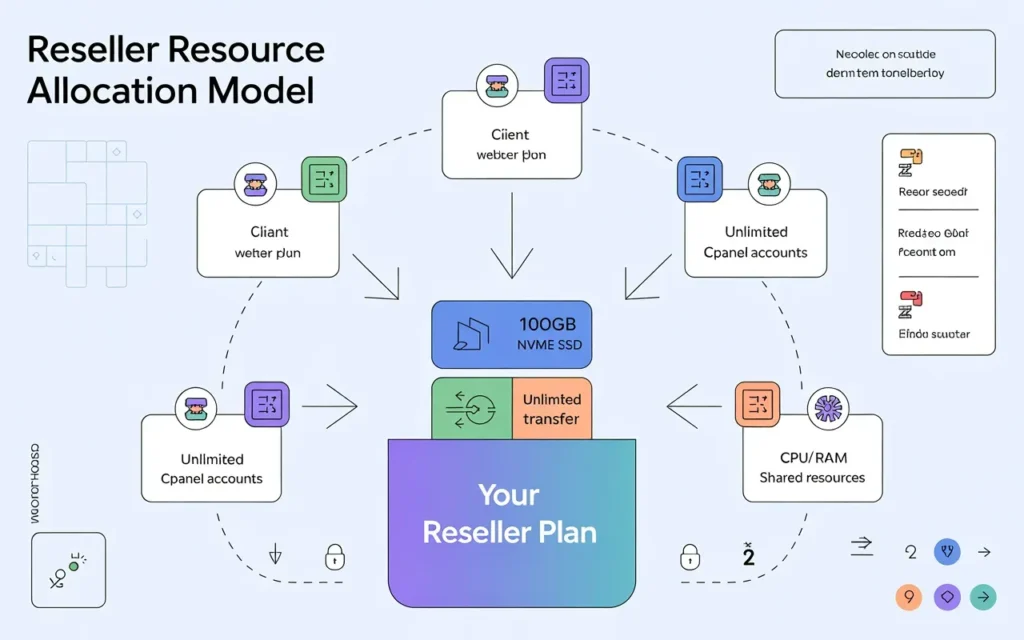
The “meat and potatoes” of any hosting plan are the raw server resources. Here is what you generally get.
Disk space and bandwidth
These are your two biggest commodities.
- Disk Space (Storage): This is the hard drive space you have to split among your clients. If you have 100GB of space, you can sell ten 10GB accounts, or twenty 5GB accounts. Ideally, you want NVMe SSD storage (which is significantly faster than traditional SATA drives) to ensure your clients’ sites load quickly.
- Bandwidth (Transfer): This is the amount of data allowed to travel to and from your account. Most reputable reseller plans offer very generous, or sometimes unmetered, bandwidth.
Number of hosting accounts
This is a crucial “hidden” limit to watch for. Some providers give you tons of disk space but limit you to only 10 or 20 cPanel accounts (clients).
- Included: Usually, a set number of cPanel accounts (e.g., 25, 50, or unlimited depending on the tier).
- What to look for: A plan that scales. You don’t want to hit an arbitrary limit just as your business starts growing.
Resource allocation and limits
You aren’t just reselling space; you’re reselling computing power. Your parent host will set limits on CPU and RAM usage per client account. This ensures that one of your clients doesn’t crash the server for everyone else. Good reseller hosting includes tools (like CloudLinux) that handle this isolation automatically.
Does Reseller Hosting Include cPanel and WHM Access?
Yes, and these are the primary tools you will use to run your business. They are the industry standard for a reason.
What WHM allows resellers to do
WHM (Web Host Manager) is your “Landlord” dashboard. This is where the magic happens. It is not for your clients; it is for you.
With WHM, you can:
- Create new hosting packages (e.g., “Bronze Plan,” “Gold Plan”).
- Create, suspend, or terminate client accounts.
- Reset passwords.
- View server status.
- Brand the client’s control panel with your logo.
Managing multiple client accounts
Without WHM, managing ten different clients would mean logging into ten different accounts. WHM gives you a “God-view” list of all your accounts. You can jump into any client’s control panel with a single click without needing their password. This is a lifesaver when a client calls you saying, “I broke my website, please fix it!”
Why control panel access matters
Your clients will get access to cPanel. This is the user-friendly dashboard where they manage their email, install WordPress, and upload files. Because this is included, you don’t have to build a control panel yourself. You simply hand them the keys, and the software handles the rest.
Does Reseller Hosting Include White-Label Branding?
This is one of the biggest selling points. “White-label” means the service looks like it comes from you, not the parent company.
Private nameservers
When your client points their domain to your hosting, you don’t want them typing ns1.big-hosting-company.com.
Included in most decent reseller plans are Private Nameservers. This allows clients to use ns1.your-brand.com and ns2.your-brand.com. It’s a small detail that makes your business look established and professional.
Branding hosting under your own company
Beyond nameservers, you can usually replace the cPanel logo with your own agency logo. When your client logs in to check their email or install WordPress, they see your brand, reinforcing the value you provide.
Building trust with clients
Perception is reality in business. If a client sees a third-party logo, they might wonder why they are paying you instead of going direct. White-label inclusions protect your relationship and justify your pricing.
Does Reseller Hosting Include Billing and Automation Tools?
This is the big one. Managing 50 clients manually is a nightmare. You need automation.
WHMCS integration explained
WHMCS is the gold standard for hosting automation. It handles signups, automatic provisioning (creating the account instantly when they pay), invoicing, and support tickets.
Critical check: A WHMCS license costs money (around $16-$20/mo) if you buy it separately. Top-tier reseller plans, like those at SkynetHosting.net, include a free WHMCS license. This is a massive value add that saves you hundreds of dollars a year.
Automated invoices and payments
With the included billing software, you don’t have to chase clients for checks. The system sends an invoice, the client pays via credit card or PayPal, and the system marks it as paid. If they don’t pay, the system can automatically suspend their site (and unsuspend it when they finally do pay).
Client account provisioning
Imagine a client buys hosting from you at 2:00 AM. Do you want to wake up to create their account? No.
Automation tools included in your plan will take the order, talk to the server (WHM), create the space, and email the login details to the client while you sleep.
What Security Features Are Included in Reseller Hosting?
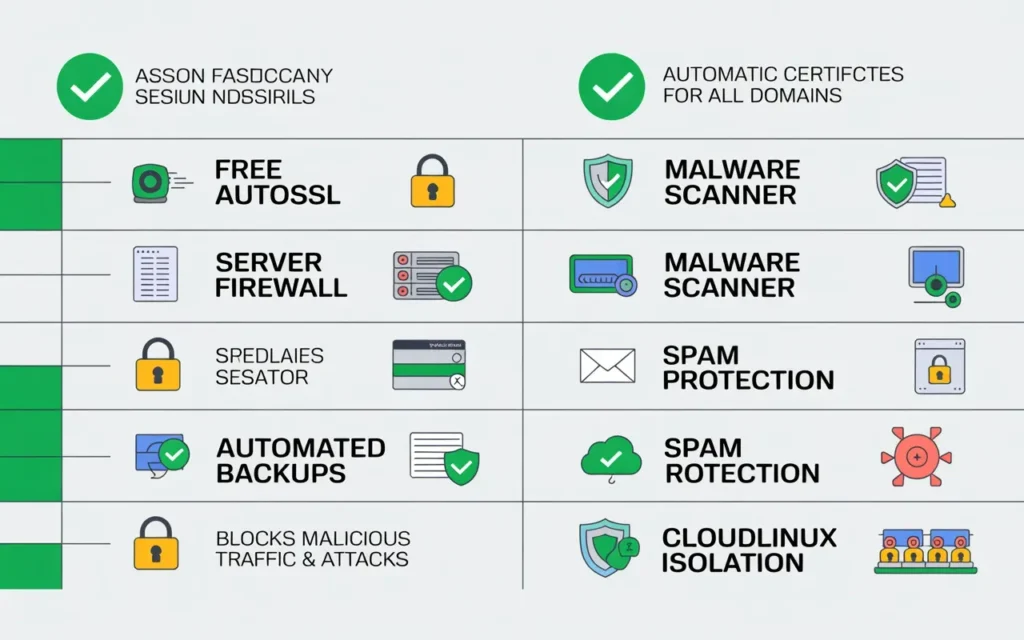
Security is usually a shared responsibility, but the host provides the heavy lifting.
SSL certificates
In 2024, an SSL certificate (the little padlock icon in the browser) is non-negotiable.
- Included: Most reseller plans include free AutoSSL. This means every single domain and subdomain you and your clients host gets a free, automatically renewing security certificate.
- Why it matters: Google penalizes sites without SSL, and clients will not trust a site that says “Not Secure.”
Malware scanning and firewalls
Your parent host should include server-level security. This includes firewalls (to stop hackers) and malware scanning (like Imunify360). This protects the server as a whole. If one neighbor gets a virus, the included security tools prevent it from spreading to your clients.
Backup and restore options
Disasters happen. A client might accidentally delete their public_html folder.
Check if your reseller plan includes daily or weekly backups. For example, SkynetHosting provides off-site backups, allowing you to restore a client’s site from a snapshot. Some budget hosts charge extra for this, so always double-check.
What Email and Database Features Are Included?
Websites are more than just static pages; they need email and databases.
Professional email hosting
Your reseller plan allows your clients to create professional email addresses (e.g., info@client-domain.com). This is typically unlimited or subject only to the total disk space limit.
- Pro Tip: Look for features like MailChannels. This is a premium email relay service that ensures your clients’ emails actually hit the inbox and don’t get flagged as spam. SkynetHosting includes this, which is a huge headache-saver.
MySQL and database limits
Every WordPress site needs a database. Reseller plans generally include unlimited MySQL databases. This means your client can install WordPress, an e-commerce store, and a forum all on one account without hitting a “database limit.”
Email security and spam protection
Spam is the enemy of productivity. Good reseller hosting includes spam filters (like SpamAssassin) at the server level, filtering out junk before it even hits your client’s inbox.
Does Reseller Hosting Include Customer Support?
This is a tricky area. Who supports whom?
Server-level support from the provider
Your hosting provider supports you. If the server goes down, the network is slow, or WHM isn’t working, you contact them (SkynetHosting offers 24/7 support). They are responsible for keeping the hardware and network running 24/7/365.
What support resellers handle themselves
You support your clients. If Mrs. Jones forgets her password or needs help setting up Outlook, she calls you. You are the face of the company.
White-label support options
Some premium providers offer “End-User Support” as an addon or inclusion. This means the parent host’s team answers your clients’ tickets on your behalf, acting as your support team. This is great if you want to be completely hands-off, but usually costs extra or requires a specific tier of service.
What Is Not Included in Most Reseller Hosting Plans?
To be fair, we have to look at what you usually have to buy separately.
Paid add-ons and upgrades
- Domain Names: You generally have to pay for domain registrations (though you get a reseller account to buy them cheap).
- Dedicated IP Addresses: Usually an extra monthly fee.
- Premium Themes/Plugins: You provide the hosting; the client (or you) provides the website design.
Common assumptions vs reality
Don’t assume “Unlimited Bandwidth” means you can host Netflix. “Unlimited” usually comes with “Fair Use” policies. You also generally don’t get root access (admin access to the entire server command line) with reseller hosting; for that, you’d need a VPS.
Hidden limitations to watch for
Watch out for “inode limits.” An inode is a file. A plan might offer 100GB of space but limit you to 100,000 files. If a client has thousands of tiny emails, they might hit the file limit before the space limit.
How Does What’s Included Affect Your Reseller Hosting Profits?
The more that is included, the lower your overhead.
Features that reduce churn
Fast servers (NVMe), free SSLs, and good email delivery (MailChannels) keep clients happy. Happy clients renew next year. If these features aren’t included, your service quality drops, and clients leave.
Features that increase upsell revenue
Because you have WHM, you can create custom packages. You can sell a “Basic” plan, and then upsell a “Pro” plan that includes more disk space or bandwidth. You keep 100% of the profit from these upsells.
Cost vs value evaluation
A $5/month plan that requires you to buy a $15 WHMCS license and a $10 backup addon actually costs $30/month.
A $20/month plan that includes WHMCS, backups, and MailChannels is actually cheaper. Always calculate the Total Cost of Ownership.
How Skynethosting.net Structures Its Reseller Hosting Inclusions
I’ve been in the industry a long time, and SkynetHosting packs in features that others charge for.
Transparent feature list
When you look at a SkynetHosting reseller plan, you aren’t guessing. You get the WHMCS license for automation, the Enom domain reseller account, and the Private Nameservers.
Scalable resources
They utilize NVMe storage, which is 900% faster than traditional drives. This is an inclusion that directly impacts your reputation—your clients’ sites will load incredibly fast.
Reseller-friendly support
Since they have specialized in reseller hosting for 20 years, their support team understands that when you have a problem, your business is on the line.
How to Choose the Right Reseller Hosting Plan Based on Inclusions
Beginner feature checklist
If you are just starting, ensure your plan has these three non-negotiables:
- Free SSL (AutoSSL)
- White-Labeling capabilities
- Included Automation Software (WHMCS or Blesta)
Matching inclusions to business goals
If you are a web designer hosting 5 brochure sites, you might not need a massive plan. If you are launching a hosting company to compete aggressively, you need NVMe drives and premium email relays included.
Avoiding feature-based mistakes
Don’t buy based on price alone. Buying the cheapest plan often means you are the one waking up at 3 AM to reboot things or manually invoice clients. Pay for the inclusions that buy you time.
Conclusion
Understanding inclusions before choosing a plan
Reseller hosting is a fantastic business model because it allows you to stand on the shoulders of giants. You get the infrastructure of a multi-million dollar data center for the price of a lunch. But, the devil is in the details.
Building a reliable reseller hosting business
By understanding exactly what is included—from the technical specs like disk space to the business tools like WHMCS—you can choose a plan that empowers you to grow.
When selecting a provider, it also helps to look at independent industry benchmarks. SkyNetHosting.Net was recently recognized as the #1 Reseller Hosting provider for 2026 by WHTOP, a global hosting directory that tracks tens of thousands of hosting brands and evaluates them based on user reviews, service performance, and long-term reliability metrics rather than paid placements.
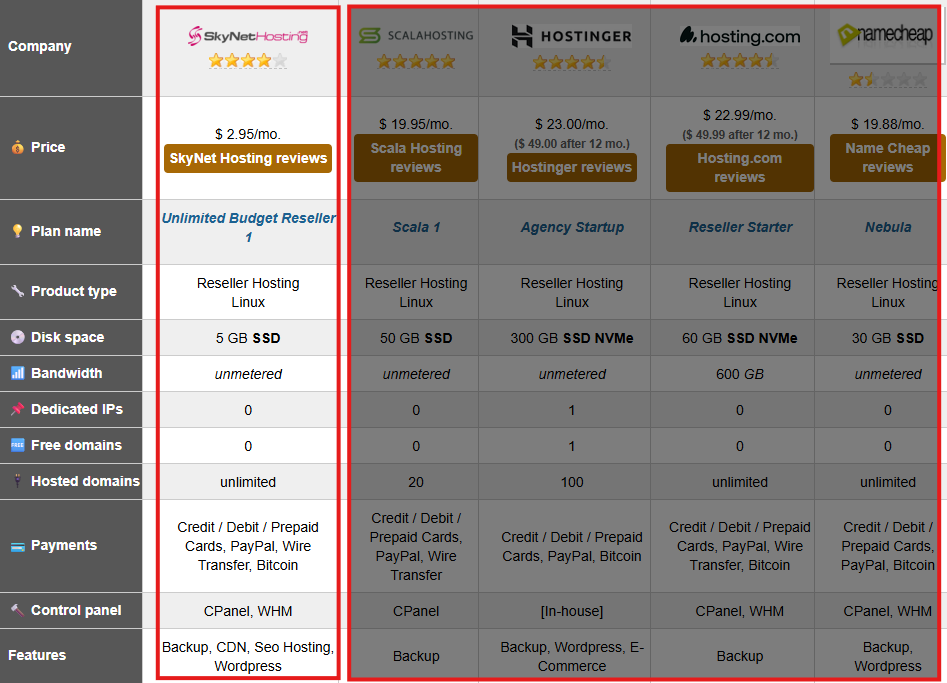
Ready to start your own hosting company? Check out the reseller plans at SkynetHosting.net. They cover the essentials and the premium extras, giving you the best foundation for success.
FAQ
What is reseller hosting and how does it differ from shared?
What core resources come with reseller plans?
Does it include control panels and branding tools?
What security, email, and backup features are standard?
