
WHMCS vs HostBill: Key Differences Explained (2026 Comparison)
TL;DR
- WHMCS uses monthly SaaS fees scaling by active clients; HostBill demands thousands upfront but owns license forever.
- WHMCS installs in one hour with clean admin; HostBill overwhelms beginners with complex spaceship-like configurations everywhere.
- WHMCS excels at standard cPanel reseller provisioning; HostBill shines for niche cloud/VPS metering billing needs.
- WHMCS offers thousands of themes/API hooks via huge marketplace; HostBill limits third-party customizations heavily encrypted.
- WHMCS scales reliably to 50k+ clients for agencies; HostBill suits enterprises with complex multi-currency taxation rules.
- Skynethosting.net bundles free WHMCS license with optimized NVMe/LiteSpeed servers for seamless reseller automation.
If you’ve been in the hosting game for as long as I have—going on a decade now—you know that choosing your automation platform is like choosing the foundation for your house. Get it right, and everything you build on top of it feels solid. Get it wrong, and you’ll spend years fixing cracks in the walls.
For 2026, the debate usually comes down to two heavyweights: WHMCS and HostBill.
I’ve used both extensively. I’ve migrated clients from one to the other (and back again). I’ve seen agency owners pull their hair out over HostBill’s pricing updates, and I’ve watched developers curse at WHMCS’s encrypted code.
In this guide, I’m going to cut through the marketing fluff. We’ll look at real-world differences, pricing traps, and which platform is actually going to make your life easier as you scale your hosting business.
Let’s dive in.
What Are WHMCS and HostBill Used For?
Before we start throwing punches, let’s make sure we’re in the same weight class. Both of these tools are arguably the best in the business for what they do, but they approach the job differently.
Purpose of hosting automation platforms
At their core, both platforms are designed to automate the boring stuff so you can focus on growth. They handle billing, provisioning (setting up the actual server space when a client buys it), support tickets, and domain registration.
Without these tools, you’d be manually creating cPanel accounts, sending PDF invoices via email, and tracking expiration dates on a spreadsheet. Trust me, I’ve been there in the early days. You don’t want to do that.
Typical users of WHMCS and HostBill
WHMCS is the standard. It’s the tool used by probably 80% of the small-to-medium hosting providers I talk to. It’s perfect for resellers, agencies, and standard web hosts.
HostBill, on the other hand, tends to attract a more specialized crowd. It’s often the go-to for data centers, cloud providers, and telcos—companies that need to bill for weird things like bandwidth usage per gigabyte or colocation rack space.
Core problems these tools solve
The main problem they solve is scalability. You can manage 10 clients manually. You cannot manage 1,000. These platforms ensure that when a customer pays you at 3 AM, their service is active by 3:01 AM without you waking up. They also handle the automated suspension if that customer stops paying, which saves you from awkward collections conversations.
How Do WHMCS and HostBill Differ in Pricing?

This is usually the dealbreaker. The pricing philosophies of these two companies couldn’t be more different.
WHMCS licensing model explained
WHMCS operates on a classic SaaS (Software as a Service) monthly recurring model. You pay a monthly fee based on the number of active clients you have.
For a startup, this is great. The entry cost is low. You can get started for a manageable monthly fee, and the price only goes up as your revenue goes up. However, there is no “owned” license anymore. You will pay WHMCS forever. If you stop paying, your software stops working.
HostBill pricing and ownership model
HostBill takes the opposite approach. They are expensive upfront—often costing thousands of dollars for a license—but you usually own that version of the software.
It’s a high barrier to entry. I’ve seen many startups shy away from HostBill purely because they couldn’t justify dropping $5k+ on software before they had their first customer. However, the allure is that you don’t have that monthly “rent” to pay on the software itself.
Long-term cost comparison
Here is the kicker: HostBill does charge for updates after the first year. So, while you own the software, if you want security patches and new features (which you absolutely do), you are still paying a hefty annual fee.
In my experience, WHMCS tends to be cheaper for the first 3-4 years of a business. HostBill only becomes mathematically cheaper if you are a massive enterprise scaling over a long period, and even then, their update fees can be surprisingly high.
Which Platform Is Easier to Set Up and Use?
User experience is where I see the biggest divide in client satisfaction.
Initial setup experience
WHMCS is easier to install. Period. Most hosting providers (like us at Skynethosting.net) even offer one-click installers or pre-installed setups. You can have a basic WHMCS site live in an hour.
HostBill is a beast. It’s powerful, but setting it up feels like piloting a spaceship. There are more settings, more modules pre-installed, and more configuration options. If you love tinkering, it’s paradise. If you just want to sell hosting, it can be overwhelming.
Admin dashboard usability
WHMCS has a very clean, logical admin area. It’s easy to find clients, invoices, and support tickets. The interface is modern and mobile-friendly.
HostBill’s admin area is incredibly feature-rich but can feel cluttered. There are buttons and sub-menus everywhere. It takes my staff about twice as long to get trained on HostBill compared to WHMCS.
Learning curve for agencies
If you run a digital agency, you want to spend time on design and code, not billing software. WHMCS is the clear winner for agencies. The learning curve is shallow. You can figure it out in an afternoon. HostBill requires a dedicated sysadmin or a very patient owner to really master.
How Do Automation and Provisioning Features Compare?
This is the engine room. If the automation fails, you lose money.
Server and control panel integrations
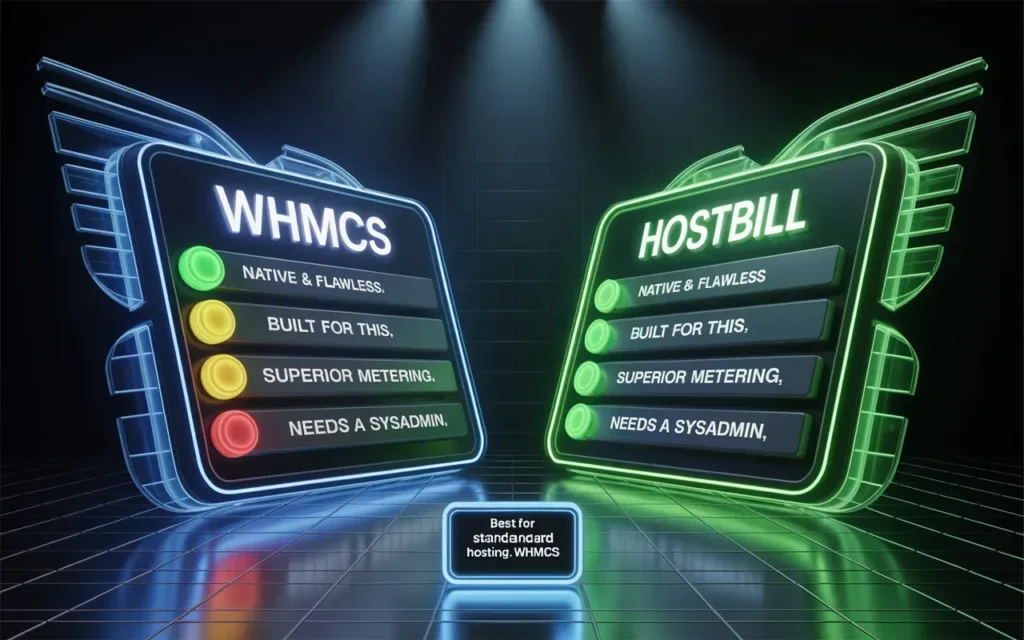
WHMCS covers all the basics perfectly: cPanel, Plesk, DirectAdmin, Virtualizor. It works seamlessly.
HostBill, however, supports an insane amount of integrations out of the box. We are talking about obscure cloud platforms, random domain registrars, and niche VPS managers. If you are using a very specific or rare technology stack, HostBill is more likely to have a native integration for it.
VPS, cloud, and reseller automation
For standard reseller hosting (selling shared accounts), WHMCS is king. It’s what it was built for.
For Cloud and VPS, HostBill has a slight edge. Its cloud metering features—charging clients based on exact CPU or RAM usage—are more robust out of the box. WHMCS can do this, but often needs third-party plugins to handle true utility billing well.
Reliability of automation workflows
Both are reliable, but WHMCS feels more stable for standard tasks. I’ve found that because HostBill tries to do everything, occasionally an update breaks a niche integration. WHMCS does fewer things, but the core provisioning for cPanel and domains is rock solid.
How Do Customization and Flexibility Compare?
You want your billing portal to look like your brand, not generic software.
Template and UI customization
WHMCS uses a Smarty template system. It’s very easy to customize. There are thousands of themes available on ThemeForest and other marketplaces. You can make WHMCS look like anything.
HostBill is harder to theme. There are fewer third-party themes available, and editing the core templates can be trickier. You often get stuck with the “HostBill look” unless you pay a developer to heavily customize it.
API and developer flexibility
WHMCS has a fantastic API. It’s well-documented (mostly) and widely understood. Any PHP developer can build a hook or module for WHMCS.
HostBill’s code is more heavily encrypted. While they have an API, customization at the core level is harder because they protect their source code aggressively.
White-label capabilities
Both allow you to remove their branding (usually for a fee or included in higher tiers). However, WHMCS feels truly white-label. Your clients will never know you are using it. HostBill sometimes leaves artifacts or specific URL structures that give it away.
Which Platform Is Better for Scaling a Hosting Business?
Growth changes everything. What works for 100 clients might break at 10,000.
Performance at scale
I’ve seen WHMCS installations with 50,000+ clients run smoothly, provided they are on good hardware. However, the database can get bloated over time.
HostBill is optimized for performance. It handles large databases very well. If you are planning to become the next GoDaddy, HostBill’s architecture might handle the massive load slightly better efficiently, but for 99% of users, WHMCS scales perfectly fine.
Client and service limits
WHMCS charges you per client bracket. This “success tax” annoys people. As you scale, your bill goes up. HostBill doesn’t usually limit client counts on their owned licenses, which makes scaling cheaper in terms of licensing fees (if you ignore the support costs).
Enterprise-level readiness
HostBill feels more “Enterprise” out of the box. It supports multi-brand, complex taxation rules, and multi-currency setups better than a default WHMCS install. WHMCS needs addons to reach that same level of enterprise complexity.
How Do Security and Updates Differ?
Security is non-negotiable. You are holding client credit card tokens and personal data.
Update frequency and stability
WHMCS updates are frequent. Sometimes too frequent. It can be annoying to keep up. However, they are generally stable.
HostBill releases updates constantly—sometimes weekly. This is good for features but bad for stability. I’ve had “Update Tuesday” turn into “Troubleshoot Wednesday” with HostBill more often than with WHMCS.
Security track record
Both have had vulnerabilities in the past. It’s the nature of software. However, WHMCS has a massive user base, meaning vulnerabilities are found (and patched) quickly. HostBill’s smaller user base means obscure bugs might linger longer, but they are also less of a target for mass automated attacks compared to WHMCS.
Compliance considerations
Both support GDPR features and various compliance tools. WHMCS makes it very easy to manage data retention policies and cookie consents.
What About Add-Ons, Modules, and Ecosystem Support?
This is WHMCS’s superpower.
Third-party modules availability
WHMCS has a massive Marketplace. If you need a payment gateway for a specific country, or a specific SMS notification plugin, it exists for WHMCS.
HostBill includes a lot of modules built-in, which is nice, but the third-party ecosystem is tiny. If HostBill doesn’t build it, you probably can’t find it.
Community and developer ecosystem
If you have a problem with WHMCS, you can Google it and find 50 forum threads with the answer. The community is huge.
If you have a problem with HostBill, you usually have to open a ticket with HostBill. The community help just isn’t there in the same volume.
Marketplace strength
The WHMCS Marketplace is thriving. Developers make a living building for WHMCS. This competition drives quality up and prices down for addons. HostBill lacks this vibrant external economy.
WHMCS vs HostBill for Agencies and Resellers
If you are reselling hosting, listen up.
Billing and client management
For agencies, you want simple recurring billing. WHMCS does this beautifully. You can set up a product, link it to Stripe or PayPal, and forget it.
Automation reliability
Resellers rely on the upstream provider’s server. WHMCS connects to reseller accounts effortlessly. HostBill can be overkill here. You don’t need data center management tools if you are just reselling a few cPanel accounts.
Support workload impact
Because WHMCS is easier to use, your clients will have fewer questions about how to use the client area. HostBill’s complex interface often generates “How do I do this?” tickets from confused customers.
When Should You Choose WHMCS?
After ten years in this industry, here is my verdict.
Best use cases for WHMCS
Choose WHMCS if you are a:
- Standard Web Hosting Provider
- Reseller Host
- Web Design Agency offering hosting
- MSP (Managed Service Provider)
Businesses that benefit most
Startups and growing businesses benefit most. The low monthly cost and massive community support make it the safest bet.
Long-term viability
WHMCS is owned by WebPros (the same company that owns cPanel and Plesk). They aren’t going anywhere. It is the industry standard for a reason.
When Does HostBill Make More Sense?
HostBill isn’t bad; it’s just specific.
Advanced or custom hosting needs
If you are selling Colocation, specialized Cloud services, or ISP services (like fiber internet), HostBill is superior.
Businesses with in-house developers
If you have a team of developers who can manage the software and handle complex configurations, HostBill gives you a lot of power.
One-time license advantages
If you absolutely hate monthly fees and have a large capital budget upfront, the math might work out in your favor with HostBill eventually.
Migration Considerations Between WHMCS and HostBill
Thinking of switching? Proceed with caution.
Data migration challenges
Moving data between these two is a nightmare. Scripts exist, but they rarely bring over everything perfectly. You often lose ticket history or credit logs.
Automation risks during migration
I’ve seen migrations where the new system accidentally re-billed every client or suspended active services. It requires careful planning.
Client communication planning
You have to tell your clients. They will have to log in to a new system, reset passwords, and learn a new interface. Friction causes churn. Only migrate if you absolutely have to.
How Skynethosting.net Supports WHMCS-Based Hosting Businesses
At Skynethosting.net, we bet on WHMCS a long time ago, and it’s paid off for our resellers.
WHMCS-optimized hosting environment
Our servers are tuned to make WHMCS fly. We use NVMe storage and LiteSpeed servers, which means your client area loads instantly. A slow billing portal loses sales; ours keeps them.
Automation-ready infrastructure
We offer a Free WHMCS License with our reseller plans. That saves you ~$16/month right off the bat. Our infrastructure is built to accept WHMCS API calls instantly, ensuring your provisioning never hangs.
Expert support for agencies
Since we provide the license, we also understand the software. If your WHMCS throws an error, our 24/7 support team can actually help you troubleshoot it. You aren’t on your own.
Start Your Reseller Hosting Journey Today
With free WHMCS licenses, automation-ready infrastructure, and expert support at your side, SkynetHosting.net makes managing reseller hosting effortless. Don’t settle for less when scaling your business. Visit SkynetHosting.net now to explore our reseller hosting plans and enjoy premium tools that help you succeed!
FAQ
How do WHMCS and HostBill pricing models differ?
Which is easier to set up for resellers?
What automation strengths does each platform have?
How customizable are WHMCS versus HostBill?
