
Dedicated Server for Gaming: Why Serious Gamers Choose Dedicated Infrastructure
TL;DR
- Dedicated servers offer full CPU, RAM, NVMe SSD access with no sharing, ensuring consistent low-latency performance for Minecraft, CS, or modded worlds.
- Prioritize high-clock-speed CPUs (3.5GHz+) for single-threaded game logic like AI, physics, and player sync over core count.
- RAM scales with mods/players: 8-16GB light, 32-64GB heavy packs; add 100-200MB per player for smooth scaling.
- NVMe SSDs boost load times 200% vs. standard drives; DDR5 RAM cuts latency for persistent worlds and high traffic.
- Include DDoS protection, global low-latency networks, and 24/7 uptime for competitive edges and community growth.
- SkyNetHosting delivers gaming-optimized bare-metal servers with these specs, full root access, and easy scaling.
Running a gaming server on shared hosting is like trying to run a marathon in flip-flops—it might work, but you’re setting yourself up for problems.
After working with gaming communities for over a decade, I’ve seen firsthand how the right infrastructure can make or break the player experience.
A dedicated server for gaming gives you exclusive access to all server resources. No sharing CPU, RAM, or bandwidth with anyone else. This means consistent performance, lower latency, and the power to handle demanding workloads.
Whether you’re hosting a private Minecraft realm for friends or running a public Counter-Strike server with hundreds of players, dedicated infrastructure delivers the reliability serious gamers need.
This guide breaks down everything you need to know about dedicated gaming servers, from hardware specs to security features, helping you make an informed decision for your gaming community.
What Is a Dedicated Server for Gaming?
A dedicated gaming server is a physical machine entirely allocated to hosting your game. Unlike shared environments where multiple users compete for resources, you get the entire server to yourself.
Think of it like owning a house versus renting an apartment. With a house, you control everything—the layout, the rules, and who gets to enter. That’s what dedicated hosting offers.
How dedicated hosting differs from shared environments
Shared hosting splits one server among dozens or hundreds of users. When someone else’s application consumes excessive resources, everyone suffers.
With a dedicated server, you avoid the “noisy neighbor” problem completely. Your game performance stays consistent regardless of what’s happening on other servers in the data center.
Understanding the differences between hosting types helps clarify why dedicated infrastructure matters for gaming.
Why gaming workloads require isolated resources
Games process data in real-time. Every player action—shooting, jumping, building—must be calculated and synchronized across all connected clients instantly.
This requires:
- High-frequency CPU processing
- Fast memory access
- Rapid disk read/write operations
- Consistent network bandwidth
Shared resources create unpredictable performance. One second your server runs smoothly, the next it stutters because someone else started a resource-intensive task.
Examples of games that benefit from dedicated servers
Nearly any multiplayer game performs better on dedicated infrastructure:
- Minecraft: Supports massive modpacks and hundreds of concurrent players
- ARK: Survival Evolved: Handles large persistent worlds with complex AI
- Rust: Manages real-time combat and base building mechanics
- Counter-Strike: Global Offensive: Delivers the low latency competitive players demand
- Valheim: Hosts persistent multiplayer worlds with minimal lag
If you’re setting up a gaming server for any of these titles, dedicated hosting provides the foundation for success.
Why Do Gamers Need Dedicated Servers Instead of Shared Hosting?
Shared hosting works fine for basic websites. For gaming? It’s a recipe for frustration.
I’ve helped countless communities migrate from shared hosting to dedicated servers. The difference is night and day.
Resource contention and lag issues explained
On shared hosting, you’re competing with dozens of other users for CPU time, RAM, and disk access.
When another user’s application spikes in resource usage, your game server slows down. Players experience lag spikes, rubber-banding, and disconnections.
This happens because the hypervisor managing the shared resources must constantly balance demands from multiple tenants. Your gaming workload—which requires consistent, real-time processing—gets deprioritized when someone else needs resources.
Stable performance during peak player activity
Gaming servers face predictable usage patterns. Players log in during evenings and weekends, creating traffic surges.
On shared hosting, these surges often coincide with increased activity from other users. The result? Your server struggles exactly when you need it most.
Dedicated servers handle peak loads effortlessly because all resources belong to you. When 50 players log in simultaneously, your server has the CPU and RAM needed to accommodate them.
Hosting multiplayer environments without slowdowns
Multiplayer games require constant synchronization between the server and all connected clients.
Every player movement, every projectile fired, every block placed—these actions must be processed, validated, and broadcast to other players within milliseconds.
Shared hosting introduces inconsistent processing delays that disrupt this synchronization. Players on your server might see different game states, leading to unfair gameplay and community complaints.
If you’re building a gaming network, dedicated infrastructure ensures every player gets the same responsive experience.
How Does a Dedicated Server Improve Gameplay Performance?
Performance isn’t just about raw power. It’s about consistent, predictable processing that keeps gameplay smooth.
Let me break down exactly how dedicated servers deliver better performance.
Faster processing with high-frequency CPUs
Gaming servers are largely single-threaded applications. They prioritize clock speed over core count.
A modern dedicated server equipped with a high-frequency CPU (3.5GHz+) processes game logic faster than any shared hosting environment.
This matters for complex calculations like:
- AI pathfinding in survival games
- Physics simulations in building games
- Projectile trajectories in shooters
- Entity updates in massive multiplayer environments
Higher clock speeds translate directly to smoother gameplay and support for more simultaneous players.
Reduced latency and improved tick rates
Tick rate is how often your server updates the game state. Higher tick rates mean more responsive gameplay.
Most competitive shooters run at 64 or 128 ticks per second. Each tick requires processing power and must complete within the allocated time window.
Dedicated servers maintain consistent tick rates because they have guaranteed CPU access. Shared hosting often causes tick rate fluctuations, creating the choppy gameplay serious gamers hate.
Consistent performance for competitive gaming
Competitive gaming demands absolute consistency. A single lag spike during a crucial moment ruins the experience.
Dedicated servers eliminate performance variability. Your server runs at the same speed during off-peak hours as it does during prime time.
This consistency matters for:
- Esports tournaments requiring fair conditions
- Ranked competitive matches
- Speedrunning communities
- Any gaming environment where precision matters
Professional gaming organizations exclusively use dedicated infrastructure for this reason.
What Hardware Specifications Matter Most for Gaming Servers?
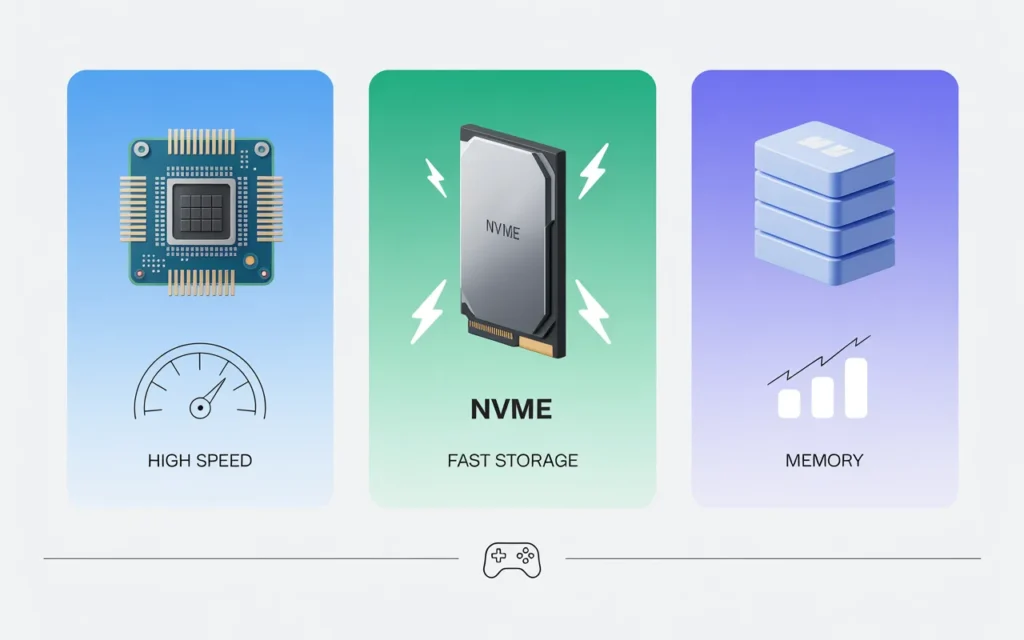
Not all dedicated servers are created equal. The specifications you choose dramatically impact your gaming experience.
Here’s what actually matters.
CPU performance vs core count considerations
For gaming servers, prioritize single-core performance over total core count.
A CPU with 8 cores at 2.5GHz will underperform compared to a 4-core CPU at 4.0GHz for most game servers.
Look for modern processors like:
- Intel Xeon E-series with high base frequencies
- AMD Ryzen or EPYC processors optimized for single-thread performance
- Latest generation CPUs with improved IPC (instructions per cycle)
The hardware specifications outlined in this dedicated hosting guide provide excellent benchmarks.
Importance of NVMe SSD storage for fast world loading
Game servers constantly read from and write to disk—loading world chunks, saving player progress, accessing configuration files.
Traditional hard drives (HDDs) create bottlenecks. Standard SSDs improve things significantly. NVMe SSDs eliminate storage bottlenecks entirely.
NVMe drives deliver:
- 3,000+ MB/s read speeds (versus 500 MB/s for SATA SSDs)
- Microsecond-level latency
- Higher IOPS (input/output operations per second)
This translates to faster world generation, quicker chunk loading, and reduced stuttering when players explore new areas.
NVMe SSD hosting has become the standard for modern gaming servers.
RAM requirements for modded and large-scale servers
RAM determines how much game data your server can keep readily accessible.
Vanilla game servers might run on 4-8GB of RAM. Modded servers need significantly more:
- Light modpacks: 8-16GB
- Heavy modpacks: 16-32GB
- Massive modpacks with 200+ mods: 32-64GB
More players also increase RAM requirements. A 100-player server needs substantially more memory than a 20-player server hosting the same game.
Dedicated servers let you scale RAM as your community grows, something impossible with most shared hosting plans.
How Important Is Low Latency in Multiplayer Gaming?
Latency—commonly called “ping”—measures the time data takes to travel between players and your server.
Lower is always better.
Understanding ping and routing optimization
Ping consists of multiple components:
- Player’s local connection quality
- ISP routing efficiency
- Geographic distance to server
- Server processing time
- Return trip to player
You can’t control players’ local connections, but you control server location and processing power.
Dedicated servers process requests faster than shared hosting because they’re not competing for CPU cycles. This reduces the “server processing time” component of ping.
Choosing server locations near player bases
Physics limits how fast data can travel. A player in Australia connecting to a server in Europe will always experience higher latency than connecting to a server in Sydney.
The solution is straightforward: host your server geographically close to your player base.
If your community spans multiple regions, consider:
- Multiple servers in different locations
- Cross-server networking that lets players choose their closest server
- Content delivery optimizations that reduce data transfer requirements
Quality hosting providers offer data centers across multiple continents.
Network stability for real-time gameplay
Consistent latency matters more than absolute latency for many games.
A stable 50ms connection feels better than a fluctuating connection that varies between 20ms and 100ms.
Dedicated servers connected to premium network infrastructure deliver consistent routing. Your packets follow the same optimized path every time.
This stability prevents the rubber-banding effect where players appear to teleport because the server is receiving delayed position updates.
What Security Features Should a Gaming Server Include?
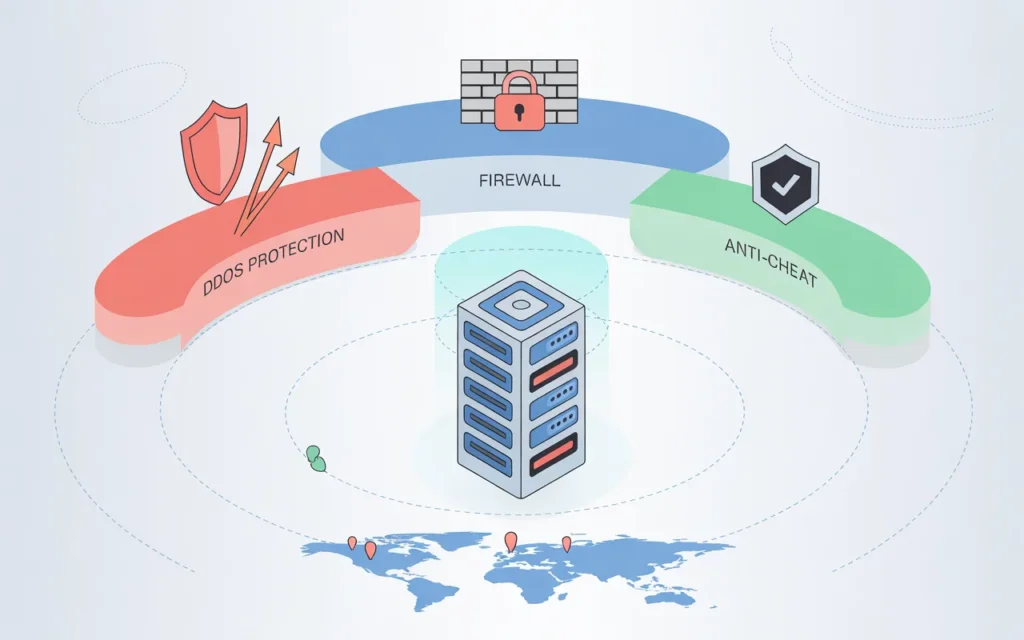
Gaming servers are attractive targets for attacks. Protecting your community requires robust security measures.
DDoS protection for uninterrupted matches
Distributed Denial of Service (DDoS) attacks flood your server with traffic, making it unreachable for legitimate players.
These attacks are common in competitive gaming, where malicious actors try to disrupt tournaments or take revenge for in-game actions.
Professional hosting providers include DDoS mitigation that:
- Detects attack traffic patterns
- Filters malicious requests before they reach your server
- Maintains legitimate player connections during attacks
- Scales to handle massive attack volumes
Without DDoS protection, a single attacker can take down your entire gaming community.
Firewall and access control configurations
Dedicated servers need properly configured firewalls that:
- Block unauthorized access attempts
- Restrict administrative access to specific IP addresses
- Limit attack surface by closing unused ports
- Monitor for suspicious connection patterns
You should also implement:
- Strong password policies for administrative accounts
- SSH key authentication instead of password-only access
- Regular security audits of your server configuration
- Automated alerts for potential security incidents
Protecting communities from malicious attacks
Beyond technical measures, security requires community management:
- Anti-cheat systems that detect and ban cheaters
- Moderation tools for managing toxic players
- Backup systems that protect against data loss
- Recovery procedures for when problems occur
The most sophisticated technical security means nothing if you don’t have processes to respond to incidents.
Regular backups are especially critical. When something goes wrong—and eventually something will—backups let you restore your gaming community to a working state.
Can Dedicated Servers Handle Modded and Custom Game Environments?
Absolutely. In fact, this is where dedicated servers truly shine.
Supporting heavy mods and plugins
Mods add features game developers never anticipated. They can:
- Introduce hundreds of new items and mechanics
- Create entirely new game modes
- Add complex automation systems
- Generate additional world content
These modifications demand substantial resources. A heavily modded Minecraft server might use 10x the CPU and RAM of a vanilla server.
Shared hosting typically prohibits resource-intensive mods or limits what you can install. Dedicated servers impose no such restrictions.
Full root access for customization
With dedicated hosting, you have root (administrator) access to the entire server.
This means you can:
- Install custom software and libraries
- Modify system-level configurations
- Run multiple game servers on the same machine
- Implement advanced networking setups
- Use any hosting control panel or management tool
This level of control is essential for advanced server configurations and automation.
Running persistent worlds and large player counts
Some games support persistent worlds that run continuously, evolving even when players are offline.
These environments require:
- Constant server uptime
- Sufficient resources to process background events
- Fast storage for frequent world saves
- Scalable architecture as the world grows
Dedicated servers handle these requirements better than any alternative hosting solution.
Large player counts create exponential complexity. A 200-player server isn’t just 10x harder than a 20-player server—it’s dramatically more complex.
You need the processing power and memory that only dedicated infrastructure provides.
How Scalable Are Dedicated Gaming Servers as Communities Grow?
Your gaming community won’t stay the same size forever. You need infrastructure that grows with you.
Expanding resources for larger audiences
Dedicated servers offer straightforward scaling:
- Upgrade RAM to support more concurrent players
- Add faster CPUs for improved processing
- Expand storage for growing world files and backups
- Increase bandwidth for higher player counts
Most providers offer in-place upgrades. Your server stays online while they add resources.
For significant growth, you might eventually need multiple servers. Dedicated infrastructure makes this transition smoother because you already understand the technology.
Supporting esports and public gaming networks
Esports tournaments require flawless infrastructure. Players expect:
- Zero lag during competition
- Fair conditions for all participants
- Spectator support for broadcasts
- Reliable uptime throughout events
Public gaming networks that host multiple game modes or titles need sophisticated setups with load balancing, player synchronization, and centralized management.
These advanced configurations require the control and flexibility that dedicated servers provide.
Transitioning from small servers to large ecosystems
Many successful gaming communities start small. You might begin with a single 20-player server for friends.
As your community grows, you expand:
- First, upgrade your existing dedicated server’s specs
- Add a second server for different game modes or locations
- Implement cross-server networking so players can move between servers
- Create a centralized authentication system
- Build a web presence with forums and wikis
This evolution is only possible with infrastructure you fully control.
Virtual dedicated servers offer another growth path, providing dedicated resources with additional flexibility.
What Are the Advantages of Dedicated Servers for Game Developers and Streamers?
Dedicated servers aren’t just for community hosting. They’re valuable tools for content creators too.
Testing builds in controlled environments
Game developers need stable test environments to:
- Verify multiplayer functionality works correctly
- Load test with simulated player counts
- Debug network synchronization issues
- Benchmark performance under various conditions
Dedicated servers provide consistent, reproducible test environments. You know exactly what hardware and network conditions your tests use.
Hosting branded community servers
Streamers and content creators often host community servers where fans can play together.
These servers become extensions of your brand. A laggy, unreliable server reflects poorly on you.
Dedicated infrastructure ensures your community server delivers the quality experience your audience expects.
You can also customize these servers with:
- Custom maps showcasing your content
- Special ranks or permissions for subscribers
- Unique game modes you’ve designed
- Branded textures and assets
Ensuring reliable uptime for live audiences
When you’re streaming gameplay to thousands of viewers, server issues are visible embarrassments.
Nothing kills momentum faster than your server crashing mid-stream, forcing you to troubleshoot technical problems while your audience watches.
Dedicated servers minimize these risks through:
- Superior uptime compared to shared hosting
- Faster recovery when issues do occur
- Professional support teams available 24/7
- Infrastructure built for demanding workloads
For streamers, server reliability is a professional necessity, not a luxury.
How Does SkyNetHosting.Net Inc. Deliver High-Performance Dedicated Hosting for Gaming?
Not all hosting providers understand gaming workloads. SkyNetHosting.Net Inc. specializes in infrastructure that gamers need.
Powerful bare-metal infrastructure built for demanding workloads
SkyNetHosting.Net Inc. provisions dedicated servers with gaming-optimized specifications:
- High-frequency CPUs for fast single-thread performance
- NVMe SSD storage delivering read speeds up to 200% faster than standard SSDs
- DDR5 RAM for reduced latency and improved bandwidth
- Enterprise-grade hardware built for 24/7 operation
Their bare-metal servers give you direct access to powerful hardware without virtualization overhead.
Optimized network connectivity for low-latency gameplay
SkyNetHosting.Net Inc. operates data centers in 25 worldwide locations, letting you host near your players regardless of their location.
Their network infrastructure includes:
- Premium bandwidth with minimal routing hops
- DDoS protection included with all plans
- Multiple Tier-1 carrier connections for redundancy
- Low-latency routing optimized for real-time applications
Geographic distribution means you can serve global audiences without forcing players to connect across continents.
Reliable uptime that keeps gaming communities online 24/7
Gaming communities expect 24/7 availability. SkyNetHosting.Net Inc. delivers enterprise-grade uptime through:
- Redundant power systems in all data centers
- Network redundancy preventing single points of failure
- Automated monitoring that detects issues instantly
- Expert technical support available around the clock
When problems occur—and they occasionally do with any infrastructure—responsive support makes the difference between five minutes of downtime and five hours.
Whether you’re looking for VPS hosting as a stepping stone or ready for full dedicated infrastructure, SkyNetHosting.Net Inc. provides solutions that scale with your needs.
How Do You Choose the Right Dedicated Gaming Server Plan?
Selecting the right server requires understanding your specific requirements.
Matching server specs to game requirements
Start by researching your game’s recommended dedicated server specifications. Official documentation typically provides guidelines for:
- Minimum CPU and RAM requirements
- Storage space needed
- Network bandwidth recommendations
- Operating system compatibility
Add a buffer beyond these minimums. Games often underestimate resource requirements, especially for modded servers.
For example, if the game recommends 8GB RAM, start with 16GB. This headroom accommodates:
- Operating system overhead
- Background processes and monitoring tools
- Traffic spikes during peak hours
- Future growth as you add players
Planning for player capacity and growth
Calculate resource requirements per player, then multiply by your target player count.
A rough formula:
- Base server requirements (from game documentation)
- Plus: 100-200MB RAM per player
- Plus: Additional CPU capacity for player AI interactions
- Plus: Storage for player data and world saves
Remember that 100 players require more than 5x the resources of 20 players due to the exponential complexity of player interactions.
Plan for growth. If you expect your community to double in size over the next year, provision resources accordingly now. Upgrading is easier than constantly hitting resource limits.
Avoiding common performance bottlenecks
Watch out for these frequent pitfalls:
Underestimating storage I/O: Games that frequently save world state need fast storage. If your world generates faster than your disk can save, you’ll experience lag during save operations.
Ignoring network bandwidth: Each player consumes bandwidth. 100 players might need 50-100Mbps of sustained bandwidth. Ensure your plan includes sufficient data transfer.
Choosing the wrong server location: A powerful server on the wrong continent delivers terrible performance for your players. Geography matters more than raw specs for player experience.
Forgetting about backups: Budget resources for regular backups. Backing up a 50GB world file requires storage space and bandwidth.
Compare different hosting options systematically. Understanding VPS versus dedicated hosting helps clarify which solution fits your budget and requirements.
Powering Your Gaming Community
Dedicated servers for gaming provide the foundation successful communities need—consistent performance, complete control, and reliable uptime.
Throughout this guide, we’ve explored why dedicated infrastructure outperforms shared hosting for gaming workloads. The combination of exclusive resources, powerful hardware, low latency, and robust security creates experiences players appreciate and return to.
Key takeaways:
- Dedicated servers eliminate resource contention that causes lag and disconnections
- High-frequency CPUs and NVMe storage deliver the performance competitive gaming demands
- Low-latency network connectivity keeps gameplay responsive across global audiences
- Full customization enables complex mods, plugins, and unique game configurations
- Professional DDoS protection shields your community from malicious attacks
- Scalable infrastructure grows alongside your expanding player base
The investment in dedicated hosting pays dividends through improved player satisfaction, reduced administrative headaches, and the flexibility to create exactly the gaming experience you envision.
Performance, stability, and control define the gaming experience
Players remember smooth gameplay and forget technical details. They just know your server “feels good.”
That feeling comes from infrastructure that handles every player action instantly, maintains consistent tick rates, and never stutters during crucial moments.
Dedicated servers deliver this reliability. They provide the stable foundation that lets you focus on community building instead of troubleshooting performance issues.
Choosing the right hosting partner ensures lag-free gameplay and long-term community growth
Your hosting provider is a long-term partner in your gaming community’s success.
Choose a provider that:
- Understands gaming workloads specifically
- Offers responsive 24/7 technical support
- Provides infrastructure in locations serving your players
- Scales resources as your community grows
- Protects against attacks that threaten availability
SkyNetHosting.Net Inc. checks all these boxes with gaming-optimized dedicated servers, global data center presence, and enterprise-grade reliability.
Ready to give your gaming community the infrastructure it deserves? Explore SkyNetHosting.Net Inc.’s dedicated server plans and experience the difference professional hosting makes.
FAQs
What makes dedicated servers ideal for gaming?
Dedicated servers allocate all CPU, RAM, NVMe storage, and bandwidth exclusively to your game, eliminating lag from shared resources. This ensures stable performance for 50+ players, mods, and real-time actions like shooting or building.
Why prioritize CPU clock speed over cores?
Gaming apps are single-threaded, relying on high GHz (3.5GHz+) for fast AI pathfinding, physics, and entity updates. More cores help less than raw speed for smooth synchronization across players.
How much RAM for modded servers?
Vanilla needs 4-8GB; light modpacks 8-16GB; heavy packs 16-32GB; massive 200+ mod setups require 32-64GB. Factor 100-200MB extra per player for world saves and traffic spikes.
What storage speeds up gaming performance?
NVMe SSDs deliver 200% faster reads/writes than SATA SSDs, slashing world load times and save lags. Pair with DDR5 RAM for optimal low-latency access in persistent multiplayer environments.
How to plan for player growth?
Match game docs minimums, then double for headroom—e.g., 8GB recommended becomes 16GB. Calculate per-player resources exponentially; provision scalable hardware now to avoid mid-season upgrades.
What security features protect gaming servers?
Enterprise DDoS mitigation absorbs attacks; firewalls, root access, and OS hardening prevent exploits. Global networks ensure low ping; 24/7 monitoring keeps uptime for reliable community play.
