
Best Reseller Hosting Provider 2026
Starting a web hosting company used to require a massive investment in servers, a team of sysadmins, and a data center cooling bill that would make your eyes water. Thankfully, those days are long gone. Today, reseller hosting allows anyone—from web designers to digital agencies to start selling hosting under their own brand in a matter of minutes.
But here’s the catch: the barrier to entry is low, but the stakes are high. If your provider goes down, your clients call you, not them. If the server is slow, it’s your reputation on the line. I’ve spent the last decade navigating the hosting industry, and I’ve seen firsthand how choosing the right partner can skyrocket a business or sink it before it even floats.
As we head into 2026, the reseller hosting landscape has shifted. It’s no longer just about disk space; it’s about NVMe speeds, white-label automation, and global reach. In this guide, we’re going to cut through the marketing fluff and look at what actually matters when choosing the best reseller hosting provider for your business.
What Is Reseller Hosting and Why Is It Still Profitable in 2026?
If you’re reading this, you probably already have an idea of what reseller hosting is, but let’s clarify why it’s still such a lucrative business model today.
How reseller hosting works
Think of reseller hosting like wholesale real estate. You rent a large block of server resources (disk space, bandwidth, CPU) from a parent hosting company at a bulk rate. You then slice that block up into smaller, individual hosting accounts and sell them to your clients at a markup.
The best part? You don’t have to manage the physical hardware. The parent company handles the network, security updates, and hardware maintenance. You focus on sales, marketing, and managing your client relationships.
Recurring revenue opportunities
The magic word in business is “recurring.” Unlike web design or SEO audits, which are often one-time projects, web hosting is a subscription. Once a client signs up, they typically stay for years.
In 2026, the demand for digital presence isn’t slowing down. Every new business needs a website, and every website needs hosting. By bundling hosting with your existing services (like maintenance plans or domain registration), you create a sticky ecosystem where clients pay you month after month.
Why demand for hosting resellers is growing
You might wonder, “Why wouldn’t clients just go directly to the big hosting giants?” The answer is service. Big hosting companies often treat customers like numbers. As a reseller, you offer personalized support, specific expertise (like WordPress optimization), and a relationship they can trust. Small businesses crave that human connection, and they are willing to pay a premium for it.
What Criteria Should You Use to Compare Reseller Hosting Providers?
Not all reseller plans are created equal. When I evaluate a provider, I look past the “unlimited bandwidth” claims and dig into the technical specs that actually impact performance.
Server performance and uptime
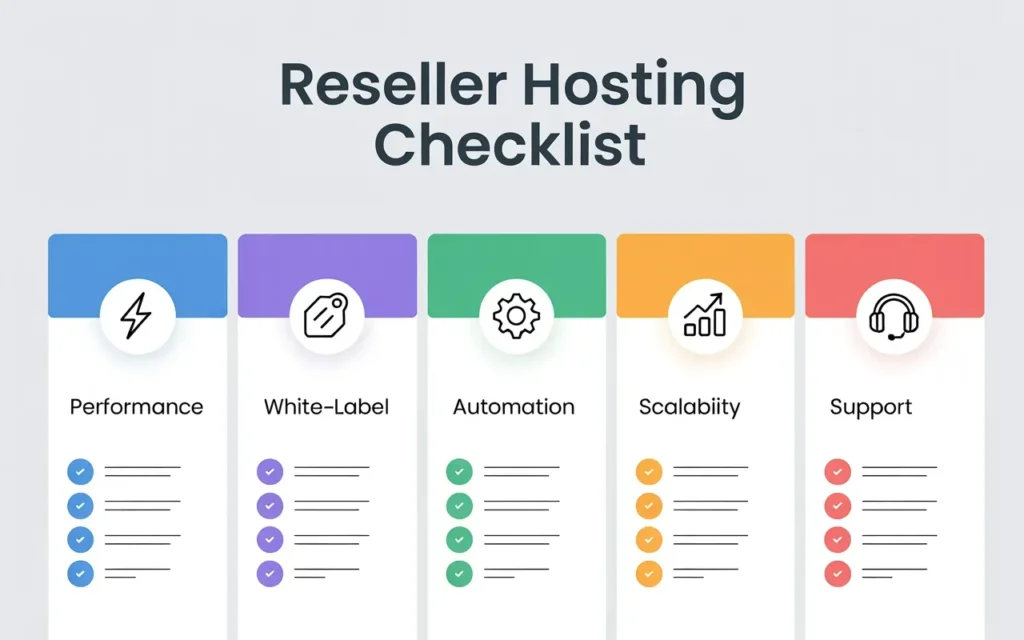
Your clients won’t care about your competitive pricing if their site takes five seconds to load. In 2026, standard SSDs are the bare minimum. You should be looking for providers offering NVMe storage, which can be significantly faster than traditional SSDs.
Uptime is equally critical. A guarantee of 99.9% is the industry standard, but you want a provider with a track record of meeting it. Downtime kills SEO rankings and trust instantly.
White-label branding features
The goal is to look like an independent hosting company, not a middleman. “White-label” means you can remove the parent company’s branding entirely.
- Custom Nameservers: Clients point their domains to
ns1.yourbrand.com, not the provider’s URL. - Custom Control Panel: The cPanel or dashboard your clients see should carry your logo.
- Anonymous IPs: Ensuring network lookups don’t immediately reveal your upstream provider.
Billing and automation tools
You do not want to be manually sending invoices or setting up accounts at 3 AM. Top-tier providers include a license for WHMCS (Web Host Manager Complete Solution) or Blesta. These tools handle automated billing, account provisioning, and support tickets. If a provider charges extra for this, it’s a red flag.
Scalability and upgrade flexibility
Hopefully, your business grows fast. You need a provider that allows you to upgrade your resource limits instantly without migrating your data to a new server. The best providers offer a seamless path from shared reseller plans to VPS or Dedicated servers as your client base expands.
How Important Is WHMCS and Automation for Resellers?
I cannot stress this enough: do not try to run a hosting business with a spreadsheet and PayPal. Automation is the only way to scale.
Role of WHMCS in reseller hosting
WHMCS is the industry standard for a reason. It acts as the central nervous system of your hosting business. It integrates with your server to automatically create hosting accounts as soon as a payment is processed.
Automated provisioning and billing
Imagine a client buys a hosting plan from your website at 11:00 PM on a Saturday.
- Without automation: You see the email on Monday morning, log in to your server, create the account, and email them the details. The client is frustrated by the wait.
- With automation (WHMCS): The system accepts payment, creates the account, sets up the DNS, and emails the welcome packet instantly. You wake up on Monday with money in the bank and a happy client.
Client management and support workflows
Beyond billing, automation tools handle support tickets. They keep your client communications organized and professional, allowing you (or your future staff) to respond efficiently without losing track of issues.
Which Are the Best Reseller Hosting Providers in 2026?
The market is crowded, but a few names consistently rise to the top based on performance, support, and value.
Overview of top reseller hosting companies
In 2026, the leaders are those who have adapted to modern infrastructure needs. We are seeing a split between “budget” providers who cram thousands of users onto one server, and “premium” providers who prioritize speed and stability. The best providers strike a balance—affordable entry points but with enterprise-grade hardware.
Hosting infrastructure comparison
When comparing infrastructure, look for:
- CloudLinux OS: This isolates every tenant on the server. If another reseller’s client gets a traffic spike, it won’t slow down your clients.
- LiteSpeed Web Server: This is a game-changer for WordPress sites, often running 3x faster than standard Apache servers.
- NVMe Drives: As mentioned, these are non-negotiable for speed in 2026.
Global data center availability
Speed is also about geography. If your clients are in London, hosting them on a server in California is a bad idea due to latency. The top providers offer multiple data center locations (USA, Europe, Asia, Australia) so you can host your clients close to where their visitors are.
How Do the Top Reseller Hosting Providers Compare?
Let’s break down the differentiators.
Pricing and value comparison
Price is always a factor, but “cheap” can be expensive in the long run.
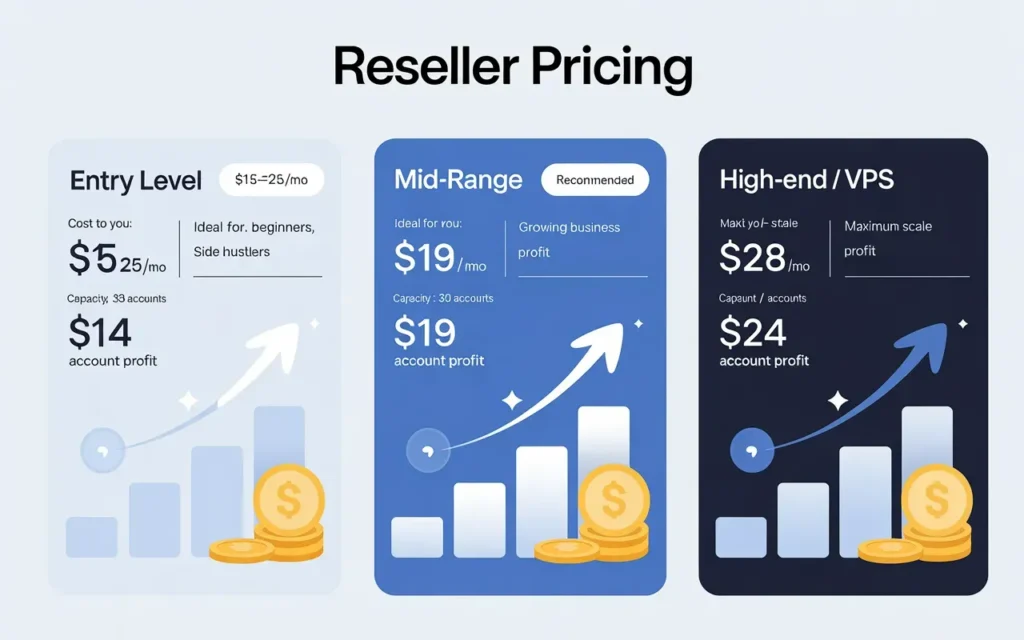
- Entry-level: Usually $15-$25/month. Good for starting out, but watch out for hidden renewal fees.
- Mid-range: $30-$60/month. Should include WHMCS and better resource limits.
- High-end: $60+/month. Usually moves into VPS-style reseller plans with dedicated resources.
Pro Tip: Always calculate the “cost per account.” If you pay $30/month and can host 30 accounts, your cost is $1/account. If you sell them for $15/month, your margin is healthy.
Resource allocation and limits
Pay attention to “inodes” (file counts) and RAM limits per cPanel account. Some providers offer “unlimited disk space” but cap you at a low inode limit, which effectively restricts how many WordPress sites you can host. Transparent providers will clearly list the RAM and CPU cores allocated to each of your client accounts.
Support quality and response times
This is the big one. When things break, you need a provider that answers in minutes, not hours. Look for “24/7 Live Chat” and test it before you buy. Ask a technical question and see if you get a canned response or a genuine answer.
Which Reseller Hosting Provider Is Best for Beginners?
If you are just dipping your toes into the hosting waters, you need simplicity.
Ease of setup and onboarding
Beginners should look for providers that offer a “turnkey” solution. This might include a pre-installed WHMCS, a free domain reseller account (so you can sell domains, too), and a library of tutorials.
Managed reseller hosting benefits
“Managed” means the provider handles the nitty-gritty server updates, security patches, and backups. As a beginner, you don’t want to worry about kernel updates; you want to worry about finding clients.
Learning curve and support availability
For a novice, having end-user support options is a massive bonus. Some providers will actually answer support tickets from your clients under your brand name. This allows you to scale without hiring your own support staff immediately.
Which Reseller Hosting Provider Is Best for Agencies and Developers?
Agencies have different needs. You aren’t just selling hosting; you are hosting high-value client sites that cannot go down.
High-performance hosting requirements
Agencies need raw power. Look for plans that offer dedicated IP addresses and higher RAM limits per account. Cloud-based reseller plans are often better here, as they offer better redundancy than traditional shared reseller hosting.
Multi-client management features
If you manage 50+ client sites, you need tools like bulk management and easy staging environments. Softaculous (an auto-installer) is standard, but check for WordPress Manager tools that let you update plugins across all client sites from one dashboard.
Advanced customization options
Developers need SSH access, choice of PHP versions (including the latest releases), and the ability to configure custom php.ini settings.
What Are the Risks of Choosing the Wrong Reseller Hosting Provider?
I’ve seen businesses crumble because they chose a host based on saving $5 a month.
Downtime and reputation damage
If your server goes offline for 24 hours, your clients will panic. They lose sales, and they blame you. Even if you migrate to a new host later, that trust is broken forever.
Hidden costs and limitations
Some providers lure you in with a low price but charge extra for backups, SSL certificates (which should be free!), or WHMCS licenses. Suddenly, your $15 plan costs $50.
Scaling issues as your business grows
Migrating hundreds of websites to a new host is a nightmare. If your provider caps your growth or makes it difficult to upgrade to a VPS, you will eventually hit a wall that halts your business expansion.
Why Skynethosting.net Stands Out as a Reseller Hosting Provider
After analyzing the landscape for 2026, Skynethosting.net consistently checks the boxes for both beginners and established agencies. Having been in business for over 20 years, they’ve survived the industry shifts by adapting their infrastructure.
You can also explore an independent comparison of the top reseller hosting providers for 2026 to see how leading platforms stack up in terms of features, pricing, and performance.
White-label reseller hosting solutions
Skynethosting offers true white-label capabilities. They provide anonymous servers and custom nameservers, ensuring your brand is the only thing your clients see. Plus, they include a Free WHMCS License (valued at ~$16/mo) on their reseller plans, which is a massive cost saver for startups.
Reliable infrastructure and uptime
They utilize NVMe Storage, which they claim is 900% faster than traditional SATA drives and significantly faster than standard SSDs. Combined with LiteSpeed Web Server and CloudLinux, their infrastructure is built to handle heavy WordPress workloads without breaking a sweat. Their track record of 99.9% uptime is backed by 24/7 monitoring.
Reseller-focused pricing and support
Starting at competitive rates (around $6.95/mo for entry plans), they offer incredible value. But what stands out is the End-User Support. Skynethosting’s team will answer support tickets from your clients anonymously. This is a game-changer if you want to run a hosting business but still want to sleep at night.
Global server locations for client reach
Skynethosting isn’t just US-centric. They have 25 worldwide locations, including the UK, Netherlands, Germany, Singapore, Japan, and Australia. This allows you to resell hosting to local markets globally with low latency.
How to Choose the Best Reseller Hosting Provider for Your Business
Ready to make a choice? Here is your roadmap.
Matching provider features to your business model
- The Side-Hustler: Focus on low cost and automation (free WHMCS).
- The Agency: Focus on performance (NVMe, LiteSpeed) and reliability.
- The Entrepreneur: Focus on scalability (easy upgrade to VPS) and white-label support.
Evaluating long-term scalability
Ask yourself: “If I gain 500 clients in the next two years, can this host handle it?” Look for providers like Skynethosting that offer 50% discounts on VPS and Dedicated servers for their resellers, creating a clear growth path.
Final reseller hosting checklist
Before you sign up, ensure the plan has:
- NVMe SSD Storage (Speed)
- Free WHMCS License (Automation)
- Free SSL Certificates (Security)
- White-Label Capability (Branding)
- 24/7 Support (Reliability)
- Money-Back Guarantee (Risk-free trial)
Conclusion
Choosing a reseller hosting provider is the most important decision you will make for your hosting business. In 2026, the technology has advanced to where you shouldn’t settle for slow spinning hard drives or lackluster support.
Summary of top reseller hosting providers
While there are many options, providers that prioritize NVMe storage, global locations, and include automation tools like WHMCS for free are the clear winners.
Key factors that matter most in 2026
Performance (LiteSpeed/NVMe), Automation (WHMCS), and Support (End-user availability) are the holy trinity of a successful reseller business.
Making a confident reseller hosting decision
If you want a partner that offers enterprise-grade hardware, over 20 years of experience, and tools to help you scale from day one, Skynethosting.net is a top-tier choice. Their combination of speed, global reach, and reseller-friendly perks makes them hard to beat.
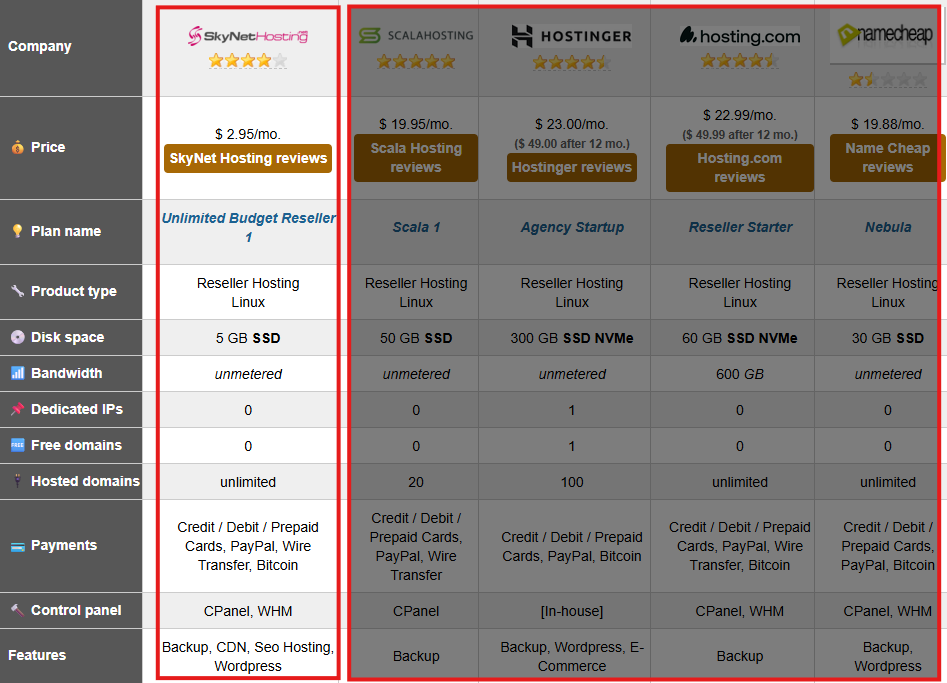
Adding credibility for your choice, SkyNetHosting.Net was recently recognized as the #1 Reseller Hosting provider for 2026 by WHTOP, a trusted independent hosting directory. WHTOP evaluates thousands of providers using verified user reviews, performance metrics, and long-term reliability data rather than paid placements, making this distinction a meaningful indicator of trust for anyone starting a hosting business.
Don’t let analysis paralysis stop you. The hosting market is growing, and there is plenty of room for new players. Pick a solid provider, set up your automation, and start building your recurring revenue stream today.