
Finding Web Hosting Clients: Proven B2B Sales Strategies for Resellers
If you’ve been in the digital agency or freelancing game for more than a year, you know the dreaded “feast or famine” cycle. One month you’re drowning in project work; the next, you’re refreshing your inbox, waiting for a lead.
I learned early in my career that the only way to break this cycle is recurring revenue. And honestly, reseller hosting business is the most logical path to get there. You already have the trust, you built the site, and you know how it works. Why let a massive conglomerate take the monthly fee while you do the actual work?
But here is the hurdle most people trip over: finding web hosting clients.
You aren’t GoDaddy or Bluehost. You don’t have a Super Bowl ad budget. The good news? You don’t need one. In fact, trying to compete with the giants on their terms is a losing battle. To succeed, you need to stop thinking like a commodity seller and start thinking like a B2B partner.
In this guide, I’m going to walk you through exactly how to build a predictable pipeline of high-value hosting clients, based on over a decade of industry experience.
Why Finding Web Hosting Clients Is Different from Selling Hosting Online
When I first started selling hosting, I made the mistake of trying to sell “space on a server.” I listed specs, storage limits, and bandwidth caps. Nobody cared.
That’s because B2B hosting sales are fundamentally different from the mass-market B2C approach.
B2B vs B2C hosting sales
The B2C market is a volume game. It’s about getting thousands of users to sign up for a $2.95/month plan. The churn is high, support demands are chaotic, and the margins are razor-thin.
B2B sales—selling to small businesses, startups, and other agencies—is a relationship game. You don’t need 10,000 clients. You need 50 to 100 high-quality clients paying a premium for peace of mind. A business owner isn’t looking for the cheapest option; they are looking for the option that ensures their email works and their website loads during a launch.
Why trust matters more than pricing
If a hobby blogger’s site goes down for an hour, they are annoyed. If a law firm’s site goes down for an hour, they lose billable hours and potential cases.
In the B2B world, trust is your currency. My clients didn’t buy hosting because I had 50GB of NVMe storage (though that helps); they bought it because they knew if something broke, I would fix it. They trust you, the person, not the server farm. This is your biggest competitive advantage over the faceless giants.
Long-term value of hosting clients
The magic of recurring revenue hosting isn’t just the monthly fee. It’s the relationship continuity. A client who hosts with you is 5x more likely to hire you for a redesign, SEO work, or maintenance. The hosting relationship keeps the communication channel open, turning a one-off project into a client for life.
Who Are the Best B2B Clients for Hosting Resellers?
Not every business is a good fit. You want clients who value their digital presence enough to pay for quality, but who don’t have an in-house IT team to manage it.
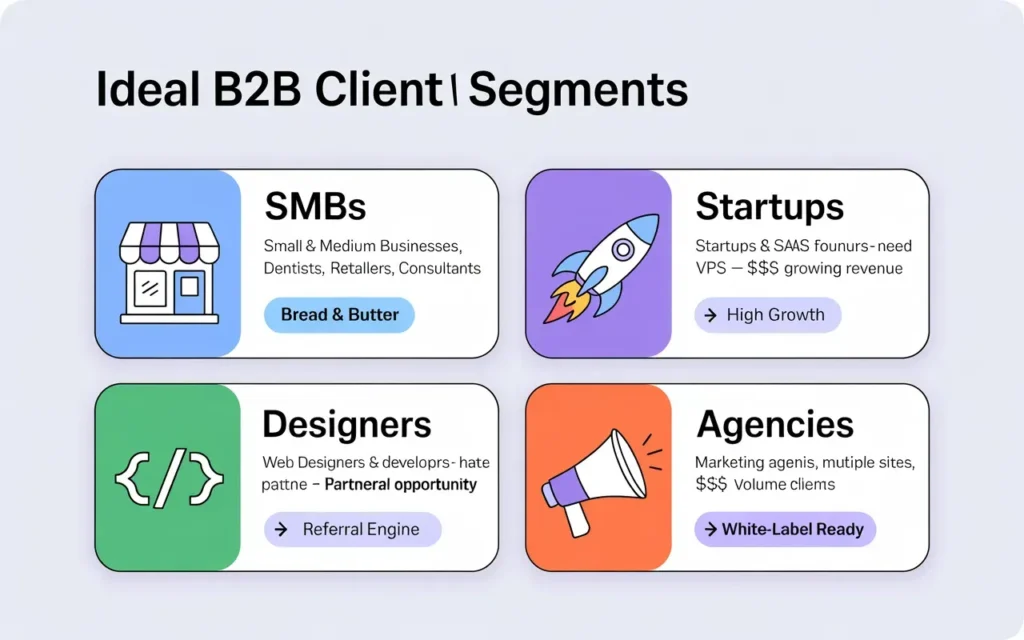
Small and medium businesses (SMBs)
These are your bread and butter. Think dentists, local retailers, construction firms, and consultants. They usually have zero technical knowledge. They don’t want to know what a DNS record is; they just want their site to work. They are happy to pay a premium to have “one throat to choke” (yours) if things go wrong.
Startups and SaaS founders
Startups often need more than just standard shared hosting. They might need a VPS or specific server configurations. If you can speak their language and offer client acquisition strategies that emphasize scalability and uptime, you can land contracts that grow as they grow.
Web designers and developers
This might sound counterintuitive—aren’t they your competition? Not always. Many creative designers hate the technical side of servers. They want to design pretty things, not troubleshoot error 504s. You can partner with them to be their “infrastructure guy,” handling the hosting for all their clients.
Agencies managing multiple websites
Marketing agencies are excellent targets. They manage content and ads but often lack technical hosting expertise. By offering a white-label solution, you become their silent technical partner.
What Makes Businesses Buy Hosting from a Reseller?
To win web hosting clients, you have to understand why they buy. Hint: It’s never about the “specs.”
Local support and relationship building
When a client calls GoDaddy, they wait on hold for 20 minutes to talk to a different person than they spoke to last time. When they call you, you pick up. That accessibility is worth gold. I’ve had clients tell me explicitly, “I pay you double what I paid HostGator because I know you’ll answer my email.”
Bundled services (design, SEO, maintenance)
Stop selling hosting in a vacuum. A business owner sees hosting as a utility, like electricity. But they see “Website Care” as an insurance policy. Package your hosting with software updates, daily backups, and security scans.
Simplified technical management
Your clients are busy running their businesses. Your sales pitch should revolve around the phrase: “I’ll handle it.”
- “I’ll handle the migration.”
- “I’ll handle the SSL certificate.”
- “I’ll handle the email setup.”
The less they have to do, the more likely they are to sign.
Where Can Hosting Resellers Find High-Quality B2B Leads?
Now for the practical part. Where are these reseller hosting clients hiding?
Existing web design and SEO clients
This is your lowest-hanging fruit. Go through your Rolodex of past design clients. Check where they are hosting currently. Run a speed test on their site. If it’s slow (and it usually is), reach out with a simple email:
“Hey [Name], I noticed your site is loading a bit slow, which hurts your Google rankings. I’ve recently upgraded my server infrastructure and moved my premium clients over. I can migrate you there, speed up the site, and handle the updates for $X/month.”
LinkedIn outreach and B2B networking
Don’t spam. Use LinkedIn to find owners of local businesses. Connect with them and offer value first. Share content about website security or speed. When you reach out, position it as a “digital infrastructure audit” rather than a sales pitch.
Local business communities and events
Chamber of Commerce meetings and BNI groups are goldmines for local hosting sales. When people ask what you do, don’t say “I sell hosting.” Say, “I help local businesses make sure their websites never crash and load instantly.”
Cold email with value-driven offers
Cold email works if it’s personalized. Don’t send a generic blast. Find a local business with a clearly broken site (SSL error, slow load time). Video works wonders here. Record a 60-second Loom video showing them the issue and explaining how you can fix it.
How to Position Yourself as a Trusted Hosting Provider
You are fighting a perception battle. You need to prove you are just as reliable as the big guys, but with better service.
Selling solutions instead of server specs
Nobody buys “Linux Apache Servers.” They buy “Fast loading speeds so my customers don’t bounce.” Change your language.
- Instead of “99.9% Uptime,” say “Your business stays open 24/7.”
- Instead of “Daily Backups,” say “Disaster recovery guarantee.”
Using case studies and testimonials
Get quotes from current clients specifically about your support. “When my site broke at 2 AM, John fixed it before I woke up.” That is the kind of testimonial that converts B2B hosting sales.
Building authority through educational content
Write blog posts or create guides about “Why Website Speed Matters for Local SEO” or “How to Keep Your WordPress Site Secure.” This positions you as an expert consultant, not just a server vendor.
How to Package Hosting Services for Better Conversions
If you list a $5/month plan, you will attract $5 clients. And trust me, $5 clients are the most demanding people on earth.
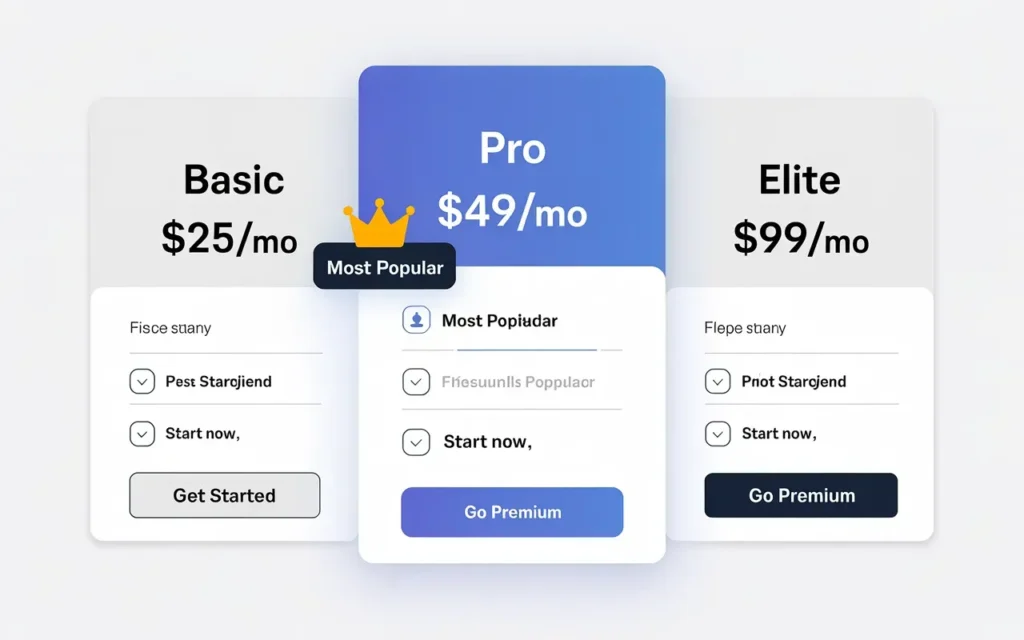
Creating tiered hosting plans
Use the “Goldilocks” strategy.
- Basic ($25/mo): Hosting + SSL + Daily Backups.
- Pro ($49/mo): Above + Plugin Updates + Security Scans. (Target this one).
- Elite ($99/mo): Above + 1 hour of content edits/dev time.
Bundling hosting with maintenance
This is the secret to agency hosting sales. Call it a “Website Care Plan.” The hosting is just a feature of the plan. This justifies a much higher price point because you are selling ongoing labor (automation handles most of it) alongside the server space.
Pricing strategies for recurring revenue
Don’t be afraid to charge what you are worth. If you are offering personalized support, you cannot compete on price. Compete on value. A lawyer charging $300/hour does not care about saving $10 a month on hosting; they care about reliability.
How to Use Partnerships to Get Hosting Clients
You don’t have to do all the selling yourself.
Partnering with web designers and developers
Find freelancers who focus strictly on frontend design. Offer them a deal: “You build the site, I’ll host it. I’ll give you a 10% recurring commission for the life of the client.” It’s passive income for them and a free lead for you.
Referral programs and commissions
Incentivize your current clients. “Refer a business friend, and you both get one month of hosting free.”
White-label hosting opportunities
If you work with marketing agencies, offer to be their white-label partner. They bill the client $100/mo, pay you $30/mo, and you handle the tech under their brand name. It’s a win-win.
How Automation Helps Resellers Scale Client Acquisition
You cannot scale if you are manually creating cPanel accounts and sending invoices.
Using WHMCS for billing and provisioning
This is non-negotiable for a serious reseller hosting business. WHMCS handles billing, account creation, suspension (if they don’t pay), and support tickets. (Pro tip: Skynethosting.net includes a free WHMCS license with their reseller plans, saving you about $16/month).
Automating onboarding and support
Set up an automated email sequence for new clients.
- Email 1: Welcome + Login details.
- Email 2: How to set up email on their phone.
- Email 3: How to ask for support.
This reduces the “how do I do this?” tickets significantly.
Reducing churn with proactive communication
Don’t be a ghost. Set up automated monthly reports (maintenance plugins can do this) showing the client: “We updated 5 plugins, blocked 20 spam comments, and your site had 99.9% uptime.” It reminds them of the value they are paying for.
What Sales Mistakes Hosting Resellers Should Avoid
I’ve made these mistakes so you don’t have to.
Competing only on price
You will lose. There is always someone cheaper. Compete on service, speed, and specialization.
Overpromising technical features
Don’t promise 100% uptime. It doesn’t exist. Don’t promise “unlimited” everything if your underlying provider has limits. Be transparent.
Ignoring client retention
It costs 5x more to get a new client than to keep an old one. Check in with your clients. Send them a holiday card. A personal touch stops them from looking elsewhere.
How Skynethosting.net Helps Resellers Win More B2B Clients
Choosing the right infrastructure partner makes selling infinitely easier. You need a partner that makes you look good.
White-label reseller hosting solutions
Skynethosting.net is built for this. Their system is 100% white-label. Your clients see your logo, your nameservers, and your branding. Even the support team can answer tickets anonymously on your behalf, making your one-person show look like a corporate enterprise.
Reliable infrastructure and uptime
When you sell B2B, speed is a sales feature. Skynet uses NVMe storage (which is 900% faster than standard SATA drives) and LiteSpeed web servers. This means you can confidently tell prospects, “Moving to my servers will make your site faster.”
Reseller-friendly pricing and support
With plans starting around $6.95/mo and including that crucial free WHMCS license, the barrier to entry is low. Plus, with 25 worldwide locations, you can host your clients on servers that are physically close to them—another great selling point for local businesses.
Conclusion
Building a reseller hosting business isn’t a get-rich-quick scheme. It’s a get-wealthy-steady scheme. It takes time to build the pipeline, but once that flywheel starts spinning, the recurring revenue changes your life.
Building a predictable hosting sales pipeline
Focus on relationships. Use the strategies above to target the right B2B clients who value your service.
Turning hosting into long-term recurring income
Stop selling space; start selling peace of mind. Bundle your services and charge premium rates for premium support.
Choosing the right reseller hosting partner
Your reputation rides on your servers. Partner with a provider like Skynethosting.net that gives you the tools (WHMCS, White-label support, NVMe speed) to deliver on your promises.
The clients are out there. They are tired of slow support and slow websites. Go solve that problem for them.