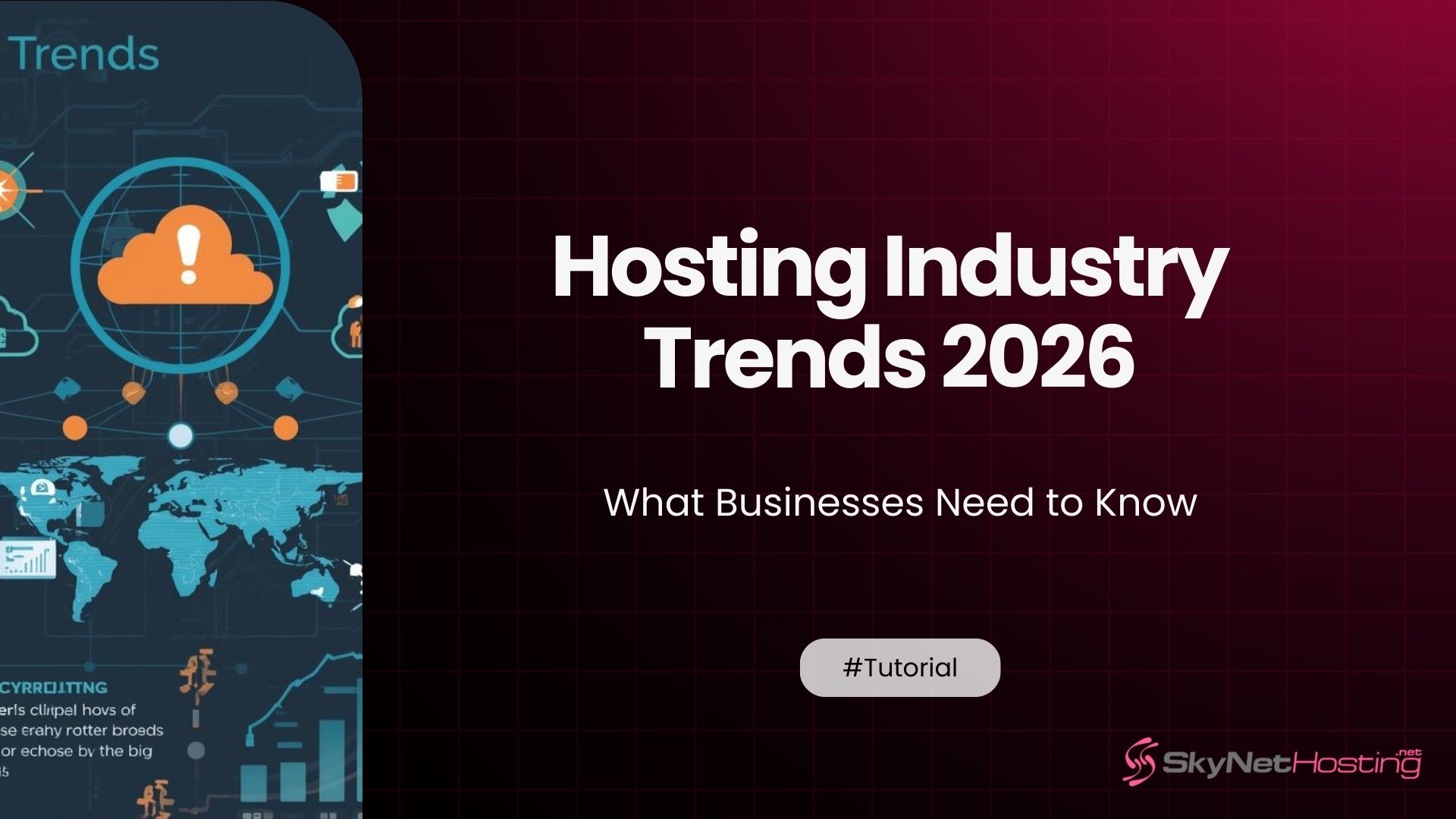
Hosting Industry Trends 2026: What Businesses Need to Know
TL;DR
- AI-driven automation handles security, performance tuning, and compliance, freeing providers for value-added services.
- Edge computing cuts latency via global nodes, dominating for real-time apps like gaming and e-commerce.
- Green hosting surges with renewable data centers and carbon reporting to meet sustainability demands.
- Multi-cloud/hybrid models offer resilience, avoiding single-provider outages or lock-in risks.
- Upskilling to VPS/dedicated/managed WP drives revenue as shared hosting commoditizes.
- Serverless scales instantly for bursts, slashing costs 50-70% on variable workloads.
The hosting industry is changing faster than most businesses can keep up with.
Over the past decade working in web infrastructure, I’ve seen countless shifts — from the death of traditional shared hosting to the rise of cloud, NVMe storage, and now AI-powered management. But 2026 feels different. The pace of change has accelerated, and the decisions businesses make about hosting right now will define their competitiveness for years to come.
This post covers the key hosting industry trends shaping 2026. Whether you’re running a reseller business, managing infrastructure for clients, or simply trying to pick the best hosting setup for your company, these trends will affect you directly.
Let’s get into it.
What Are the Key Hosting Trends Shaping 2026?
Cloud Adoption and Hybrid Infrastructures
Cloud hosting isn’t new. But in 2026, the conversation has shifted from “should we use cloud?” to “how do we combine cloud with what we already have?”
Most businesses aren’t going fully cloud. They’re building hybrid setups — keeping certain workloads on dedicated hardware for performance and compliance reasons, while using cloud for elasticity and rapid scaling. This hybrid approach gives companies the best of both environments without forcing them into one rigid model.
If you’re comparing infrastructure options, our colocation vs cloud hosting guide breaks down exactly when each model makes sense.
Serverless and Event-Driven Hosting Models
Serverless hosting is gaining significant traction. Instead of paying for a server that runs 24/7, you pay only for the compute you actually use — triggered by specific events or requests.
For developers building APIs, microservices, or scheduled tasks, this model dramatically reduces costs. You’re not provisioning idle resources. The function runs, the work gets done, and billing stops.
This is particularly useful for businesses with unpredictable traffic spikes. Rather than overprovisioning a VPS or dedicated server “just in case,” serverless handles burst demand automatically.
AI-Driven Hosting Management and Automation
AI is now embedded in how modern hosting infrastructure is managed. Providers are using machine learning to predict hardware failures before they happen, automatically reallocate resources during traffic spikes, and flag security anomalies in real time.
From a business perspective, this means fewer surprises. Your hosting doesn’t just respond to problems — it anticipates them.
How Is Green and Sustainable Hosting Evolving?
Energy-Efficient Data Centers and Renewable Power
The energy numbers behind hosting are staggering. According to the International Energy Agency’s 2025 Energy and AI report, data centers consumed approximately 415 terawatt-hours (TWh) of electricity in 2024 — roughly 1.5% of global electricity consumption. That figure is projected to more than double to around 945 TWh by 2030.
That’s more electricity than Japan uses today.
The response from serious hosting providers has been to invest aggressively in energy-efficient hardware. NVMe SSDs consume less power than traditional drives while delivering dramatically faster performance. Modern processors deliver more computation per watt than their predecessors. Smart cooling systems adjust dynamically to actual server loads rather than running at full capacity 24/7.
Carbon-Neutral Hosting Adoption
Beyond hardware efficiency, many providers are pursuing carbon neutrality through renewable energy procurement, power purchase agreements with solar and wind suppliers, and Renewable Energy Certificates (RECs).
The distinction matters. A provider claiming to be “green” because they’ve purchased offsets is very different from one that has directly contracted renewable power or runs on-site renewable generation. When evaluating providers, ask for specifics.
Our green web hosting guide covers exactly what to look for — and how to spot greenwashing from providers who use sustainability as a marketing label rather than an operational commitment.
Why Eco-Friendly Hosting Is Becoming a Market Differentiator
Sustainability has crossed from “nice to have” to a genuine business requirement for many organizations. Enterprise procurement teams now include carbon footprint criteria in vendor evaluations. Government contracts in several jurisdictions require emissions reporting.
For resellers and agencies, this creates a real opportunity. Offering sustainable hosting isn’t just good for the planet — it helps you win clients who have sustainability commitments built into their procurement standards.
Which Technologies Are Driving Performance in Hosting?
NVMe and SSD Storage Improvements
If your hosting provider is still running SATA drives, you’re leaving significant performance on the table.
NVMe (Non-Volatile Memory Express) drives connect directly to the server’s PCIe bus, achieving read speeds over 3,000 MB/s compared to roughly 500 MB/s for SATA SSDs. For database-heavy applications, e-commerce stores, and high-traffic WordPress sites, the difference is measurable — often sub-second page loads versus 3-4 second loads on older storage.
NVMe also handles high IOPS (input/output operations per second) far better than traditional storage. During traffic spikes, sites on NVMe hosting maintain performance. Sites on older storage don’t.
Learn more about how NVMe storage translates to real-world speed gains in our NVMe web hosting with cPanel breakdown.
Edge Computing and Low-Latency Solutions
Edge computing pushes processing and content delivery closer to the end user, reducing the physical distance data has to travel.
For global businesses, this matters enormously. A server in Dallas serving users in Singapore will always perform worse than a server in Singapore. Edge infrastructure addresses this by distributing workloads across geographically dispersed nodes.
By 2026, edge computing is no longer exclusively the domain of large enterprises. Managed hosting providers with multi-region data center networks are making low-latency edge delivery accessible to mid-market businesses and resellers.
Enhanced Network Infrastructure and Redundancy
The bar for network reliability has risen. Single-provider, single-path network connections are a liability. Businesses expect multi-carrier redundancy, automatic failover, and DDoS protection built into the network layer — not purchased as an add-on.
Providers operating across 20+ global locations with multiple Tier-1 carrier connections give businesses and their clients the geographic flexibility and resilience that today’s workloads demand.
How Are Reseller Hosting Trends Shaping the Market?
White-Label Solutions and Automation
The reseller hosting market is maturing. Basic white-label setups that just slap a logo on a provider’s dashboard no longer cut it.
Competitive resellers in 2026 are offering fully branded client portals, automated provisioning, transparent SLAs, and real-time resource monitoring. The backend is invisible to clients. The experience feels like a dedicated hosting company — because for all practical purposes, it is one.
If you’re building or growing a reseller business, our white-label reseller hosting guide covers how to structure this effectively.
Integration with Billing and WHMCS Tools
Automation at the billing layer is what separates scalable reseller businesses from ones stuck manually chasing invoices.
WHMCS (Web Host Manager Complete Solution) is the engine most serious resellers rely on. It automates client onboarding, invoice generation, payment capture, and account provisioning — all without manual intervention. When a client signs up and pays, their hosting account is live within seconds. No emails back and forth. No human in the loop.
The platform connects with major payment gateways including Stripe, PayPal, and Authorize.Net, and supports tokenized recurring billing so clients don’t need to re-enter payment details at renewal. For a detailed walkthrough of how this works in practice, see our WHMCS payment gateways guide.
SkyNetHosting.Net includes a free WHMCS license with reseller plans — removing a $15-20/month overhead that many competing providers charge separately.
Attracting Eco-Conscious and Niche Customers
Sustainability is one differentiator. But niche focus matters too. Resellers who specialize in hosting for specific industries — legal firms, healthcare organizations, e-commerce brands — command higher margins than generalist hosts competing purely on price.
Understanding your niche means understanding their compliance requirements, performance expectations, and support preferences. Infrastructure that meets those needs specifically is more valuable than generic shared hosting at a lower price.
What Role Will AI and Automation Play in 2026 Hosting?
AI-Powered Monitoring and Predictive Maintenance
Traditional monitoring catches problems after they happen. AI-powered monitoring catches them before.
By analyzing patterns in server metrics — CPU usage, memory pressure, disk I/O, temperature — AI systems can identify the early signatures of hardware failure days or weeks before a drive fails or a processor degrades. This shifts maintenance from reactive to proactive, dramatically reducing unexpected downtime.
For businesses where downtime has a direct revenue impact, this isn’t a feature — it’s a requirement.
Automated Resource Scaling
Manual resource planning is becoming obsolete. The old model — buy enough capacity for peak demand and let it sit idle the rest of the time — wastes money.
Automated scaling adjusts resources in real time based on actual demand. Traffic spike at 2 PM? The system allocates additional CPU and memory automatically. Demand drops overnight? Resources scale back down. You pay for what you use, not what you might need.
For SaaS applications and e-commerce stores with variable traffic patterns, this directly impacts both performance and operating costs.
Intelligent Customer Support and Ticket Resolution
AI is also reshaping support. Natural language processing now handles a significant volume of routine support tickets — password resets, billing inquiries, basic configuration questions — without routing them to a human agent.
This doesn’t eliminate human support. It filters out the noise so technical staff can focus on complex issues that genuinely require expertise. Response times drop. Customer satisfaction improves. Support costs scale more efficiently as the client base grows.
How Are Dedicated and High-Performance Hosting Needs Changing?
Demand for Gaming, SaaS, and Enterprise Applications
Dedicated servers are far from obsolete. For workloads that need guaranteed, isolated performance — gaming servers, enterprise databases, high-frequency trading platforms, complex SaaS applications — virtual shared environments still can’t match bare-metal.
The gaming sector is a clear example. Dedicated servers for gaming require high-frequency CPUs, fast NVMe storage, and low-latency network connections. Shared or even VPS environments introduce the “noisy neighbor” problem, where another tenant’s resource consumption degrades your performance. Our dedicated server for gaming guide covers the hardware specifications that actually matter for these workloads.
Low-Latency, High-Reliability Infrastructure
Enterprise clients and SaaS providers increasingly specify latency requirements in SLAs, not just uptime. A service that’s “up” but responding slowly is still failing its users.
Meeting latency requirements means selecting server locations that are geographically close to your user base, using high-frequency processors, deploying NVMe storage, and maintaining network connections with multiple upstream carriers for optimal routing.
Managed Hosting with Specialized Performance Guarantees
Unmanaged dedicated servers require significant internal expertise to operate securely and reliably. The market is moving toward managed dedicated hosting — where the provider handles OS maintenance, security patching, monitoring, and hardware replacement, while the client retains full control over their applications.
This model suits businesses that want dedicated performance without building out a server management team.
What Security Trends Are Emerging in Hosting?
Enhanced DDoS Protection and Threat Detection
DDoS attacks have grown in both frequency and sophistication. A volumetric attack that would have been considered large a few years ago is now routine. Providers without network-level DDoS mitigation expose their clients to service disruption that can last hours.
Effective DDoS protection in 2026 operates at the network layer — detecting and filtering malicious traffic before it reaches the server. It needs to scale to handle large attack volumes without affecting legitimate traffic.
For VPS and dedicated hosting specifically, choosing a provider that includes DDoS protection by default — not as a paid add-on — is a baseline requirement. Our best VPS hosting provider for 2026 comparison evaluates providers specifically on this criteria.
Zero-Trust Networking Models
The perimeter security model — where everything inside your network is trusted and everything outside isn’t — has broken down. Remote work, cloud resources, and API-driven architectures mean there’s no longer a clearly defined “inside.”
Zero-trust architecture responds to this reality. Every request is authenticated and authorized regardless of its origin. Users and systems prove who they are at each interaction, not just at the point of network entry.
For hosting environments handling sensitive client data, zero-trust principles translate to strict access controls, multi-factor authentication, minimal privilege assignment, and continuous session monitoring.
Compliance with Global Data Privacy Standards
GDPR, CCPA, and a growing number of regional data privacy frameworks impose requirements on where data is stored, how it’s processed, and how breaches are reported. Hosting providers who operate across multiple jurisdictions and can clearly articulate their compliance posture are increasingly preferred over those who can’t.
For businesses serving enterprise or regulated-industry clients, your hosting provider’s compliance certifications are part of your own compliance story.
How Does SkyNetHosting.Net Inc. Stay Ahead in Hosting Trends?
Modern Infrastructure Supporting Cloud, Dedicated, and Serverless Environments
SkyNetHosting.Net operates across 25+ global data center locations with NVMe-powered infrastructure, Intel Dual Xeon processors, and a network built on multiple Tier-1 carrier connections.
This geographic distribution means businesses can place workloads close to their user base — critical for both performance and certain data residency requirements. The infrastructure supports VPS, dedicated servers, and reseller hosting environments, with LiteSpeed web servers and CloudLinux for more efficient, isolated account performance.
Sustainable Data Centers and Energy-Efficient Hosting
The move toward energy-efficient hosting isn’t just an environmental obligation — it’s operationally sensible. Modern hardware consumes less power per unit of performance, which means lower operating costs and more competitive pricing.
SkyNetHosting.Net’s adoption of NVMe storage, efficient processors, and smart resource allocation reflects the same principles that underpin green hosting: do more with less, and don’t waste capacity you’re not using.
For businesses building hosting offerings with a sustainability component, this matters — both for their own carbon reporting and for the clients they serve.
Scalable Solutions for Resellers, Agencies, and Enterprise Clients
The reseller hosting market is served with white-label capabilities, a free WHMCS license for billing automation, and 24/7 support that extends to end-user clients — a significant operational advantage for agencies managing hosting on behalf of their customers.
For enterprise clients and agencies with technical requirements, the combination of dedicated server options, managed VPS plans, and cloud hosting for business gives teams the flexibility to match infrastructure to workload rather than fitting every workload into one model.
How Should Businesses Prepare for the 2026 Hosting Market?
Evaluating Infrastructure for Scalability and Performance
Start with an honest audit of your current infrastructure. Where are the bottlenecks? What’s the storage technology? How does the provider handle traffic spikes?
If you’re still on SATA-based shared hosting, performance-hungry applications are being artificially constrained. If your provider lacks global data center coverage, latency is a permanent problem for distributed user bases.
Use our guide on choosing the right VPS plan as a framework for assessing whether your current hosting matches your performance requirements — or whether an upgrade is overdue.
Adopting Eco-Friendly and AI-Driven Solutions
The easiest entry point is choosing a provider that has already invested in efficient hardware and renewable energy sourcing. You don’t need to build green infrastructure from scratch — you need to partner with providers who already have it.
For AI and automation, WHMCS is the practical starting point for most reseller and agency businesses. Automated billing, provisioning, and client management removes the manual overhead that limits growth. Layering in AI-powered monitoring comes next — many managed hosting providers now include this at the infrastructure level.
Aligning Offerings with Emerging User Expectations
End users expect fast load times, minimal downtime, and clear data privacy practices. They’re increasingly aware of sustainability issues. And they’re unforgiving when support is slow or unhelpful.
The businesses that will be competitive in 2026 are those that build hosting offerings around these expectations — not just around spec sheets and pricing tiers.
The Hosting Trends You Can’t Afford to Ignore
Hosting in 2026 will be defined by three things: performance, automation, and sustainability.
Performance means NVMe storage, low-latency network infrastructure, and workload-matched resources — not overprovisioned shared environments. Automation means AI-powered management, automated scaling, and billing systems that run without manual intervention. Sustainability means energy-efficient infrastructure, verifiable renewable energy use, and providers who can back up their green claims with operational data.
The businesses that move on these trends now will have real advantages over those still running on outdated infrastructure. The technology gap between providers is widening, not narrowing.
SkyNetHosting.Net’s combination of global data center coverage, NVMe infrastructure, WHMCS-enabled automation, and 24/7 support gives businesses and resellers a platform aligned with where the market is heading. If you’re evaluating your hosting infrastructure for 2026, it’s worth starting there.
FAQs
What dominates 2026 hosting trends?
AI automation for security/performance, edge computing for low latency, and green renewables lead. Providers shift from price wars to premium VPS, managed services, and hybrid/multi-cloud resilience.
How does AI change hosting operations?
How does AI change hosting operations?
AI optimizes resource allocation, predicts traffic spikes, automates threat detection, and ensures compliance. It cuts manual ops by 40%, letting teams focus on client growth and innovation.
Why prioritize green hosting now?
Renewable-powered data centers reduce carbon footprints amid regulations; 40% of buyers seek eco-providers. Efficient NVMe/LiteSpeed hardware adds savings without speed loss for sustainable branding.