Multi-Tenant SaaS Hosting Architecture: Building Scalable and Secure SaaS Platforms
TL;DR
- Pooled model uses single database with tenant ID column on every record for maximum cost efficiency.
- Bridge model creates separate database schemas per tenant within shared instance for better isolation.
- Silo model dedicates full database servers per tenant, ideal for strict compliance like HIPAA or PCI.
- Load balancers and auto-scaling groups handle traffic spikes across all tenants without downtime.
- API gateways enforce authentication, rate limiting, and tenant-specific routing centrally.
- Caching layers like Redis/ElastiCache reduce database load by 70% for responsive multi-tenant apps.
Building a SaaS product is one thing. Building one that scales without breaking, leaking data, or draining your infrastructure budget is another challenge entirely.
Multi-tenant SaaS hosting architecture is the foundation that makes scalable, secure, and cost-efficient software platforms possible. It determines how your application serves hundreds — or hundreds of thousands — of customers from a single, shared environment. Get it right, and your platform grows confidently. Get it wrong, and you’ll be refactoring infrastructure while trying to run a business.
This guide breaks down everything you need to know: how multi-tenancy works, the security measures required to protect customer data, the performance trade-offs you’ll face, and how to design an infrastructure that grows with your SaaS rather than against it.
What Is Multi-Tenant SaaS Hosting Architecture?
Definition and Core Concept
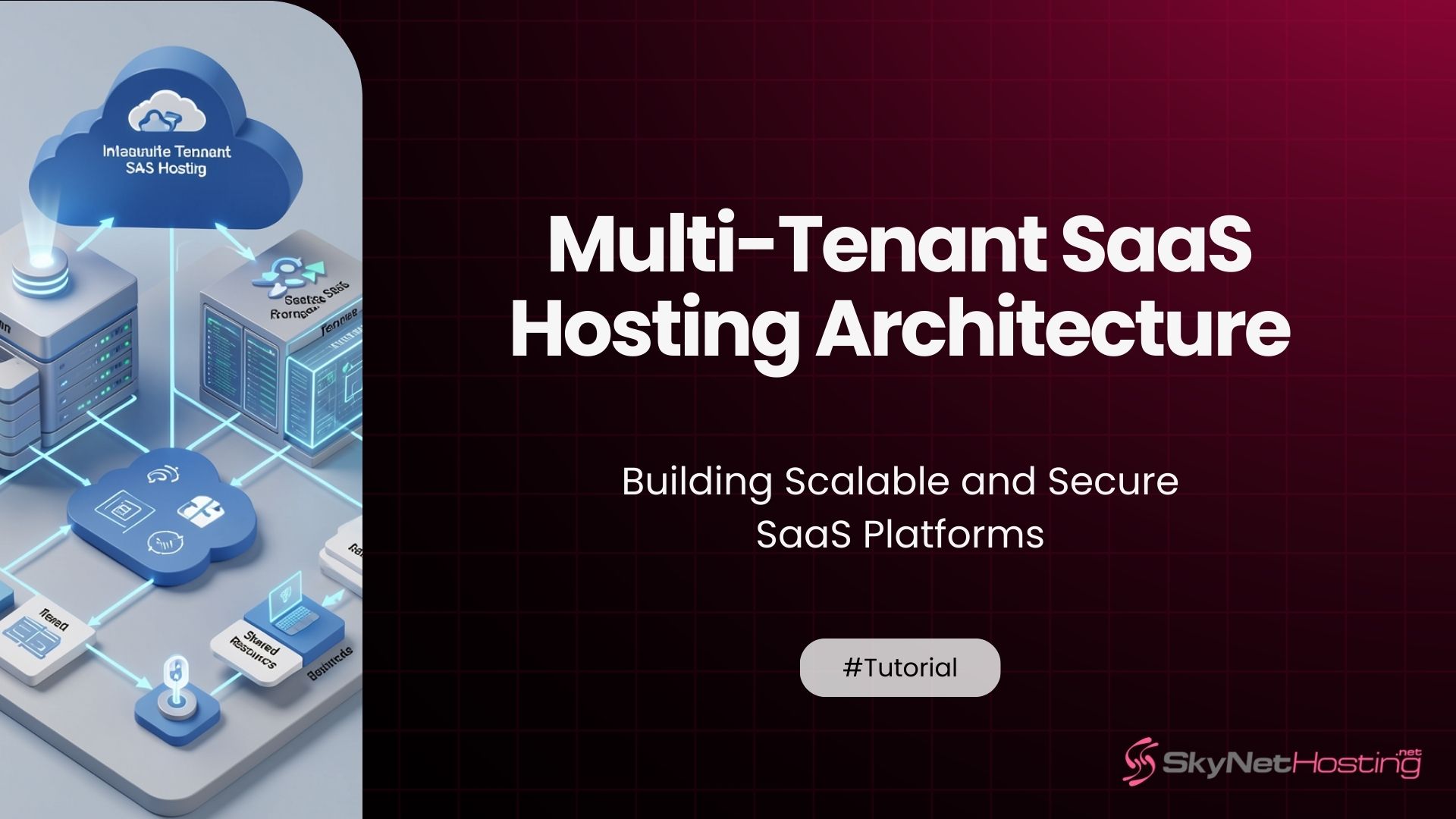
Multi-tenant SaaS hosting architecture is a software delivery model where a single application instance serves multiple customers — called tenants — simultaneously. Each tenant shares the same underlying infrastructure, codebase, and database environment, while their data remains logically separated and secure.
Think of it like an apartment building. Every resident shares the same structure, plumbing, and electrical grid. But each apartment has its own lock, its own space, and its own private life.
How Multiple Customers Share One Infrastructure
In a multi-tenant environment, compute resources, storage, networking, and application logic are all shared. Each incoming request is tagged with a tenant identifier, and the application routes data, permissions, and functionality accordingly. Tenants never see each other’s data — not because they’re physically separated, but because the architecture enforces strict logical boundaries at every layer.
Differences from Single-Tenant Models
Single-tenant architecture gives each customer their own dedicated instance of the application. It’s the equivalent of every resident owning their own separate house. This model offers natural isolation and deep customization, but it comes with a significant cost: higher infrastructure expenses, more complex maintenance, and slower onboarding.
| Aspect | Multi-Tenant | Single-Tenant |
|---|---|---|
| Cost per customer | Lower — shared resources | Higher — dedicated resources |
| Scalability | Scales across all tenants centrally | Requires per-tenant scaling |
| Maintenance | One update serves all tenants | Each instance updated separately |
| Data isolation | Logical separation | Physical separation |
| Customization | Limited per tenant | Highly customizable |
| Onboarding speed | Fast — add new tenant account | Slow — deploy new instance |
For most SaaS products, multi-tenancy is the only practical model for serving thousands of customers without an operations nightmare.
How Does Multi-Tenancy Work in SaaS Applications?
Shared Application Layer
Every user request in a multi-tenant SaaS platform is processed within a tenant context. Middleware tags each request with its owner — a tenant_id — and all business logic respects that boundary. Tenant A cannot read Tenant B’s records. This is enforced at the application layer before any data is ever retrieved.
Keeping application servers stateless is critical here. Tenant-specific state lives in the database or distributed cache, not in memory on a single server. This allows you to run multiple application instances behind a load balancer and scale horizontally as demand grows.
Database Design Approaches: Shared vs. Isolated Schemas
The database layer is where multi-tenancy gets technical — and where the most important architectural decisions are made. There are three primary patterns:
1. Shared Database, Shared Schema (Pool Model)
All tenants share the same database and tables. A tenant_id column on every record distinguishes whose data is whose. This is the most cost-efficient option and scales to thousands of tenants easily, but it requires disciplined implementation to prevent cross-tenant data access. Row-Level Security (RLS) in PostgreSQL can enforce tenant isolation at the database level, adding a critical safety net beneath your application logic.
2. Shared Database, Separate Schema (Bridge Model)
Each tenant has their own schema within a shared database instance. This provides stronger logical separation without multiplying infrastructure costs. It works well for platforms serving 10 to 500 tenants who need some customization but share a core data model.
3. Separate Database per Tenant (Silo Model)
Each tenant gets their own dedicated database instance. This delivers maximum data isolation and is the right choice for enterprise customers with strict compliance requirements — HIPAA, PCI-DSS, or GDPR. The trade-off is significantly higher operational overhead and cost, making it impractical for platforms serving thousands of small tenants.
Logical Data Separation Techniques
Beyond schema design, logical separation relies on consistent enforcement across every query, API call, and integration. Composite database indexes — with tenant_id placed first — ensure query performance doesn’t degrade as data volumes grow. Connection pooling tools reduce overhead when many tenants are active simultaneously. And automated tests that attempt cross-tenant data access are an essential part of any QA process.
What Are the Advantages of Multi-Tenant Architecture?
Cost Efficiency Through Shared Resources
Because all tenants share base infrastructure, the per-customer cost is significantly lower than maintaining separate stacks. Resources scale based on actual collective load. When tenants are inactive, infrastructure costs drop accordingly. This dynamic resource allocation is what makes SaaS pricing models economically viable at scale.
Easier Updates and Centralized Maintenance
One codebase. One deployment. One security patch that protects every tenant at once. Multi-tenancy eliminates the need to push updates to dozens of isolated instances, saving engineering time and ensuring consistency across your customer base. Your team can focus on building features — not managing infrastructure fragmentation.
Faster Scalability for Growing User Bases
A new tenant is simply a new account in your system. There are no servers to provision, no instances to configure, no deployment pipelines to trigger. A customer can sign up and be productive almost immediately. As your user base grows from 10 to 10,000, your architecture scales out — not up — through centralized resource management.
What Security Measures Are Required for Tenant Isolation?
Security in a multi-tenant environment is non-negotiable. A single lapse in isolation logic can expose one tenant’s data to another — an outcome that damages trust, triggers compliance violations, and can end a SaaS business.
Role-Based Access Control
Every authorization decision should answer: “Does this user belong to this tenant, and are they permitted to perform this action in that tenant’s context?” Role-based access control (RBAC) structures this clearly. Each tenant is treated as an organization, with users assigned roles within that organization. This model speeds security reviews, simplifies audits, and reduces legal risk.
Encryption at Rest and in Transit
Encryption is a baseline requirement, not a differentiator. All data at rest should be encrypted using strong key management. Data in transit must be protected via enforced SSL/TLS connections. For platforms serving enterprise tenants, customer-managed encryption keys — one per tenant — provide an additional layer of demonstrable isolation.
Preventing Cross-Tenant Data Exposure
A defense-in-depth strategy addresses this at multiple layers simultaneously:
- Database level: Row-Level Security policies that enforce tenant filtering at the query layer
- Application level: Middleware that validates tenant context on every request
- API level: JWT claims validation ensuring tokens cannot be used across tenant boundaries
- Testing level: Automated test suites that actively attempt cross-tenant access
- Monitoring level: Alerts that fire when queries return cross-tenant data patterns
Audit logging is equally critical. Knowing who did what, in which tenant context, and when is essential for compliance and incident response.
How Does Multi-Tenant Architecture Improve Scalability?
Horizontal Scaling with Load Balancers
Stateless application servers can be replicated and distributed behind a load balancer. When traffic increases, you spin up more instances. When it drops, you scale back. No single server becomes a bottleneck — tenant load is spread across your entire compute fleet.
Auto-Scaling Cloud Environments
Cloud environments with auto-scaling capabilities adjust compute capacity in real time based on demand. For SaaS platforms with variable or unpredictable workloads, this means you’re never over-provisioned during quiet periods or under-powered during traffic spikes. Resources align with actual tenant activity, not worst-case projections.
Efficient Resource Utilization
Multi-tenancy allows you to pack more value into each infrastructure dollar. Compute, memory, and storage are shared across your entire tenant base. Caching layers — like Redis with tenant-aware keys — reduce database load on frequently accessed data. Sharding strategies distribute tenants across database clusters as data volumes grow, preventing any single database from becoming a performance ceiling.
What Are the Performance Challenges in Multi-Tenant Hosting?
Resource Contention Between Tenants
The “noisy neighbor” effect is the defining performance challenge in multi-tenancy. If one tenant generates a traffic spike or runs a resource-intensive operation, it can degrade performance for others sharing the same infrastructure. Good architecture limits this through resource quotas, throttling, and monitoring — but the risk never disappears entirely in a fully shared environment.
Database Bottlenecks
As tenant count and data volumes grow, shared databases become performance-sensitive. Missing a tenant_id index, failing to use query optimization tools like EXPLAIN ANALYZE, or neglecting connection pooling can turn a fast query into a slow one that affects every tenant on the platform. Composite indexes, partial indexes, and regular maintenance tasks like VACUUM ANALYZE keep performance consistent.
Monitoring and Performance Optimization
Visibility into per-tenant performance is the only way to catch problems before customers report them. Effective monitoring tracks usage, errors, and response times at the tenant level — not just the system level. When Tenant A’s queries are degrading, you need to know that before Tenant B calls your support line.
When Should You Choose Multi-Tenant Over Single-Tenant?
SaaS Startups with Rapid Growth Goals
If you’re building a product that needs to onboard customers quickly and scale without proportional infrastructure cost increases, multi-tenancy is the right model. It lets you grow from 10 to 10,000 customers without re-architecting your platform.
Platforms Serving SMB Customers
Small and mid-sized business customers rarely require the strict compliance isolation that enterprises demand. A shared or schema-based multi-tenant model serves their needs efficiently and affordably — which translates directly into competitive pricing.
Cost-Sensitive Subscription-Based Models
Monthly recurring revenue models depend on healthy unit economics. Single-tenant infrastructure erodes margins at scale. Multi-tenancy preserves them by spreading fixed infrastructure costs across a growing tenant base.
How Does SkyNetHosting.Net Inc. Support Multi-Tenant SaaS Platforms?
High-Performance Cloud Infrastructure for Shared Workloads
SkyNetHosting.Net Inc. operates across 25 data centers worldwide, providing the geographic distribution that multi-tenant SaaS platforms need to serve tenants with low latency. Support tickets receive an initial response within 60 minutes — with most resolved in under 15 minutes — ensuring that infrastructure issues are addressed before they become customer-facing problems.
Scalable Environments with Reliable Uptime
SkyNetHosting.Net backs its infrastructure with a 99.9% Uptime SLA, defined as no more than 45 minutes of unscheduled service outage per calendar month. For every additional 45 minutes of downtime beyond that threshold, customers receive a 10% credit. This SLA accountability matters for SaaS platforms where uptime directly affects customer trust and subscription retention.
Daily and weekly automated backups cover every hosted account, adding a recovery layer beneath your application’s own data protection strategy.
Flexible Hosting Solutions Tailored to SaaS Growth
From shared cloud environments for early-stage SaaS products to VPS and dedicated server configurations for platforms requiring dedicated resources, SkyNetHosting.Net offers hosting infrastructure that can evolve as your tenant base grows. A 30-day free trial allows SaaS teams to validate their hosting environment before committing — a meaningful risk reduction when you’re making foundational architecture decisions.
How Do You Design a Future-Proof Multi-Tenant SaaS Infrastructure?
Planning for Horizontal Scaling
Build stateless application servers from day one. Every tenant-specific state belongs in the database or a distributed cache — never in server memory. This single architectural decision makes horizontal scaling possible without refactoring. Know your sharding strategy before you need it: hash-based, range-based, or geography-based distribution each has trade-offs worth understanding early.
Building Redundancy and Failover Systems
In a pooled environment, an outage affects every tenant simultaneously. The blast radius is larger than in a silo model, which makes resilience planning more critical, not less. Multi-AZ deployments, read replicas, connection pooling with automatic failover, and tested disaster recovery procedures are the infrastructure foundations that turn an outage from a catastrophe into an inconvenience.
Choosing Hosting That Adapts as Your SaaS Expands
Your hosting provider is a long-term infrastructure partner. The right choice supports your architecture today — shared resources for cost efficiency at early scale — and provides upgrade paths as your tenant base and compliance requirements evolve. Starting on infrastructure that can’t grow with you means a forced migration during your platform’s most critical growth phase.
Build Once. Scale Confidently.
Multi-tenant SaaS hosting architecture is the structural foundation that separates platforms that scale from platforms that stall. Cost efficiency, centralized maintenance, and fast onboarding make it the dominant model for SaaS products built for growth.
Security and performance planning can’t be retrofitted after launch. Tenant isolation, encryption, role-based access control, and per-tenant monitoring need to be built into the architecture from the first line of code. The patterns exist — pool, bridge, silo, and hybrid combinations — and choosing the right one for your tenant profile determines how cleanly your platform scales.
The right hosting infrastructure makes this entire architecture possible. SkyNetHosting.Net Inc.’s global data center footprint, backed SLA commitments, and flexible cloud, VPS, and dedicated server configurations provide the foundation your SaaS platform needs to scale — without the risk of building on infrastructure that can’t keep pace.
Your platform’s growth depends on the decisions you make before your first thousand customers arrive. Make them well.
FAQs
What defines multi-tenant SaaS architecture?
Multi-tenant SaaS runs single application code serving thousands of customers on shared infrastructure while isolating data via tenant identifiers or schemas. This maximizes resource efficiency, enables centralized updates, and scales economically compared to single-tenant deployments.
How does pooled database model work?
Pooled architecture stores all tenant data in one database using tenant_id column on every table row with row-level security preventing cross-access. PostgreSQL RLS enforces isolation automatically while minimizing infrastructure costs for platforms serving thousands of customers efficiently.
When choose bridge model with schemas?
Bridge model creates separate database schemas per tenant within shared database instance, balancing cost and isolation for 10-500 customer platforms. Each tenant gets logical separation with shared compute resources, ideal for moderate customization needs without full siloing expenses.
Why use silo model despite higher costs?
Silo dedicates complete database servers per tenant ensuring maximum isolation for PCI, HIPAA, SOC2 compliance requirements. Though expensive, it eliminates shared resource risks entirely, providing enterprise-grade security and customization critical for regulated industries serving high-value customers.
What components ensure scalability?
Application load balancers distribute traffic evenly across auto-scaling container groups while CDN caches static content globally. Kubernetes orchestrates microservices independently while message queues like Amazon SQS handle asynchronous tasks reliably across all tenants seamlessly.
How to monitor performance across tenants?
Centralized monitoring via Prometheus/Grafana tracks latency, errors, resource usage per tenant with alerting thresholds. Automated billing through Stripe ties usage metrics to invoices while audit logs maintain compliance through comprehensive activity tracking for every customer individually.