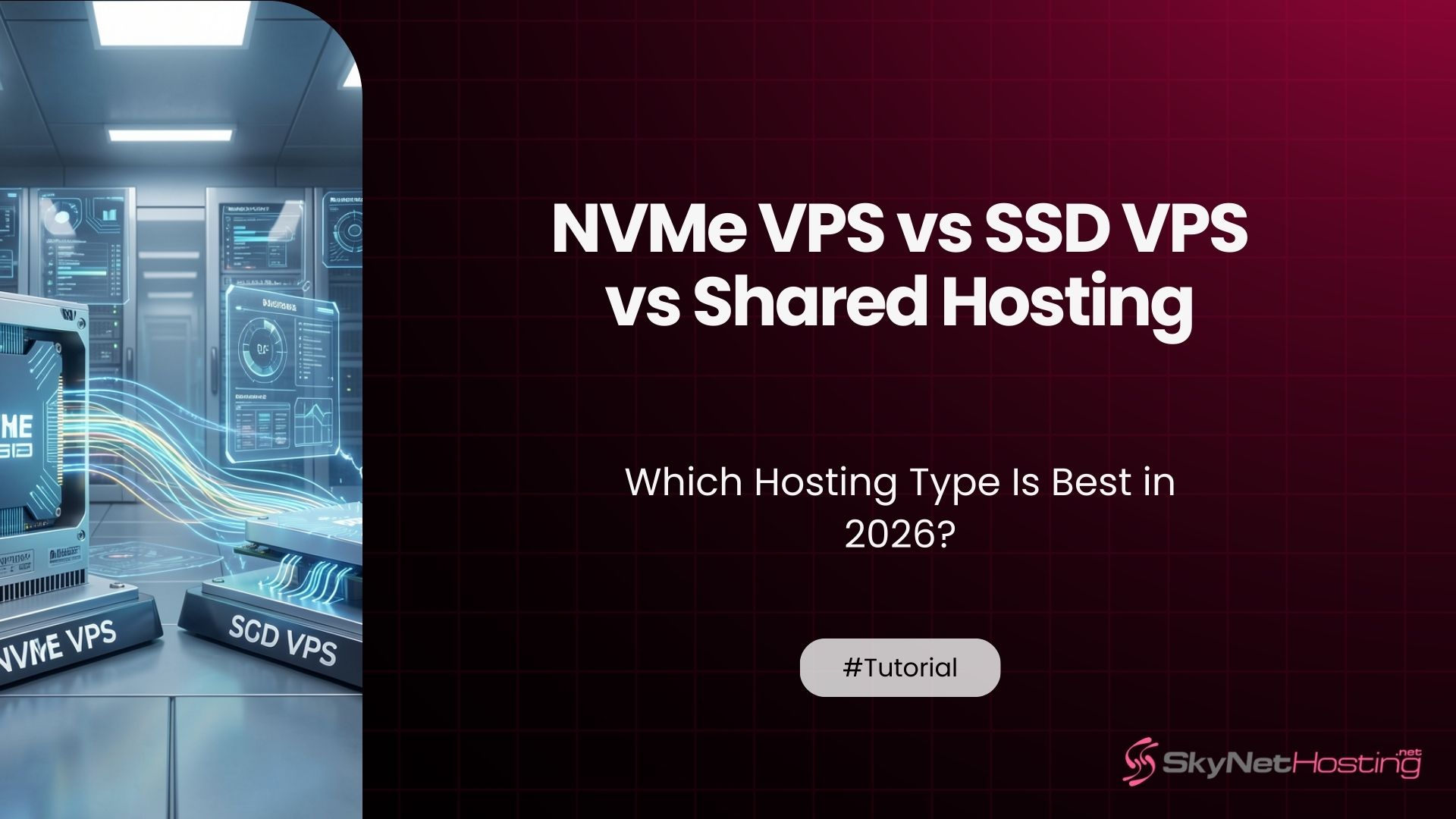
NVMe VPS vs SSD VPS vs Shared Hosting: Which Is Best in 2026?
You’ve probably noticed your website getting slower. Pages take longer to load. Traffic spikes send everything to a crawl. Maybe you’re seeing more downtime than you’d like.
Most of the time, the problem isn’t your website. It’s your hosting.
After working in web hosting infrastructure for over a decade, I’ve seen this pattern hundreds of times. Business owners and developers stay on the wrong hosting plan for too long—and it quietly costs them traffic, conversions, and rankings.
This guide breaks down the three most common hosting types in 2026: shared hosting, SSD VPS, and NVMe VPS. I’ll explain how each one works, where each one shines, and—most importantly—which one is right for you.
No jargon. No fluff. Just a clear, honest comparison.
What Is Shared Hosting?
Shared hosting is where most websites start. It’s affordable, easy to set up, and managed entirely by the hosting provider.
How shared hosting environments work
Think of shared hosting like renting a room in a large house. Many tenants live under the same roof. You each have your own space, but you share the kitchen, the Wi-Fi, and the water heater.
On a shared hosting server, hundreds—sometimes thousands—of websites sit on the same physical machine. They all draw from the same pool of CPU, RAM, and storage.
The hosting provider manages everything on the backend. You just upload your site and focus on your content.
Resource sharing among multiple websites
This is where things can go sideways.
If one website on your shared server gets a sudden traffic spike, it pulls extra resources from that shared pool. Your site slows down—even though nothing happened on your end.
This is called the “noisy neighbor” effect. You have no control over it. And if your own site grows and starts consuming more resources, the provider may throttle your account.
Advantages and limitations of shared hosting
Shared hosting has real advantages:
- Low cost — Plans often start at a few dollars a month
- Zero maintenance — The provider handles server updates, security, and backups
- Beginner-friendly — No technical knowledge required
But the limitations matter:
- Performance fluctuates based on what neighbors are doing
- Limited control over server settings
- Difficult to scale when traffic grows
- Security risks if a neighboring site is compromised
For a personal blog or a simple small business website, shared hosting is perfectly fine. But the moment your traffic starts growing or your site becomes business-critical, you’ll feel the ceiling.
If you’re wondering whether shared hosting is still the right fit, our guide on the top 7 questions to ask before choosing a shared hosting provider walks through exactly what to look for.
What Is SSD VPS Hosting?
A VPS—Virtual Private Server—is a significant step up from shared hosting. And when that VPS runs on SSD storage, the performance difference is immediately noticeable.
Understanding virtual private servers
A VPS uses virtualization software (called a hypervisor) to divide one powerful physical server into multiple isolated virtual machines. Each virtual machine acts like its own independent server.
You get your own dedicated slice of CPU, RAM, and storage. Your performance is no longer affected by what your neighbors do.
It’s like upgrading from that shared house to your own apartment. Same building, but your kitchen, bathroom, and utilities are yours alone.
Benefits of SSD storage for websites
Traditional hard drives use spinning mechanical disks to read and write data. SSDs (Solid State Drives) have no moving parts. They use flash memory instead.
The result? SSDs are dramatically faster at accessing data. Database queries return quicker. Pages load faster. Admin dashboards respond instantly.
For most WordPress sites, WooCommerce stores, and business applications, an SSD VPS delivers a substantial performance boost over shared hosting.
Performance improvements over shared hosting
The difference is significant. According to data cited in SkyNetHosting’s is VPS hosting worth it in 2025 analysis, VPS-hosted sites can deliver up to 60% faster page loads compared to shared hosting environments.
That translates directly to lower bounce rates, higher conversions, and better SEO rankings.
What Is NVMe VPS Hosting?
NVMe VPS hosting takes everything good about SSD VPS and pushes it much further.
How NVMe storage technology works
NVMe stands for Non-Volatile Memory Express. It’s a storage protocol built specifically for flash-based storage.
Here’s the key difference: a standard SSD connects to the server through a SATA interface—a legacy connection originally designed for slow spinning hard drives. NVMe drives bypass that bottleneck entirely. They connect directly to the motherboard via PCIe lanes, communicating straight with the CPU.
Less distance to travel. Fewer queues. Much faster response.
Faster data transfer through PCIe interfaces
The numbers here are striking.
According to benchmarks from WeHaveServers.com testing enterprise-grade drives in 2025:
- A standard SATA SSD delivers sequential read speeds around 540 MB/s and handles roughly 98,000 random read IOPS
- An NVMe SSD (PCIe 4.0) reaches 7,050 MB/s sequential reads and over 1,200,000 random read IOPS
- Read latency on SATA SSDs sits between 100–300 microseconds; NVMe drives respond in under 20 microseconds
That’s roughly 10x faster throughput and 10–12x better IOPS and latency. The gap is especially dramatic in random I/O workloads—exactly the kind your database generates with every page request.
Atlantic.Net’s dedicated hosting analysis confirms this pattern: “NVMe drives respond in under 20 microseconds, while SATA SSDs usually take 50–150 microseconds.”
Why NVMe is becoming the new hosting standard
These performance gains have direct, real-world consequences for websites. Databases respond faster. WordPress admin panels feel snappier. Checkout flows complete without delay.
For sites running WooCommerce, membership platforms, API-driven apps, or high-traffic blogs, NVMe storage reduces the storage bottleneck to near zero. It’s why providers like SkyNetHosting.net have made NVMe their standard for VPS infrastructure.
Our deep dive on NVMe web hosting with cPanel covers the practical benefits in detail, including how it affects page load times, security scans, and backup operations.
NVMe VPS vs SSD VPS: What’s the Performance Difference?
Both store data on flash memory. But the interface between the drive and the CPU makes an enormous difference.
Storage architecture comparison
| Feature | SATA SSD | NVMe SSD (PCIe 4.0) |
|---|---|---|
| Sequential Read | ~540 MB/s | ~7,050 MB/s |
| Random Read IOPS | ~98,000 | ~1,200,000 |
| Read Latency | 100–300 μs | Under 20 μs |
| Interface | SATA III (legacy) | PCIe (native) |
The SATA interface was designed for spinning hard drives decades ago. NVMe was built from the ground up for flash storage. That architectural difference explains the performance gap.
Latency and I/O performance improvements
Latency is the metric that matters most for interactive workloads—database queries, API calls, search requests, checkout operations.
A 10–15x reduction in read latency means your database can serve far more simultaneous queries without queuing. For an eCommerce store processing orders during a flash sale, that difference is the gap between a smooth checkout and a timeout error.
Real-world application performance impact
In practical terms, switching from SSD VPS to NVMe VPS has the biggest impact on:
- Database-heavy sites — WordPress with large databases, WooCommerce, Magento
- High-concurrency apps — SaaS platforms serving many users simultaneously
- API-driven applications — Where each request triggers multiple database reads
- File-intensive workloads — Media platforms, large downloads, backup operations
For a simple static site or a low-traffic blog, the difference between SSD and NVMe is less noticeable. But for anything with real database activity and growing traffic, NVMe wins.
Shared Hosting vs VPS Hosting: Key Differences
This is the most important comparison for anyone currently on shared hosting.
Resource allocation and isolation
On shared hosting, resources are pooled. Everyone gets a slice, but no one owns their slice. On a VPS—whether SSD or NVMe—your CPU, RAM, and storage are dedicated to you.
One site having a traffic spike doesn’t touch your resources. Your neighbor installing a broken plugin doesn’t slow your database. That isolation is the foundation of everything else.
Security and reliability differences
In a shared environment, you share more than resources. Security risks travel across the same infrastructure. If one site on the server is compromised, the entire server can be exposed.
A VPS isolates your environment completely. You control your own firewall, your own security settings, and your own software stack. As SkyNetHosting’s analysis puts it, VPS hosting “significantly reduces cross-site contamination.”
Scalability and traffic handling
Shared hosting has a hard ceiling. When you hit it, your only options are to stay and suffer or migrate to a different plan.
A VPS scales with you. Need more RAM? Add it. Traffic growing? Upgrade your CPU cores. With SkyNetHosting’s infrastructure, those upgrades happen without migrating your data or taking your site offline. Our guide on why VPS hosting matters covers the scalability advantages in practical detail.
Which Hosting Option Is Best for Different Websites?
There’s no single right answer. The best hosting type depends on your website’s size, traffic, and technical requirements.
Shared hosting for beginners and small websites
Shared hosting is the right starting point if:
- You’re launching a personal blog, portfolio, or small business brochure site
- You’re learning web development and need a low-stakes environment
- Your traffic is low and predictable
- Budget is a primary concern
It handles the basics reliably. SkyNetHosting’s shared hosting plans, for example, now include NVMe storage even at the entry level—meaning even shared environments perform better than they used to.
SSD VPS for growing businesses
An SSD VPS makes sense when:
- Your traffic is growing and shared hosting is starting to slow you down
- You need more control over your server environment
- You’re running a WordPress site with multiple plugins or a small WooCommerce store
- You need root access to install custom software
The jump from shared hosting to SSD VPS is one of the most impactful upgrades a growing site can make. You eliminate resource contention and gain a stable, predictable performance baseline. Our post on cheap VPS web hosting shows that VPS doesn’t have to break the budget—plans start well under $10/month.
NVMe VPS for high-performance applications
NVMe VPS is the right choice when:
- You’re running a high-traffic eCommerce store where checkout speed directly affects revenue
- Your application makes heavy use of the database—queries running constantly, thousands of reads per second
- You’re building a SaaS product that needs to serve many concurrent users reliably
- You run a content-heavy platform where storage I/O is a constant factor
For these use cases, the performance gap between SSD and NVMe is real and measurable. Faster storage means faster queries, faster pages, and better user experiences.
When Should You Upgrade from Shared Hosting to VPS?
Most people wait too long. By the time they upgrade, their site has already been losing traffic and conversions for months.
Signs your website has outgrown shared hosting
Watch for these signals:
- Page load times are consistently above 2–3 seconds
- Your hosting provider has warned you about resource usage
- You’re hitting database connection limits
- You’ve needed to install custom software or modify server settings, but can’t
- Your site crashes or slows down when traffic spikes
Any one of these is a strong signal. If you’re seeing several of them, the upgrade is overdue.
Traffic spikes and resource limitations
Seasonal traffic—holiday shopping, viral content, a popular promotion—is where shared hosting fails most visibly. The shared resource pool gets depleted, and your site joins the queue.
A VPS handles spikes differently. Your dedicated resources are yours regardless of what’s happening elsewhere on the physical server. Our is VPS hosting worth it in 2025 breakdown shows VPS-hosted eCommerce sites experience significantly less downtime during peak periods compared to shared environments.
Performance improvements after upgrading
The improvements are typically immediate and significant. Faster page loads. Stable uptime. No more “database connection” errors during busy periods.
For context, our guide on how to choose the right VPS plan recommends starting with 2–4 vCPUs, 4GB RAM, and NVMe storage for most growing WordPress or WooCommerce sites.
How Does SkyNetHosting.Net Provide High-Performance VPS Hosting?
Not all VPS providers are built equally. The hardware, network, and support structure behind your hosting matters as much as the plan itself.
Modern NVMe-powered infrastructure
SkyNetHosting.net uses NVMe storage across its VPS infrastructure, running on latest-generation Intel Dual Xeon CPUs. This combination—fast processors paired with ultra-low-latency storage—eliminates the two most common performance bottlenecks for web applications.
Every VPS plan includes dedicated CPU and RAM allocation. Your resources are yours. No resource pooling, no noisy neighbors.
Reliable VPS environments with dedicated resources
SkyNetHosting backs its infrastructure with a 99.9% uptime SLA and 24/7 human support—not automated bots. When something goes wrong at 3 AM, you’re talking to a real server technician.
For agencies and resellers, their VPS plans include a free WHMCS license (saving approximately $20/month), white-label hosting capabilities, and access to 25+ global data center locations. That global footprint means you can deploy your server physically close to your target audience, directly reducing latency. As our best VPS hosting providers in 2026 guide notes, “If your customers are in London but your server is in Los Angeles, there is going to be a delay.”
Scalable hosting solutions for growing businesses
SkyNetHosting’s VPS architecture is built for growth. Upgrading your plan—adding RAM, more CPU cores, or additional storage—requires no data migration and minimal downtime. You scale your resources as your traffic grows, paying for what you need when you need it.
For those comparing the full hosting ladder, our VPS vs dedicated hosting comparison shows where VPS ends and dedicated infrastructure begins, helping you plan your growth path.
How to Choose the Right Hosting Plan in 2026
The best hosting plan is the one that matches your current needs while giving you room to grow.
Evaluating performance needs
Start with your site type and traffic:
- Personal blog or portfolio — Shared hosting with SSD or NVMe storage is plenty
- Small business site with a contact form — Shared or entry-level SSD VPS
- Growing eCommerce or content site — SSD VPS, 4GB RAM minimum
- High-traffic app or WooCommerce store — NVMe VPS, 4+ vCPUs, 8GB+ RAM
- SaaS application with heavy database usage — NVMe VPS, dedicated CPU cores
If you need a more granular breakdown, our complete guide to choosing the right VPS plan in 2026 walks through every spec in plain English.
Balancing cost and scalability
Shared hosting is the cheapest option upfront, but the cost of poor performance—lost traffic, lower conversions, frustrated users—adds up quickly.
A quality NVMe VPS starts at a competitive price point and delivers infrastructure that won’t limit your growth. When evaluating cost, factor in the renewal rate, not just the introductory offer. Some providers triple their price after the first year.
SkyNetHosting offers transparent pricing across plans. There are no surprise renewal traps, and essentials like backups and DDoS protection are included—not sold as add-ons.
Our shared vs reseller hosting comparison is worth reading if you manage multiple client websites and are evaluating whether reseller hosting makes more financial sense than individual VPS plans.
Selecting a hosting provider with modern infrastructure
Your hosting provider is, in effect, your infrastructure partner. Look for:
- NVMe storage as standard, not a premium upgrade
- Dedicated CPU and RAM on VPS plans (not shared pools)
- Multiple global data center locations to minimize latency for your audience
- 24/7 human support with clear response-time SLAs
- Transparent pricing with visible renewal rates
- DDoS protection included in the base plan
The Right Hosting for the Right Stage
Shared hosting, SSD VPS, and NVMe VPS each serve a legitimate purpose. The key is matching your hosting infrastructure to where your website actually is—not where it was when you signed up.
Shared hosting is an excellent entry point. Low cost, zero maintenance, and perfectly capable for small, low-traffic sites. If you’re just starting out, there’s no reason to overpay.
SSD VPS is the right move when your site starts growing. Dedicated resources eliminate the noisy neighbor problem, give you full control over your environment, and deliver consistent, reliable performance.
NVMe VPS is where serious websites and applications belong. The storage performance difference—10x faster throughput, 10–12x better IOPS, latency under 20 microseconds—is measurable in real-world application speed, SEO performance, and user experience.
If you’re still on shared hosting and your site is generating revenue, the upgrade to NVMe VPS is likely the highest-ROI infrastructure decision you can make this year.