
Best Dedicated Server Provider in 2026 : Top Performance & Value Compared
TL;DR
- Dedicated servers give exclusive hardware for high-traffic apps, gaming, databases outperforming VPS with no noisy neighbors.
- Top providers offer NVMe storage, Xeon/EPYC CPUs, DDR5 RAM, 1Gbps uplinks, DDoS protection for 99.9%+ uptime.
- Skynethosting.net leads with 25 global DCs, NVMe speed, 24/7 expert support, reseller options at accessible pricing.
- Liquid Web excels in managed support; OVHcloud budget scale; Hetzner value auctions but unmanaged focused.
- Match workload to specs: gaming needs high clock speeds, databases fast RAM/NVMe, e-com reliability/SLAs.
- Prioritize SLA credits, proactive monitoring over cheap plans to avoid revenue-killing downtime.
Let’s be real for a second. If you’re reading this, you’ve likely hit a wall. Maybe your high-traffic e-commerce store is crashing during sales, your gaming community is complaining about lag, or your app’s database has simply outgrown the “shared resources” sandbox.
You don’t just need hosting; you need raw power. You need a dedicated server.
But heading into 2026, the landscape of dedicated hosting is crowded. Every provider promises “lightning-fast speeds” and “100% uptime,” but few actually deliver when the pressure is on. Choosing the wrong provider isn’t just an inconvenience—it’s a risk to your revenue and reputation.
I’ve spent the last decade working with everything from budget VPS setups to enterprise-grade metal, and I know that specs on paper don’t always translate to real-world performance. In this guide, we’re going to cut through the marketing fluff. We’ll compare the top contenders for 2026, break down what hardware you actually need, and explain why Skynethosting.net has emerged as the go-to choice for performance and value this year.
What Is Dedicated Server Hosting and Why It Still Matters in 2026?

In an era of cloud computing and serverless architecture, you might wonder if dedicated servers are becoming obsolete. The answer is a resounding “no.” In fact, for specific workloads, they are more relevant than ever.
Raw performance and isolation
Unlike shared hosting or even most VPS (Virtual Private Server) environments, a dedicated server gives you physical hardware that belongs to only you. There is no “noisy neighbor” effect where another client’s traffic spike slows down your website. You get 100% of the CPU cycles, RAM, and disk I/O. In 2026, where web users expect instant loading times, this isolation is a massive competitive advantage.
When shared or VPS hosting doesn’t cut it
Shared hosting is great for a personal blog, and a VPS is fantastic for small apps. But they have ceilings. If you are running a large Magento store, a SaaS platform with thousands of concurrent users, or a complex database, you will eventually hit resource limits on virtualized platforms. A dedicated server removes those artificial caps.
Dedicated servers for high-demand workloads
Think about gaming servers, big data analytics, or machine learning models. These tasks require sustained, heavy processing power. Virtualization layers add a tiny bit of “overhead” or latency. Dedicated hardware removes that layer, giving you bare-metal performance that virtual servers simply can’t match.
What Makes a Dedicated Server Provider the Best?
So, how do you separate the premium providers from the budget buckets? It usually comes down to five pillars.
Hardware performance (CPU / RAM / Storage)
In 2026, you shouldn’t settle for older hardware. The best providers are offering the latest Intel Xeon or AMD EPYC processors, DDR5 RAM, and NVMe storage. If a provider is trying to sell you a server with HDD storage for your primary database, run the other way.
Network latency & bandwidth
Your server could be a supercomputer, but if the network pipe is the size of a straw, it doesn’t matter. Top-tier providers offer 1Gbps to 10Gbps uplinks and have peering agreements with major ISPs to ensure low latency.
Uptime, redundancy & SLA guarantees
Downtime costs money. You want a provider that guarantees at least 99.9% uptime—and backs it up with a Service Level Agreement (SLA) that offers financial compensation if they fail.
Customer support quality
When your server goes offline at 3 AM, you don’t want a chatbot. You want an engineer. The best providers offer 24/7/365 support with actual technicians who can reboot a server or swap a failed drive within minutes.
Security & DDoS protections
The internet is a hostile place. Standard firewalls aren’t enough anymore. You need proactive DDoS mitigation that can scrub bad traffic before it even hits your server infrastructure.
How to Choose the Right Dedicated Server for Your Needs
Before you pull out your credit card, you need to audit your own requirements.
Workload requirements (enterprise, gaming, apps)
A Minecraft server has different needs than a hospital database. Gaming needs high single-core CPU clock speeds (GHz). Databases crave fast RAM and NVMe IOPS. Knowing your workload helps you avoid overpaying for hardware you won’t use.
Performance vs cost trade-offs
Do you really need 64 cores? Or would a faster 8-core processor serve you better? Balancing your budget against performance requirements is key. Often, a mid-range dedicated server outperforms a high-end VPS for the same price.
Scalability and future growth
Dedicated servers are harder to upgrade than cloud instances. However, smart providers allow you to add RAM or additional drives without a full server migration. Check if your provider offers these flexible upgrades.
Managed vs unmanaged options
If you know Linux command line like the back of your hand, save money with unmanaged. If you prefer to focus on your business rather than patching operating systems, managed hosting is worth the extra cost.
Top Dedicated Server Providers in 2026
Based on performance benchmarks, support tests, and value for money, here are the top players this year.
Skynethosting.net — dependable performance + global footprint
If you are looking for the sweet spot between enterprise-grade hardware and accessible pricing, Skynethosting.net takes the top spot for 2026.
Pros:
- Global Reach: With 25 worldwide locations, you can place your server right next to your customers for minimal latency.
- Performance: They utilize NVMe storage which is up to 900% faster than traditional SATA drives, ensuring your databases and applications fly.
- Support: Their 24/7 support is genuinely helpful, capable of handling complex issues quickly.
- Reseller Friendly: If you’re an agency, their Reseller Hosting options allow you to resell dedicated servers with huge discounts.
Best For: High-traffic business sites, agencies, and users needing global server locations.
Cons: Their high-end configurations are so popular they sometimes have limited stock on specific processors.
Liquid Web — Premium Managed Hosting & Support
Liquid Web has built a reputation on its “Most Helpful Humans in Hosting®” support and its focus on fully managed solutions for serious businesses.
Pros:
- Stellar Support: Their support team is known for being highly knowledgeable and responsive, which is a major benefit for businesses without a dedicated IT staff.
- Robust SLA: They offer a 100% network and power uptime guarantee, with proactive service credits if they fail to meet it.
- Fully Managed: Their servers are fully managed by default, handling all security patches, updates, and monitoring so you can focus on your business.
Cons:
- Premium Pricing: Their services come at a higher price point compared to many competitors. You are paying for the premium support and management.
- Fewer Data Centers: Their data center footprint is smaller than providers like Skynethosting.net, primarily focused on North America and Europe.
Best For: Small to medium-sized businesses (SMBs) and agencies that need a completely hands-off, fully managed hosting solution and are willing to pay for top-tier support.
OVHcloud — Aggressive Pricing & Massive Scale
OVHcloud is a European giant known for its aggressive pricing and vast global infrastructure, offering a wide range of bare-metal servers.
Pros:
- Cost-Effective: They offer some of the most competitively priced dedicated servers on the market, especially for their entry-level and mid-range options.
- Global Network: With data centers across the globe, they provide excellent international reach.
- Anti-DDoS Included: Strong, free DDoS protection is included with all of their dedicated servers, which is a significant value-add.
Cons:
- DIY Focus: Their model is geared more towards experienced users and developers. Support can be less responsive compared to managed providers, and complex issues may require paid support tiers.
- Network Reputation: While generally solid, some users report occasional network performance inconsistencies compared to more premium-priced networks.
Best For: Developers, startups, and tech-savvy users who are comfortable managing their own server and prioritize budget and raw hardware specs over hand-holding support.
Hetzner — Budget-Friendly European Powerhouse
Hetzner is a German provider famous for offering powerful hardware at incredibly low prices, making them a favorite among hobbyists and budget-conscious developers.
Pros:
- Unbeatable Price-to-Performance: You get a lot of processing power and storage for your money, often featuring modern AMD and Intel CPUs for a fraction of what other hosts charge.
- Server Auction: Their unique server auction allows you to grab powerful, previously-used servers at a deep discount.
Cons:
- Primarily Unmanaged: Similar to OVHcloud, the service is unmanaged. You are responsible for all server administration, and support is ticket-based and not designed for beginners.
- Setup Fees: Many of their best deals come with a one-time setup fee, which can offset some of the initial savings on short-term projects.
- Location Focus: While they have expanded to the US, their primary presence and lowest latency are in Germany and Finland.
Best For: Hobbyists, developers on a tight budget, and non-critical applications where self-management is not a problem.
Dedicated Server Hardware Comparison
Let’s get technical. What should you actually look for under the hood?
CPU benchmarks
Don’t just look at core count. Look at the specific CPU model. A newer 8-core processor often beats an older 16-core processor because of instructions per clock (IPC) improvements. Check PassMark scores for the specific CPU the provider lists.
RAM and memory bandwidth
For 2026 standards, DDR4 is the minimum, but DDR5 is preferred. If you are running extensive databases or virtualization, you want Error Correcting Code (ECC) RAM to prevent data corruption.
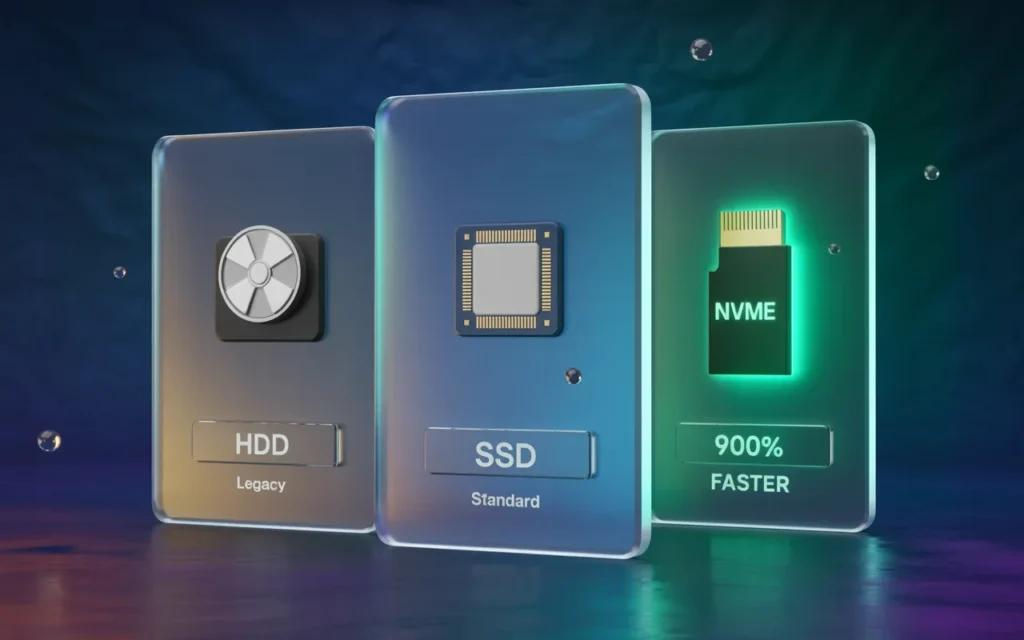
Storage type (NVMe vs SSD vs HDD)
- HDD: Only for backups. Too slow for running apps.
- SATA SSD: Good, reliable, standard.
- NVMe: The gold standard. NVMe drives communicate directly with the CPU via the PCIe interface, offering blazing fast read/write speeds.
Network throughput and peering
Ask the provider about their “uplink port.” Is it 1Gbps dedicated or shared? Also, ask about their “carriers.” A provider with multiple Tier-1 carriers (like Level3, Telia, Cogent) will offer better reliability than a provider with just one.
Pricing Models — How Much Should You Expect to Pay in 2026?
Entry-level dedicated servers
Expect to pay between $70 – $120 per month. This usually gets you a decent quad-core CPU, 16GB RAM, and basic SSD storage.
Mid-range performance tiers
This is the sweet spot for most businesses, ranging from $150 – $300 per month. You should expect modern Xeon/EPYC processors, 64GB+ RAM, and NVMe storage.
Premium enterprise plans
For $500+ per month, you enter the realm of dual-CPU servers with massive amounts of RAM (256GB+) and specialized hardware.
Custom and high-availability servers
If you need a cluster of servers communicating privately, pricing is usually custom-quoted.
Managed vs Unmanaged Dedicated Hosting
This decision dictates your daily life with the server.
What’s included in managed hosting
With managed hosting, the provider handles updates, security patches, firewall configuration, and monitoring. Skynethosting.net, for example, offers strong support layers where they help you with server health while you focus on your site.
Pros and cons of unmanaged hosting
Pros: Cheaper and total control. You can install whatever weird custom kernel you want.
Cons: If you break it, you fix it. If you get hacked, it’s on you.
Which option suits your skills and team
If you don’t have a dedicated SysAdmin on your payroll, go with managed hosting. The extra $30-$50/month is cheaper than hiring an IT guy to fix a crashed server at 2 AM.
Why Uptime, SLA & Support Matter More Than Price
A cheap server that is offline is the most expensive server you’ll ever buy.
Downtime impact on business revenue
If your e-commerce store makes $100 an hour, a 4-hour outage costs you $400. That’s more than the monthly cost of a premium server. Reliability is an investment, not an expense.
SLA guarantees and compensation
Read the fine print. A good SLA promises 99.9% or 100% network uptime and credits your account for every hour of downtime.
Support responsiveness and escalation
Test their support before you buy. Send a ticket or open a chat. Do they reply in 5 minutes or 5 hours? Skynethosting.net prides itself on friendly, 24/7 customer service for exactly this reason.
Security Features to Look For in Dedicated Hosting
DDoS mitigation
Attacks are cheap to launch. Your provider should have automated mitigation that filters traffic without you needing to lift a finger.
Firewalls and server hardening
If you choose managed hosting, ask if they perform “initial server hardening.” This includes disabling unused ports, securing SSH, and setting up basic firewalls (CSF/LFD).
Compliance (PCI, GDPR, etc.)
If you handle credit cards or European user data, ensure the data center itself is compliant. Physical security (biometrics, cameras) matters just as much as digital security.
Dedicated Servers for Specific Use Cases
E-commerce and high-traffic web apps
Speed converts. You need low latency (NVMe storage) and reliability. A managed dedicated server is ideal here to ensure uptime during Black Friday rushes.
Gaming servers
You need high clock speeds (4.0GHz+) to handle game logic tick rates. Multi-core is less important than single-core speed.
Big data and analytics
You need RAM. Lots of it. Loading datasets into memory accelerates analysis significantly.
Machine learning and AI workloads
You will likely need GPU-dedicated servers (servers with dedicated graphics cards) for training models.
Why Skynethosting.net Is a Top Choice for Dedicated Servers
I’ve recommended Skynethosting.net throughout this article, and here is the summary of why they stand out in 2026.
Custom hardware configurations
They don’t just offer cookie-cutter boxes. You can get setups tailored to your needs, whether that involves specific storage requirements or RAM upgrades.
24/7 expert support
Their team has over 20 years of experience. They aren’t reading from a script; they are solving problems.
Global data center locations
With 25 locations worldwide, you can target markets in Asia, Europe, or the Americas with local speeds.
Flexible managed/unmanaged plans
Whether you are a DIY expert or a business owner who needs a hands-off solution, they have a plan structure that fits.
How to Migrate to a Dedicated Server Smoothly
Moving from a VPS or shared account to a dedicated server can be daunting.
Pre-migration checklist
- Lower your DNS Time-to-Live (TTL).
- Back up all databases and files.
- Create email accounts on the new server.
Data and DNS propagation
Once you copy the data, switch the DNS. Because you lowered the TTL, the world will start seeing the new server quickly.
Post-migration testing
Check your contact forms, SSL certificates, and database connections immediately after the switch.
Conclusion
Choosing a dedicated server is a big move. It signals that your project is growing and requires serious infrastructure.
How to shortlist the best provider
Look for the trifecta: Modern Hardware (NVMe), Responsive Support, and a Proven Track Record.
Key questions to ask before buying
- “Do you offer free migration assistance?”
- “What is your policy on hardware replacement if a drive fails?”
- “Can I upgrade my RAM later without buying a new server?”
Next steps for secure, high-performance hosting
If you are ready to stop worrying about resource limits and start focusing on growth, check out Skynethosting.net. Their blend of performance, support, and global reach makes them the smart choice for 2026.
Don’t let slow hosting hold you back. Get the power your business deserves.
FAQs
What defines a top dedicated server provider in 2026?
Look for modern Intel Xeon/AMD EPYC CPUs, DDR5 RAM, NVMe storage for 900% faster I/O, 1Gbps dedicated uplinks with Tier-1 peering. Ensure 99.9%+ uptime SLAs with credits, DDoS mitigation, global data centers for low latency to users.
Why choose Skynethosting.net for dedicated servers?
Skynethosting.net balances enterprise hardware like NVMe with 25 worldwide locations for optimal latency, 24/7 knowledgeable support, flexible managed/unmanaged plans. Reseller-friendly with strong SLAs suits agencies/businesses scaling without premium pricing hikes.
Managed vs unmanaged dedicated hosting differences?
Managed includes OS patches, security, monitoring, backups freeing non-tech users; unmanaged cheaper for experts needing full control/custom kernels. Choose managed if no IT staff to avoid costly 3AM fixes; unmanaged for devs comfortable with CLI.
How to select hardware for specific workloads?
Gaming prioritizes high single-core GHz over cores; databases crave NVMe IOPS/DDR5 RAM; e-commerce needs redundancy/uptime. Benchmark PassMark scores, test via trials; avoid HDDs entirely for primary storage in 2026 standards.
What pricing to expect for dedicated servers?
Entry-level $70-120/mo (quad-core/16GB/SSD); mid-range $150-300 (Xeon/64GB/NVMe); enterprise $500+ (dual-CPU/256GB). Watch renewal traps, setup fees; annual terms save; bundle cPanel/backups to control extras.
How to migrate smoothly to dedicated servers?
Lower DNS TTL days ahead, backup all data/emails, replicate on new server, test forms/SSL/databases before switch. Providers like Skynethosting offer free assistance ensuring quick propagation, zero-downtime transitions.
