
Best NVMe VPS Hosting Providers in 2026: Top Picks for Performance, Reliability & Value
TL;DR
- NVMe VPS connects storage via PCIe for 10-20μs latency and massive IOPS, transforming database/eCommerce performance over slow SATA SSDs.
- Ideal for WordPress/WooCommerce, SaaS, agencies needing sub-second loads to meet Core Web Vitals and cut bounce rates.
- SkyNetHosting tops lists with true enterprise NVMe, LiteSpeed servers, 25 global DCs, free migrations, and 20+ years reliability.
- Vultr suits devs with API scaling and hourly billing but requires self-management; strong for cloud-native apps.
- Contabo offers high specs cheap for storage-heavy tasks; Hostinger excels for beginners with easy panels and backups.
- Evaluate via IOPS, CPU/RAM, uptime SLAs, support quality, and scalability—test before committing long-term.
I’ve spent over a decade evaluating hosting infrastructure. And if there’s one pattern I keep seeing, it’s this: the biggest performance gains don’t come from upgrading your code or CDN. They come from what’s sitting underneath your server — your storage.
NVMe VPS hosting has quietly become the most important decision you can make for your website’s speed in 2026. Not “nice to have.” Not a premium upgrade. A genuine necessity if you want your site to compete.
This guide walks you through what NVMe VPS hosting actually means, which providers deliver it well, and how to pick the right one for your specific needs. I’ve kept it direct, honest, and practical.
What Is NVMe VPS Hosting and Why It Matters in 2026?
Let’s start simple. VPS stands for Virtual Private Server. You get a dedicated slice of a powerful physical machine — your own CPU, RAM, and storage — without the cost of renting an entire dedicated server.
NVMe stands for Non-Volatile Memory Express. It’s a storage protocol that connects directly to your server’s motherboard via PCIe lanes, bypassing the slower communication pathways that traditional SATA SSDs use.
The result? Storage that’s drastically faster — capable of 100,000+ IOPS compared to a standard SATA SSD’s 500–1,000 IOPS.
How NVMe Storage Improves VPS Performance
Think of storage like a highway. SATA SSDs are a solid two-lane road. NVMe is a 12-lane superhighway with no speed limits.
When your server reads or writes data — which happens constantly — NVMe processes those operations in 10–20 microseconds. SATA drives take 100–500 microseconds. That gap is enormous when multiplied across thousands of daily requests.
For database-heavy applications, eCommerce checkouts, or any site running WordPress with multiple plugins, that difference translates directly into page load time. And faster load times mean better SEO, lower bounce rates, and more revenue.
Why Modern Websites Need High-Speed Hosting
Google’s Core Web Vitals have made page speed a direct ranking signal. A site that loads in under one second consistently outperforms one loading in three seconds — not just in user experience, but in organic search position.
Beyond SEO, users are less patient than ever. Studies consistently show that even a one-second delay reduces conversions. For eCommerce sites, that’s real money walking out the door.
A quality NVMe web hosting with cPanel plan delivers sub-second load times that simply aren’t achievable with older storage technology.
Who Benefits Most from NVMe VPS Plans?
- eCommerce store owners who need instant database queries during checkout
- WordPress site owners running WooCommerce, Elementor, or high-traffic blogs
- Developers and agencies managing multiple client environments
- SaaS businesses where application response time affects user retention
- Anyone migrating away from slow shared hosting and needing consistent, reliable performance
If you’re still on shared hosting or an older SSD-based VPS, the performance jump to NVMe is significant enough to notice immediately.
What Criteria Define the Best NVMe VPS Hosting Providers?
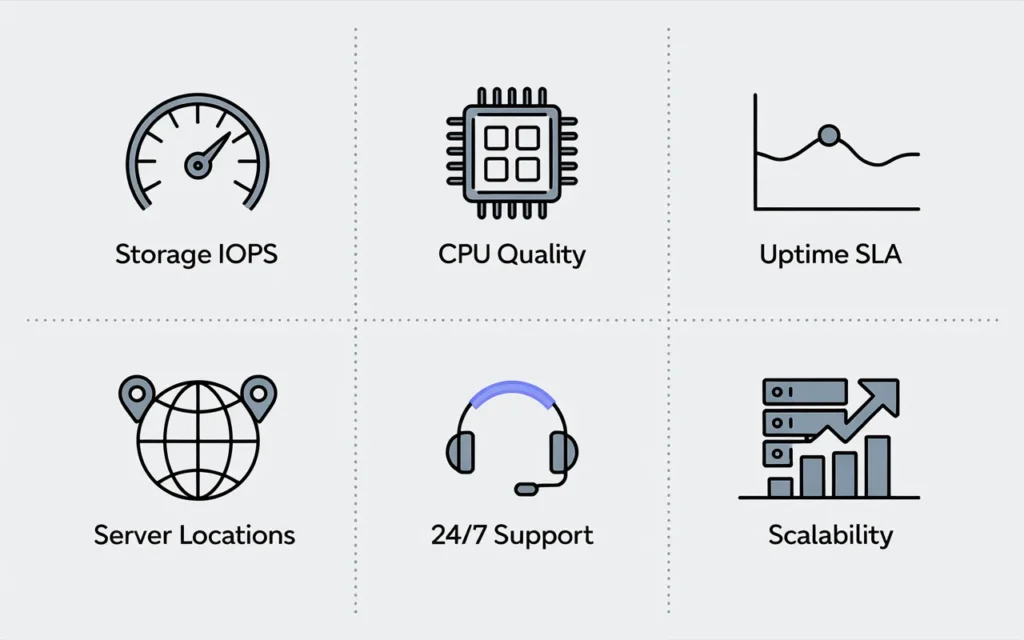
Not every provider offering “NVMe” actually delivers on it equally. Before I get into specific providers, here’s what I evaluate.
Performance Metrics: CPU, RAM, IOPS, Latency
Raw NVMe IOPS matter, but so does the CPU supporting those operations. Look for modern processors (AMD EPYC or Intel Xeon generations) paired with ample RAM. A slow CPU with fast storage creates a bottleneck just as much as the reverse.
As covered in detail in this guide on how to choose the right VPS plan, matching your CPU, RAM, and storage specs to your actual workload is what separates a well-performing VPS from an expensive disappointment.
Uptime Guarantees and Network Reliability
A fast server that’s offline is worthless. Look for providers guaranteeing 99.9% uptime minimum, backed by redundant network infrastructure and independent monitoring. Check third-party uptime reports, not just the provider’s marketing claims.
Scalability, Backup, and Support
Can you upgrade your plan without rebuilding the server? Is backup automatic and frequent? Is support available 24/7 from people who actually understand NVMe infrastructure? These operational factors often matter more than raw specs once you’re running a live business.
Best NVMe VPS Hosting Provider #1: SkyNetHosting.Net
SkyNetHosting.Net has been in the hosting business for over 20 years, operating across 25 worldwide server locations and hosting more than 700,000 websites globally.
Key Features and Benefits
- True NVMe Storage: Enterprise-grade NVMe drives that are 900% faster than traditional SATA drives and 200% faster than standard SSDs — not hybrid or partial NVMe
- LiteSpeed Web Server: Up to 300% faster page loading than Apache, with LiteSpeed Cache for WordPress included
- KVM Virtualization: Full isolation with dedicated resources, not oversold shared pools
- 24/7 US-Based Support: Real technical staff available around the clock via live chat, ticket, and phone
- Free Migration Service: Their technical team handles the transfer with zero downtime
- 25 Global Data Centers: Locations across North America, Europe, Asia, and beyond — meaning low latency for your specific audience
- Daily and Weekly Backups: Automatic data protection built in
- Free WHMCS License: Valued at $15.95/month, included at no extra cost for reseller clients
Target User Segments
SkyNetHosting is particularly strong for resellers, agencies, and growing businesses that need reliable NVMe performance across multiple client sites. Their 20-year track record makes them a stable long-term partner rather than a startup gamble.
Pros and Cons to Consider
Pros: Proven infrastructure, genuine NVMe speeds, excellent support depth, global reach, strong value for resellers
Cons: Their primary website leans heavily toward reseller hosting, so pure VPS buyers need to navigate to the right section — but the infrastructure quality is consistent across product lines
For anyone serious about understanding their hosting needs before committing, their post on unmanaged VPS hosting with full root access is worth reading first.
Best NVMe VPS Hosting Provider #2: Vultr
Vultr is a US-based cloud infrastructure provider with a strong developer following. They offer NVMe-based Cloud Compute and High Performance instances across 32 global locations.
Key Features and Benefits
- NVMe-backed High Performance VPS tiers starting at competitive price points
- Hourly billing for flexible scaling
- Large global network with low-latency routing
- Extensive API and automation support
- One-click app deployments
Target User Segments
Developers, DevOps teams, and tech-forward businesses who want programmatic control over their infrastructure. Less suited for non-technical users who need managed hosting.
Pros and Cons to Consider
Pros: Excellent developer tooling, global reach, granular control, transparent pricing
Cons: Fully unmanaged — you’re responsible for all server administration. Support quality for complex issues can be inconsistent.
Best NVMe VPS Hosting Provider #3: Contabo
Contabo is a German provider known for offering some of the highest raw specs at the lowest price points in the European market. They’ve expanded significantly into US infrastructure.
Key Features and Benefits
- Very high RAM and storage allocations per dollar
- NVMe SSD options available on higher-tier plans
- European and US data center options
- Managed and unmanaged options
Target User Segments
Budget-conscious teams that need high-resource VPS plans — particularly for data-heavy workloads, backups, or applications that consume large amounts of storage.
Pros and Cons to Consider
Pros: Extremely cost-effective for raw specs, strong disk space allocations, solid for internal or non-latency-sensitive workloads
Cons: Performance per dollar is high, but absolute benchmark scores aren’t always competitive with premium NVMe providers. Support response times can vary. Not ideal for latency-sensitive public-facing sites.
Best NVMe VPS Hosting Provider #4: Hostinger
Hostinger is one of the most widely recognized hosting brands globally, offering NVMe-powered VPS plans with a focus on ease of use.
Key Features and Benefits
- NVMe storage included across their VPS lineup
- Custom hPanel control panel designed for simplicity
- Multiple data center regions
- Weekly automated backups
- Managed firewall and DDoS protection
Target User Segments
Small business owners, bloggers, and first-time VPS users who need the performance of NVMe storage without the complexity of server administration.
Pros and Cons to Consider
Pros: Beginner-friendly interface, reliable uptime, aggressive promotional pricing, solid NVMe specs for entry-level plans
Cons: Promotional pricing increases significantly at renewal. Customer support quality varies depending on the issue complexity.
Best NVMe VPS Hosting Providers for Specific Use Cases
NVMe VPS for WordPress and CMS Sites
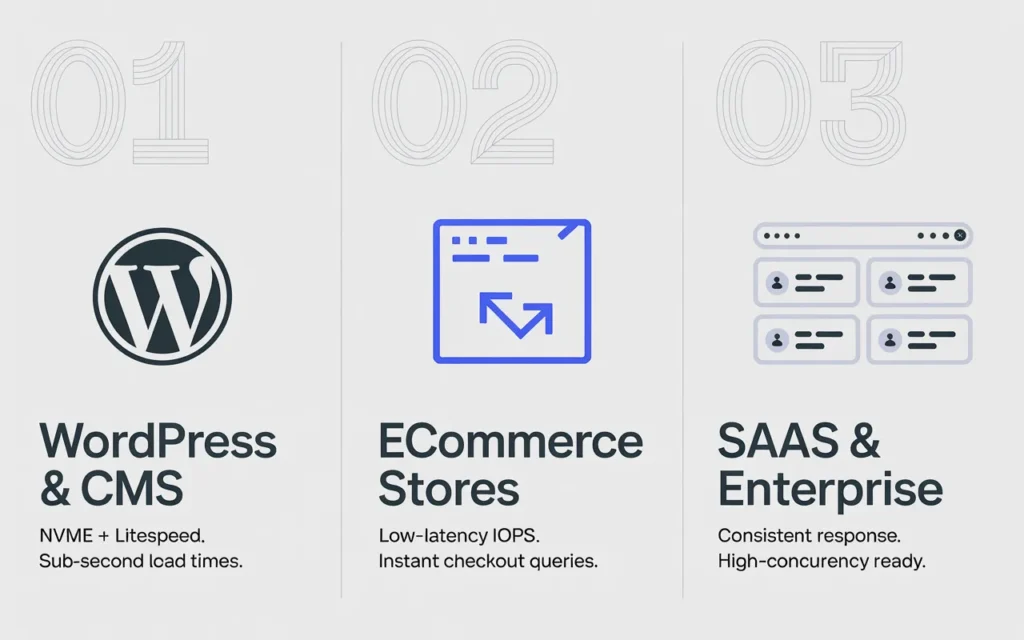
For WordPress, the combination of NVMe storage and LiteSpeed web server is close to ideal. NVMe handles database reads quickly, while LiteSpeed’s server-side caching reduces the number of PHP executions your server needs to process. SkyNetHosting’s infrastructure — NVMe plus LiteSpeed plus LiteSpeed Cache for WordPress — is purpose-built for this stack.
If you’re running WooCommerce specifically, understanding your hosting requirements before scaling is critical. Their post on hosting for eCommerce and dynamic applications breaks this down in practical terms.
NVMe VPS for eCommerce Stores
Checkout performance is directly tied to database response time. NVMe’s low-latency IOPS profile makes it the clear choice for any store running thousands of daily transactions. Pair that with a VPS that has dedicated CPU resources — not shared burstable cores — and you’ve addressed the two most common bottlenecks in eCommerce hosting.
NVMe VPS for SaaS and Enterprise Apps
SaaS applications demand consistent performance under variable load. NVMe handles I/O spikes without the latency cliff that SATA SSDs experience under sustained write pressure. For multi-tenant architectures, the lower latency also means better response times across all tenant sessions simultaneously. If you’re building for this tier, the multi-tenant SaaS hosting architecture guide is essential reading before you choose a provider.
How to Compare NVMe VPS Hosting Plans for Your Needs
Evaluating Performance vs Price
Don’t optimize purely for the cheapest plan. A $5/month VPS with HDD storage will consistently underperform a $15/month NVMe plan. The performance difference far exceeds the price difference — and in terms of its impact on your SEO, user experience, and conversion rate, the NVMe plan pays for itself quickly.
Look at what VPSBenchmarks actually measures: web server performance, CPU throughput, disk I/O stability, and network speed. These independent benchmarks cut through marketing claims and show real-world behavior. In their 2025 rankings, they benchmarked 279 cloud servers from 66 providers. In 2026, they’ve continued evaluating providers across six price ranges — checking which hosts actually deliver under load.
Matching Resources to Traffic and Workloads
A static portfolio site needs very different resources than a high-traffic WooCommerce store. Match your vCPU count, RAM, and storage IOPS to your actual workload — not your aspirational one. Start appropriately sized, monitor your resource usage, and scale up when usage consistently exceeds 75-80% of capacity.
Importance of Support and Server Locations
Choose a data center location closest to your primary audience. A server in Germany serving primarily US East Coast users will introduce unnecessary latency. Most quality providers let you choose your region at signup.
For support, test it before you need it urgently. Send a technical question before you sign up. The speed and depth of the response tells you everything.
How SkyNetHosting.Net Inc. Stands Out as a Top NVMe VPS Host in 2026
Modern, High-Speed NVMe Infrastructure
SkyNetHosting uses Intel Dual Xeon 40-core servers with 128GB RAM, NVMe drives, and LiteSpeed — a hardware stack that puts them among the most performance-forward providers in their price tier. Their NVMe storage is 900% faster than traditional SATA drives and 200% faster than standard SSDs. That’s not a rounding error — it’s a fundamentally different class of performance.
For a technical breakdown of exactly why storage speed matters so much, their post on NVMe storage vs traditional SSD hosting covers the numbers clearly.
Scalable Plans for Growing Businesses
Whether you’re starting a single-site VPS or running a reseller operation serving dozens of client sites, SkyNetHosting has a clear upgrade path. Their extended cancellation policy on reseller plans means you only pay for what your clients use — a cash flow-friendly structure for growing agencies.
Reliable Uptime and Responsive Support
Twenty years in business is not an accident. It requires consistent uptime, reliable infrastructure, and support teams that know what they’re doing. SkyNetHosting’s 24/7 customer service includes anonymized end-user support — meaning your clients can get help directly without knowing they’re being served by your white-label reseller setup.
Understanding how to manage and plan for growth within that infrastructure is easier when you’ve also read their serverless database architecture guide, which covers where modern hosting infrastructure is heading.
How to Choose the Best NVMe VPS Hosting Provider for You
Defining Your Performance Requirements
Start with your application stack. WordPress with heavy plugins? You need strong IOPS and at least 4GB of RAM. A SaaS app under sustained load? You need dedicated CPU cores and NVMe storage that handles sustained write operations cleanly. An eLearning platform? Bandwidth and concurrent session handling become primary concerns — covered well in SkyNetHosting’s hosting for online education guide.
Budget Planning and Long-Term Scalability
Don’t sign a 3-year contract with a provider you haven’t tested. Look for monthly billing options on entry-level plans, and confirm the upgrade path. A host that forces you to rebuild your server from scratch to scale up is a significant operational risk.
Trial Periods, Guarantees, and Migrations
Look for providers offering free migration services and at minimum a 30-day money-back guarantee. Free migration in particular removes the friction of switching — meaning if your current host is underperforming, there’s no excuse to stay.
The Right Storage Foundation Changes Everything
NVMe VPS hosting isn’t a luxury tier anymore. It’s the baseline for any website that needs to perform reliably under real-world conditions in 2026.
The providers in this list — SkyNetHosting, Vultr, Contabo, and Hostinger — each serve different needs and priorities. Vultr excels for developers who want API-driven infrastructure. Contabo delivers raw specs at low cost. Hostinger is beginner-friendly. SkyNetHosting offers the full stack: NVMe infrastructure, LiteSpeed performance, 25 global locations, free migration, and 20 years of operational reliability — with plans built for both direct clients and resellers.
Choosing the right provider isn’t just a technical decision. It’s the foundation your business runs on. Slow hosting costs you in search rankings, user trust, and conversion rates. Fast, reliable hosting compounds over time into real competitive advantage.
If you want a provider with documented infrastructure depth, genuine NVMe performance, and two decades of experience behind it, SkyNetHosting.Net is a strong starting point. Explore their plans, test their support, and see what modern NVMe hosting actually feels like at full speed.
FAQs
What defines NVMe VPS hosting advantages?
NVMe uses PCIe directly on the motherboard for 100,000+ IOPS and 10-20μs latency, versus SATA SSD’s 500-1,000 IOPS and higher delays—crucial for database queries, checkouts, and plugins that demand constant fast reads/writes in modern apps.
Who benefits most from NVMe VPS upgrades?
eCommerce owners get instant checkouts, WordPress users slash loads with WooCommerce/Elementor, SaaS devs ensure retention via response times, agencies manage clients scalably—anyone escaping shared hosting’s unreliability sees immediate SEO/conversion gains.
Why rank SkyNetHosting as top NVMe provider?
Enterprise NVMe 900% faster than SATA/200% over SSDs, KVM isolation, LiteSpeed for 300% speedups, 25 global DCs, 24/7 US support, free WHMCS/migrations/backups—proven 20-year track record for resellers/businesses.
How does Vultr compare for developers?
Vultr provides NVMe High Performance instances, hourly billing, API automation, one-click apps across 32 locations—perfect for DevOps scaling but fully unmanaged, so handle your own admin unlike beginner-friendly options.
What are Contabo and Hostinger’s strengths?
Contabo delivers massive RAM/storage cheaply for data workloads in EU/US; Hostinger offers NVMe with simple hPanel, DDoS/firewalls, weekly backups—budget picks for non-tech users prioritizing ease over raw power.
How to select the best NVMe VPS provider?
Match CPU/RAM/IOPS to workload via VPSBenchmarks, verify 99.9% uptime/global DCs near users, test support pre-signup, seek free migrations/30-day guarantees, prioritize scalable plans without rebuilds for long-term growth.
