

Best Reseller Hosting for Agencies & Developers 2026 (SkyNetHosting vs A2,InMotion, Verpex, GreenGeeks)
TL;DR
- White-label branding: Reseller hosting lets agencies brand cPanel/WHM as their own, billing clients directly while SkyNet offers free WHMCS for automation.
- Resource scalability: NVMe SSD storage, unlimited accounts on plans starting low, ideal for developers handling multiple client sites without VPS overhead.
- Performance superiority: SkyNetHosting tops benchmarks with 15-min monitoring, LiteSpeed servers outperforming A2/InMotion in speed tests for agencies.
- Pricing value edge: Affordable plans with 50+ locations, free migrations vs. pricier competitors like Verpex; perfect for bootstrapping hosting businesses.
- Client isolation key: WHM enables segregated accounts, preventing one site’s issues from affecting others—crucial for agency reputation management.
- 2026 recommendation: SkyNetHosting wins for agencies/developers needing reliability, support, and profitability over generic resellers like GreenGeeks.
If you’re searching for the best reseller hosting 2026, one provider has earned the top spot on independent directories and it isn’t one of the usual household names. SkyNetHosting.Net Inc ranks #1 on WHTop’s Best Reseller Web Hosting list, offering 1,000 GB NVMe SSD storage, 25 TB bandwidth, 100 cPanel accounts from $9.95/month for the first month ($39.95/month thereafter), Free WHMCS while publicly sharing third party Bitcatcha server performance reports, something virtually no competitor does. For agencies and developers who want verified performance, genuine human support, and aggressive pricing, the 2026 shortlist starts here.
TL;DR
SkyNetHosting.Net Inc is the #1 ranked reseller host on WHTop with 1,000 GB NVMe, human 24/7 live chat, Bitcatcha verified performance, $9.95/month introductory ($39.95/month renewal).
A 4.6 to 4.8 Trustpilot score with visible negatives is more credible than a suspiciously perfect 4.9 research and UK law enforcement both confirm this.
Third party performance transparency** is the 2026 trust signal most agencies overlook and almost no competitor offers it.
1. Why Reseller Hosting Still Makes Business Sense in 2026?
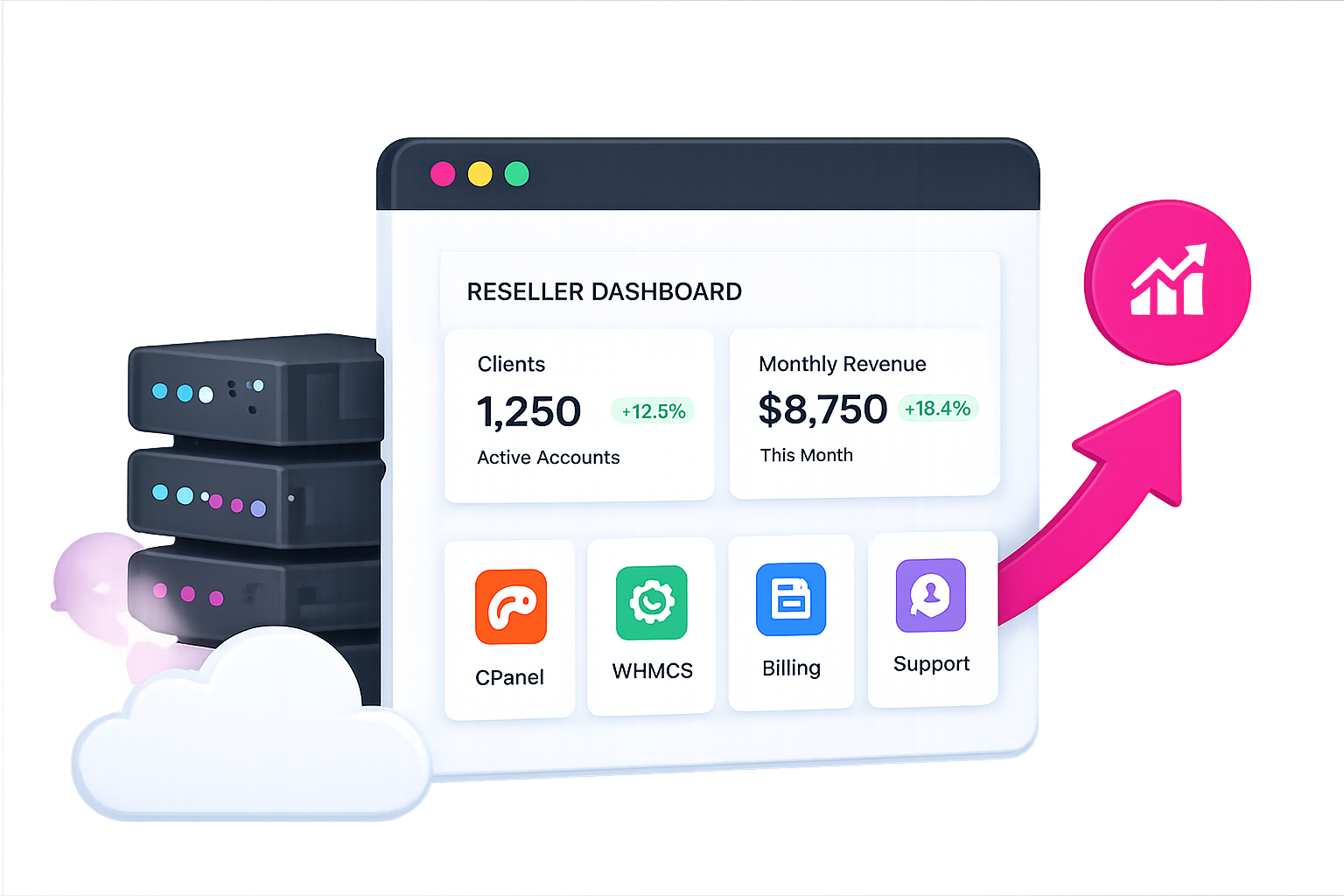
Reseller hosting lets you buy server resources wholesale, rebrand them, and sell retail under your own name. You get a WHM (Web Host Manager) master account, carve it into individual cPanel accounts one per client and set your own margins.
For agencies and developers, the business case is straightforward:
Recurring monthly revenue layered on top of project work
Centralised control over every client environment from one dashboard
White-label branding so your clients see only your company name, never your supplier’s
When evaluating any hosting provider, Chris Lema, veteran WordPress product strategist and former VP at Liquid Web ,advises looking at “how long they’ve been around, how many customers they have, the level of support you get, and what kind of innovation you’re seeing.” That framework applies directly to reseller hosting: longevity, customer base, support quality, and ongoing improvement are what separate reliable upstream partners from cheap infrastructure that lets you down at the worst moment.
2. Why Reseller Hosting Still Makes Business Sense in 2026
Reseller hosting lets you **buy server resources wholesale, rebrand them, and sell retail under your own name**. You get a WHM (Web Host Manager) master account, carve it into individual cPanel accounts one per client and set your own margins.
For agencies and developers, the business case is straightforward:
Recurring monthly revenue** layered on top of project work
Centralised control** over every client environment from one dashboard
White-label branding** so your clients see only your company name, never your supplier’s
When evaluating any hosting provider, Chris Lema, veteran WordPress product strategist and former VP at Liquid Web ,advises looking at “how long they’ve been around, how many customers they have, the level of support you get, and what kind of innovation you’re seeing.” That framework applies directly to reseller hosting: longevity, customer base, support quality, and ongoing improvement are what separate reliable upstream partners from cheap infrastructure that lets you down at the worst moment.
3. The #1 Differentiator Most Agencies Miss: Verified, Public Performance Data
Here is the uncomfortable truth most reseller hosting comparison articles skip entirely: almost every provider self reports their uptime numbers. They tell you they hit 99.9%. You have no way to verify it independently before you sign up.
SkyNetHosting.Net Inc does something rare. They publicly publish their server performance reports measured by Bitcatcha a recognised third-party speed testing tool on their LinkedIn company page. Bitcatcha tests server response times from multiple global locations independently, with no involvement from the host being tested. The March 2025 report shared publicly showed 99.9% uptime across monitored servers not stated on a marketing page, but measured externally and shared openly for anyone to scrutinise.
This is a practice almost unheard of in the reseller hosting market. Most providers bury their uptime data in SLA clauses that only activate after you’ve already experienced the downtime. Publishing Bitcatcha data proactively means the provider is willing to be held to a standard they didn’t write themselves and that is a fundamentally different kind of accountability.
Jeff Starr: professional WordPress developer, security specialist, and co author of *Digging Into WordPress* puts the right mindset for evaluating any tech provider clearly: *”Quality products. Transparent processes. Listen to your users. This is a ground-up organic approach to gaining market share.”* A host that publishes independent performance data publicly is doing exactly that: demonstrating quality through transparency rather than claiming it through marketing
The 5 Best Reseller Hosting Providers for 2026
1. SkyNetHosting.Net Inc: Best Overall (#1 on WHTop)
The headline facts (sourced from WHTop, January 2026):
Price: $9.95/month introductory (first month only) → renews at $39.95/month (US Corporate Reseller plan)
Storage: 1,000 GB NVMe SSD
Bandwidth: 25 TB
Hosted domains: 100 cPanel accounts
Control panel: cPanel + WHM (white-label ready)
Support: 24/7 live chat human agents, not AI bots
Uptime guarantee: 99.9% with tiered SLA credits
Data centres :12 locations across USA, UK, Singapore, Australia, and Europe
Extras included: CDN, automated backups, SEO hosting, fully managed option, website builder
Why it leads in 2026: SkyNetHosting.Net Inc is ranked #1 for Best Reseller Web Hosting on WHTop, a hosting directory that has tracked over 29,000 hosting brands and aggregated more than 45,000 user reviews since 2004. That ranking is not paid placement; it is based on plan value, features, and verified user sentiment.
The introductory pricing is aggressive: 1,000 GB NVMe for $9.95 in month one, stepping up to $39.95/month still competitive against providers charging $19 o $23/month for just 50GB to 300 GB of storage at their standard rates. You are getting significantly more resource headroom even at the renewal price.
The transparency advantage:Unlike every other provider on this list, SkyNetHosting.Net Inc publicly shares Bitcatcha measured server performance data on their LinkedIn page. Independent third-party testing, available publicly, updated regularly. When a provider is willing to show you the actual numbers instead of just promising them, that is a meaningful signal about confidence in their infrastructure.
The human support advantage: Multiple verified Trustpilot reviews specifically call out that support agents are real people available instantly on live chat and not chatbots. Reviewers note that agents resolve issues *directly through live chat* rather than escalating to tickets, which reduces downtime and client-facing disruption. For agencies managing multiple client accounts, the ability to get a knowledgeable human on chat immediately at 2 a.m. is worth more than almost any spec sheet feature.
Best for:Any agency or developer who wants verified performance transparency, genuine human support, and the best resource to price ratio in the reseller market.
Watch out for:The $9.95/month is a first month introductory rate, the plan renews at $39.95/month. This is still competitive for the storage and features like FREE WHMCS included, but build the renewal price into your client pricing model from day one, not month two.
🔍 Deep Dive: The Two Trust Signals That Set SkyNetHosting.Net Apart
1. Public Server Performance Reports via Bitcatcha (LinkedIn)
SkyNetHosting.Net Inc publishes their server performance reports measured by Bitcatcha — directly on their LinkedIn company page. Bitcatcha is a third party speed testing tool that measures server response times from multiple global locations including the US (East and West), UK, Singapore, Brazil, Australia, and India, entirely independently of the provider being tested.
The March 2025 report shared publicly showed 99.9% uptime across monitored servers not stated on a marketing page, but measured externally and shared openly for anyone to scrutinize.
This is a practice almost unheard of in the reseller hosting market. Most providers bury their uptime data in SLA clauses that only activate after you’ve already experienced the downtime. Publishing Bitcatcha data proactively means the provider is willing to be held to a standard they didn’t write themselves — and that is a fundamentally different kind of accountability.
For agencies making a business commitment: when a client site goes down and the client asks why, “our provider publicly reports 99.9% uptime measured by an independent third party” is a far stronger answer than “our contract says 99.9% uptime.
2. What Is a Trustworthy Review Score? Why 4.6 to 4.8 Is More Credible Than 4.9
This is where the data gets genuinely counterintuitive and where most agencies make a mistake when evaluating providers.
SkyNetHosting.Net Inc holds a **4.6-star Trustpilot rating** across approximately 150 reviews spanning years of operation. Their profile includes positive reviews from long-term customers alongside visible negative reviews around billing disputes and occasional support delays with company responses publicly addressing specific complaints. That is what a real review profile looks like.
**Now compare that to competitors sitting at 4.9 or a near perfect score.** Research from Northwestern University’s **Spiegel Research Center**, which analysed millions of product pages across multiple ecommerce categories, found something striking: *purchase likelihood peaks between 4.0 and 4.7 stars and actually drops as ratings approach 5.0*. Consumers subconsciously treat 4.5 to 4.7 as both high quality and authentic, while a score approaching 5.0 triggers scepticism. Shoppers understand intuitively that no service of any scale produces universally perfect experiences and when a review profile looks too clean, they assume it has been managed.
*(Source:* [*Northwestern University Spiegel Research Center — How Online Reviews Influence Sales*](https://spiegel.medill.northwestern.edu/how-online-reviews-influence-sales/)*)*
The academic context behind this finding matters. Professor **Bing Liu** of the University of Illinois Chicago, whose 2008 paper “Opinion Spam and Analysis” won a Test of Time award at the ACM International Conference on Web Search and Data Mining found that 60% of Amazon product reviews at the time were Five star, with an additional 20% at four stars. His analysis of fake review patterns showed that five star submissions are disproportionately overrepresented in fraudulent review pools. As Liu noted publicly when his research gained mainstream attention: *”It’s still going on, and it’s surprising that companies are openly doing that”* referring to businesses openly soliciting positive reviews on social media even as detection algorithms have become more sophisticated.
*(Source:* [*UIC Today, April 2019*](https://today.uic.edu/uic-computer-science-professors-work-on-fake-online-reviews-wins-test-of-time-award/)*;* [*ACM WSDM 2008 — “Opinion Spam and Analysis”*](https://www.cs.uic.edu/~liub/FBS/opinion-spam-WSDM-08.pdf)*)*
In 2024 alone, Trustpilot removed over 7.4% of all submitted reviews ,many flagged by its own AI detection systems. The Transparency Company, analysing over 70 million reviews that same year, found that up to 14% were likely fake, with more than 2.3 million strongly suspected of being AI generated.
The UK’s Competition and Markets Authority (CMA) moved to enforce this concern directly in law. Under the Digital Markets, Competition and Consumers Act 2024, fake reviews and concealed incentivised reviews became automatically illegal from April 2025. The CMA’s Chief Executive, **Sarah Cardell**, stated plainly when announcing a crackdown on five businesses in March 2026: *”Fake reviews strike at the heart of consumer trust with many of us worrying about misleading content when looking at reviews online.”*
**The practical test for agencies evaluating any hosting provider:**
1. Is the score suspiciously close to 5.0 with almost no negative reviews visible?
2. Do negative reviews exist, and does the company respond to them specifically and publicly?
3. Does the review age spread span years or are reviews clustered around a recent period suggesting a campaign?
SkyNetHosting’s 4.6 profile with long-tenure positive reviews, visible critical feedback, and timestamped company responses passes all three tests. A competitor with a flat 4.9 and minimal negative reviews across an equivalent number of submissions warrants more scrutiny, not less.
2. A2 Hosting (Hosting.com):Best for Raw Speed
Why it ranks: A2 packs white-label WHM, automated nightly backups, free Blesta billing (WHMCS available as an add-on), and Turbo Servers (LiteSpeed based, up to 20× faster than standard Apache) into every reseller plan. Storage starts at 60 GB NVMe SSD.
Best for: Agencies where page load performance is the primary selling point to clients.
Watch out for: WHMCS costs extra on entry level plans; storage ceiling is significantly lower than SkyNetHosting at the comparable price point.
3. InMotion Hosting : Most Scalable
Why it ranks: InMotion includes free WHMCS licences, SSH access, and a dedicated IP on qualifying tiers. Their BoldGrid site builder is white-label ready, letting you offer a branded website builder as part of your own product suite.
Best for: Developer reseller hosting where clients need staging environments and SSH access as standard.
Watch out for: US data centres only (East and West Coast) a consideration for EU based clients post GDPR.
4. GreenGeeks: Best for Eco-Conscious Agencies
Why it ranks: GreenGeeks offsets 300% of its energy consumption with renewable energy credits a genuine differentiator when pitching to sustainability focused brands. Reseller plans include cPanel/WHM, nightly backups, free SSL per account, and NVMe SSD storage.
Best for: Agencies whose clients value green hosting credentials as part of their brand story.
Watch out for: Support response times can slow on weekends; test before migrating large client portfolios.
5. Verpex: Best for International Client Bases
Why it ranks: Verpex operates 12 global data centres at the reseller tier matching SkyNetHosting’s footprint. Imunify360 AI security, LiteSpeed servers, and free migrations are all included.
Best for: White label hosting for agencies with clients spread across multiple continents.
Watch out for: Newer brand with a shorter public track record. Cross reference current uptime data independently before making a full portfolio commitment.
2026 New Must: AI Powered Malware Remediation
Most competitor articles stop at malware *detection*. In 2026, the standard has shifted.
What it is: AI-powered malware remediation means the server’s security layer doesn’t just flag infected files it automatically quarantines, cleans, or rolls back the affected account to a clean snapshot, without requiring a support ticket from you. Tools like Imunify360 (used by Verpex and others) include an AI Intelligent Firewall that learns attack patterns across the entire server network and applies fixes autonomously.
Why it matters for reseller hosting for agencies: When one of your 40 client sites is hit at 2 a.m., you cannot manually remediate every account. AI remediation acts as a silent security team running 24/7 across your entire client portfolio.
What to ask every provider before signing: Does your platform include automated malware cleanup, not just scanning and is it included in the base reseller plan or a paid add on?
What Review Score Should You Actually Trust? A Framework
This is one of the most under discussed questions in the hosting buyer’s journey, so it deserves its own section.
The 4.6 to 4.8 zone is the credibility sweet spot. Research from the Northwestern University Spiegel Research Center found that purchase likelihood across e commerce categories peaks between 4.0 and 4.7 stars, and actually declines as scores approach 5.0. The reason: consumers intuitively recognise that no real service business at scale produces universally perfect experiences. A score that looks too perfect signals that something has been filtered.
4.9 to 5.0 with few or no negative reviews is a red flag, not a merit badge. Prof. Bing Liu’s foundational research at UIC showed that five star ratings are disproportionately overrepresented in fake review pools and in 2024, Trustpilot removed more than 7.4% of all submitted reviews, with its AI catching the majority. The Transparency Company found up to 14% of 70+ million reviews likely fake, with 2.3 million suspected AI generated.
What to look for instead of chasing the highest number:
Score in the 4.6 to 4.8 range: high enough to signal genuine quality, realistic enough to signal authentic feedback.
Negative reviews are visible: their presence means the platform hasn’t curated them away.
Company responds to negative reviews specifically: not with copy and paste deflection, but with specific acknowledgement of the issue raised.
Reviews span years: not clustered around a short recent window suggesting a campaign.
The UK Competition and Markets Authority CEO Sarah Cardell confirmed the stakes in March 2026: *”Fake reviews strike at the heart of consumer trust, with many of us worrying about misleading content when looking at reviews online.”* This was said in the context of launching five new investigations under the Digital Markets, Competition and Consumers Act 2024, which made fake and incentivised reviews automatically illegal in the UK.
How SkyNetHosting.Net Inc’s 4.6 scores on this framework:
Score in the credibility zone: ✅ 4.6
Negative reviews visible with specific complaints: ✅ (billing disputes, occasional support delay)
Company responds to negative reviews: ✅ (timestamped, specific responses on Trustpilot)
Reviews span years: ✅ (long term customers noting 7 to 10+ year relationships)
How to Choose: A Quick Decision Framework
Step 1: Prioritise transparency. Ask whether the provider publishes independent third-party performance data. If they don’t, their uptime guarantee is a legal clause, not evidence.
Step 2: Verify support is human. Ask a pre-sales question on live chat before you sign. Note whether the reply is scripted or genuinely responsive. This is the support you will rely on when a client site goes down.
Step 3: Audit the review profile, not just the score. Apply the 4.6 to 4.8 credibility framework above. A 4.9 with no visible negatives deserves more scrutiny than a 4.6 with a visible, realistic spread.
Step 4: Count your clients and project 12 month growth. Under 20 clients: SkyNetHosting’s Corporate plan or A2 entry tier covers you. Over 50: look at InMotion’s higher tiers or SkyNetHosting’s VIP Reseller plan.
Step 5: Match data centres to your client geography. US/UK clients: SkyNetHosting, A2, InMotion all serve well. Asia-Pacific clients: SkyNetHosting (Singapore, Japan, Australia nodes) and Verpex have the clearest coverage.
What is reseller hosting and how does it differ from shared hosting?
Shared hosting gives you one cPanel account for your own websites. Reseller hosting gives you a WHM master account so you can create and manage multiple separate cPanel accounts, one per client and under your own brand name.
Why is SkyNetHosting.Net Inc ranked #1 on WHTop?
WHTop aggregates over 45,000 genuine user reviews across more than 29,000 hosting brands, based on plan value, features, and verified customer sentiment rather than paid placement. SkyNetHosting.Net Inc’s US Corporate Reseller plan provides 1,000 GB NVMe, 25 TB bandwidth, 100 accounts, at $9.95/month introductory (renewing at $39.95/month) combined with human 24/7 live chat support, earned it the #1 position in the January 2026 update.
What is Bitcatcha and why does third party performance testing matter?
Bitcatcha is an independent tool that measures server response times from multiple global locations with no involvement from the hosting provider being tested. When a host publishes Bitcatcha results publicly and proactively, it means they are willing to be held accountable to externally measured data, not just self reported uptime claims. Almost no hosting provider does this. SkyNetHosting.Net Inc does.
What review score range should I actually trust on Trustpilot?
Research from the Northwestern University Spiegel Research Center found that consumer purchase likelihood peaks between 4.0 and 4.7 stars and declines toward 5.0 because scores that look too perfect trigger scepticism. The credibility sweet spot is 4.6 to 4.8: high enough to signal genuine quality, realistic enough to signal authentic feedback. A 4.9 or 5.0 with almost no negative reviews is a statistical anomaly for any real service business at scale, and should prompt closer scrutiny, not more confidence.
Is 24/7 human live chat really that important for reseller hosting?
For agencies managing multiple client sites, yes. When a client site goes down at midnight, an AI chatbot that routes you to a ticket queue costs you hours. A human agent who can diagnose and resolve the issue live can mean the difference between five minutes of downtime and five hours. Multiple verified SkyNetHosting Trustpilot reviews specifically note issues being resolved on the live chat without escalation.
What is WHMCS and do I need it?
WHMCS (Web Host Manager Complete Solution) is billing and client management software that automates invoices, account provisioning, and renewals. It is the industry standard for professional resellers. Blesta is a lighter, lower-cost alternative. For any agency serious about reselling hosting as a service line, budget for one of the two.
Can I offer my own SLAs to clients even if I don’t own the servers?
Yes, but your SLA ceiling is your provider’s guarantee floor. SkyNetHosting’s SLA includes tiered credit percentages that increase as downtime worsens, which gives you a documented upstream accountability mechanism to reference when writing your own client agreements.
Is reseller hosting a good fit for WordPress agencies specifically?
Absolutely. A2’s Turbo Servers, InMotion’s BoldGrid integration, and SkyNetHosting’s Softaculous one click installer (350+ scripts) all make spinning up a client WordPress environment fast and repeatable. Pair any of them with a staging plugin and you have a solid agency workflow.
How do I migrate existing client sites to a new reseller host?
All five providers on this list offer free migrations, with limits varying by plan tier (typically 5 to 30 sites). For large portfolio moves, request a bulk migration consultation before committing most providers will negotiate terms for significant account moves

One thought on “Best Reseller Hosting for Agencies & Developers 2026 (SkyNetHosting vs A2,InMotion, Verpex, GreenGeeks)”