
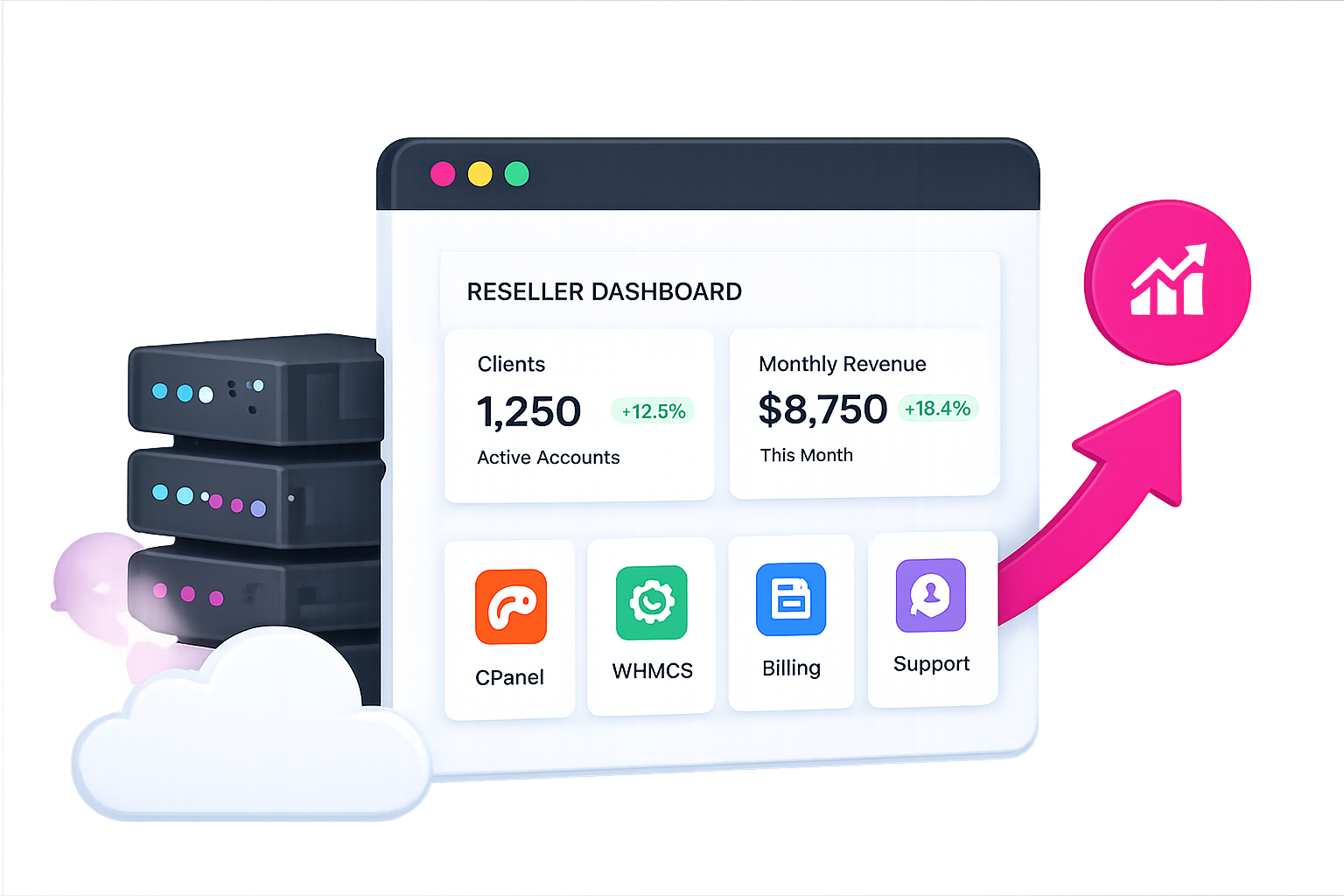

How to Track MRR and Churn Using WHMCS Reports
Quick answer: WHMCS doesn’t include MRR and churn reports by default. Track them using add-on modules:
- MetricsCube (go to Reports → Billing → MRR Report, view visual graphs/summary tables, filter by service type/product groups/countries/time periods, calculates MRR from paid recurring invoices only) or InsightDials (pre-designed dashboards showing MRR, ARR, Churn, LTV, SLAs). MRR formula: sum of all monthly fees from active paid services/domains/addons (annual fees ÷ 12, quarterly ÷ 4, semi-annual ÷ 6). Excludes one-time fees (setup, late fees) and taxes.
- Churn tracking: Revenue Churn (decrease in MRR from cancellations/downgrades), Subscription Churn Rate (canceled subscriptions ÷ total), Customer Churn Rate (lost clients ÷ total). MetricsCube shows MRR Breakdown, MRR Growth, Revenue Churn, Subscription Churn, Customer Churn.
TL;DR: To track Monthly Recurring Revenue (MRR) and churn rate in WHMCS, you need to use the Income Forecast report, Monthly Income Analysis, and Client Retention reports. MRR measures your predictable monthly income, while churn rate tracks how many customers cancel their services. Tracking both metrics helps hosting providers forecast revenue and identify retention problems early.
Are you running a hosting business and wondering where your money is actually going? You are not alone. Many hosting owners look at their bank balance and assume they are doing well. But cash in the bank does not tell the whole story.
I have spent the last 10 years helping hosting companies scale. I see the same problem over and over. Founders know what WHMCS is, but they do not know how to read the data inside it. They miss the hidden leaks in their business.
If you want to grow a predictable, profitable hosting company, you must master two metrics. You need to know your Monthly Recurring Revenue (MRR). You also need to know your churn rate. Let us break down exactly how you can use WHMCS reports to track these vital numbers.
Why do MRR and churn matter for your hosting business?
I have spent the last 10 years helping hosting companies scale. I see the same problem over and over. Founders know
Running a hosting company is different from running a traditional retail store. You do not just sell a product once. You build a relationship that pays you every month.
How do recurring revenue models work?
A recurring revenue model relies on subscriptions. Customers pay a set fee every month, quarter, or year for your services. This model is powerful because it compounds. If you add 10 new clients this month, their payments stack on top of the clients you got last month. This creates a snowball effect for your income.
Why does retention impact your profitability?
Getting a new customer is expensive. You spend money on ads, marketing, and sales time. According to industry data, acquiring a new customer costs up to five times more than keeping an existing one. If clients leave after just one or two months, you lose money on them. High retention means you recover your acquisition costs and start making pure profit. If you want to grow a reseller hosting business, keeping clients happy is your best marketing strategy.
Why is predictable cash flow important?
Predictable cash flow lets you plan for the future. When you know exactly how much money is coming in next month, you can make smart decisions. You can upgrade your servers. You can hire a new support agent. You can increase your advertising budget. Without predictable revenue, you are just guessing.
What exactly is Monthly Recurring Revenue (MRR)?
MRR is the lifeblood of any subscription business. It is the number you should check every single day.
How do you define MRR?
Monthly Recurring Revenue (MRR) is the total amount of predictable revenue your business expects to receive every month. It includes all active subscriptions. It does not include one-time fees, setup fees, or late payment penalties.
How do hosting businesses calculate MRR?
To calculate your MRR, you multiply your total number of active, paying customers by the average amount they pay you each month. For example, if you have 100 customers paying $10 per month, your MRR is $1,000. If some clients pay annually, you divide their annual payment by 12 to find their monthly contribution.
What are common MRR mistakes beginners make?
Many beginners inflate their MRR by mistake. They include one-time domain registration fees in their calculations. Domains are usually paid yearly, and clients often move them. Do not count domain registrations as reliable MRR. Beginners also forget to remove canceled accounts from their totals. If you are learning how to start a web hosting business, keep your MRR calculations strictly focused on recurring hosting packages.
What does customer churn rate mean for your business?
If MRR measures your growth, churn rate measures your leaks. You cannot grow if you are losing clients faster than you can find them.
How do you define customer churn?
Customer churn is the percentage of customers who cancel their subscriptions during a specific time period. If you start the month with 100 customers and 5 of them cancel, your monthly customer churn rate is 5%.
What is the difference between revenue churn and customer churn?
Customer churn tracks the number of human beings leaving your business. Revenue churn tracks the amount of money leaving your business.
These numbers can look very different. Imagine you have a budget client paying $5 a month and an enterprise client paying $100 a month. If the enterprise client leaves, your customer churn might only be 1%, but your revenue churn could be 20%. You must track both to get a clear picture of your business health.
Why does churn impact your long-term growth?
High churn acts like an anchor on your business. It forces you to constantly hunt for new clients just to replace the ones you lost. You end up running on a treadmill, burning energy but going nowhere. Lowering your churn rate by just a few percentage points can double your company’s value over a few years.
Which WHMCS reports actually help track your MRR?
WHMCS is a fantastic tool, but finding the exact “MRR” button is tough because it does not exist out of the box. However, you can use built-in WHMCS reports to pull this data.
How to use the Income Forecast report
The Income Forecast report is your best friend for estimating MRR. This report looks at all your active services. It calculates how much money you will make if every single active client renews their service on time.
Keep in mind that this report assumes a 100% renewal rate. It gives you a “best-case scenario” projection. You can find this report by navigating to Reports > Income Forecast in your WHMCS dashboard. If you want to master WHMCS reseller automation, checking this report weekly is a great habit.
How to use the Monthly Income Analysis
While the forecast looks forward, the Monthly Income Analysis looks backward. It shows you exactly how much money actually hit your bank account each month. By comparing your Income Forecast to your Monthly Income Analysis, you can see the gap between what you expected to make and what you actually made.
How to track product and service revenue
Sometimes you need to know which specific hosting packages bring in the most money. The Services report in WHMCS lets you break down revenue by product. You can see if your shared hosting is funding your business, or if your VPS plans are the real money-makers. This data tells you exactly where to focus your marketing efforts.
Which WHMCS reports help you measure customer churn?
Tracking lost clients in WHMCS requires a bit of manual checking, but the data is all there.
How to use Cancellation Reports
When a client wants to leave, they submit a cancellation request. WHMCS logs all of these in the Cancellation Requests report. You should review this report weekly. Look for patterns. Are clients leaving because of price? Are they leaving because of server downtime? The reasons listed here will tell you exactly how to fix your business.
How to run a client retention analysis
The built-in Client Retention report shows you how long customers stay with you before leaving. You might find that clients drop off after three months. If that happens, you know you need to improve your customer experience around the 60-day mark. Understanding this timeline is crucial when figuring out how to sell hosting under your brand.
Why should you track inactive customers?
Sometimes clients do not officially cancel. They just stop paying. Their accounts become suspended, and eventually terminated. You need to filter your client list by “Inactive” or “Closed” statuses. These silent cancellations still count toward your total churn rate.
How do you calculate MRR and churn correctly in WHMCS?
You have the reports. Now you need to do the math. Do not worry, the formulas are very simple.
What are the simple MRR formulas?
To find your current MRR, use this simple formula:
Current MRR = (Previous Month MRR) + (New MRR from new sales) + (Expansion MRR from upgrades) – (Lost MRR from cancellations) – (Contraction MRR from downgrades).
For a quick snapshot, just export your active recurring services from WHMCS to a spreadsheet. Sum up the monthly recurring amounts.
How do you calculate churn rate with examples?
The standard churn formula is simple:
Churn Rate = (Lost Customers during a month / Total Customers at the start of the month) x 100.
Example: You start January with 200 clients. During January, 10 clients cancel.
Your calculation is (10 / 200) x 100 = 5%. Your churn rate is 5%.
How should you interpret trends over time?
A single month of high churn does not mean your business is failing. Look at the numbers over a 90-day period. Did you raise prices recently? That usually causes a temporary spike in churn. Did you have a server outage? That will also cause a spike. Look for the long-term trend line to see if your business is getting healthier or sicker.
How can you use WHMCS analytics to make better business decisions?
Data is useless if you do not act on it. Here is how to use your WHMCS numbers to guide your business strategy.
How to identify your most profitable hosting packages
By comparing your product revenue against your server costs, you can find your highest-margin packages. You might discover that your $5/month plan takes up 80% of your support tickets but only provides 20% of your MRR. In that case, you should focus your marketing on your $20/month plan instead.
How to spot customer retention problems early
If you notice a sudden jump in cancellation requests, act fast. Reach out to those clients personally. Ask them why they are leaving. Sometimes a personal email from the founder can save an account. Regular monitoring helps you stop a mass exodus before it destroys your MRR.
How to forecast future revenue growth
Once you know your average MRR growth rate and your average churn rate, you can predict the future. If you know you net $500 in new MRR every month, you can confidently sign a lease for a new dedicated server, knowing the revenue will be there to cover it.
What are the best ways to reduce churn in a hosting business?
The easiest way to grow your MRR is to stop losing the clients you already have.
How does improving support quality reduce churn?
In the hosting industry, support is everything. When a client’s website goes down, they panic. If you reply in 15 minutes and fix the issue, you create a loyal customer for life. If you take 24 hours to reply, they will move to a competitor. Fast, empathetic support is the ultimate churn killer.
Why do reliable uptime and performance matter?
No amount of friendly support can make up for bad servers. Your clients pay you to keep their websites online. If your servers are slow or constantly crashing, clients will leave. This is why choosing the best reseller hosting provider for your backend infrastructure is so critical.
How to create better onboarding experiences
Most churn happens in the first 30 days. Clients sign up, get confused by the control panel, and give up. Create automated email sequences in WHMCS to guide new clients. Send them tutorials on how to create email accounts and upload their files. A smooth onboarding process dramatically increases retention.
What are the most common WHMCS reporting mistakes?
Even experienced hosting providers make mistakes when pulling data from WHMCS. Here are a few traps to avoid.
Why is ignoring cancellations and downgrades dangerous?
Some business owners only look at new sales. They celebrate getting $1,000 in new signups, but they ignore the $800 in cancellations that happened the same week. You must look at your Net New MRR, which subtracts the lost revenue from the gained revenue.
Why should you track retention, not just revenue?
You might maintain a flat MRR by replacing 20 lost budget clients with 1 new enterprise client. Your bank account looks the same, but your business is actually getting riskier. You are putting all your eggs in one basket. Track your customer retention rate separately from your revenue numbers.
Why is failing to segment customers a problem?
Not all clients are the same. A student running a personal blog behaves differently than an e-commerce store owner. Segment your clients in WHMCS using Client Groups. You might find that budget reseller hosting for students has a 10% churn rate, while business hosting has a 1% churn rate. This tells you exactly who you should target with your next ad campaign.
How does SkyNetHosting.Net Inc. support your WHMCS business?
Running a hosting business is much easier when you have the right partner handling the servers.
What is a WHMCS-compatible reseller infrastructure?
Your billing software needs to talk perfectly to your servers. SkyNetHosting.net provides infrastructure fully optimized for WHMCS. Accounts are provisioned instantly, suspensions happen automatically, and your reporting stays perfectly accurate. We have WHMCS explained extensively in our guides so you can get the most out of it.
How do we provide scalable hosting for subscription businesses?
As your MRR grows, your resource needs will grow. You do not want to migrate servers every six months. SkyNetHosting.net allows you to scale your resources seamlessly. You can start a hosting business without servers by using our white-label reseller plans, and upgrade as your client base expands.
Why do you need reliable automation and billing environments?
WHMCS relies on cron jobs to automate billing, create invoices, and suspend late payers. If your server is poorly configured, these cron jobs will fail. Your clients will not get billed, and your MRR will drop. We provide stable, fine-tuned environments to ensure your WHMCS automation never misses a beat.
Final thoughts on tracking hosting metrics
If you do not measure your business, you cannot manage it.
MRR and churn are vital metrics
These two numbers tell you the complete story of your hosting company. MRR tells you how fast you are growing. Churn tells you how well you are serving your clients.
Use WHMCS tools to make data-driven decisions
Stop guessing. Use the Income Forecast and Cancellation reports inside WHMCS to guide your strategy. Let the data tell you which plans to promote and which support processes need fixing. If you are still confused about the platform, read our guide on what reseller hosting is to understand how the tools connect.
Trust SkyNetHosting.net for your infrastructure
You focus on sales, support, and reporting. Let us handle the hardware. SkyNetHosting.net gives you the speed, uptime, and stability you need to keep your churn rate low and your customers happy.
Frequently Asked Questions (FAQ) about WHMCS reporting
Does WHMCS have a built-in MRR dashboard?
WHMCS does not feature a single dashboard labeled “MRR” out of the box. You must use the Income Forecast report or install third-party billing analytics plugins to get a visual MRR dashboard.
How can I improve my WHMCS reporting accuracy?
Ensure your product pricing is configured correctly for recurring billing. Remove setup fees from recurring cycles, and always process cancellations properly rather than just deleting client accounts.
What is a good churn rate for a web hosting business?
A healthy customer churn rate for a standard shared hosting business is between 2% and 5% per month. Anything above 7% indicates a severe problem with your product, pricing, or customer support.
How do I track MRR if I sell annual plans?
Divide the annual price of the plan by 12. If a customer pays $120 per year, their contribution to your Monthly Recurring Revenue is $10 per month.
Can I export WHMCS report data to a spreadsheet?
Yes. Almost all WHMCS reports feature an “Export to CSV” button. You can export your active services and cancellation logs to a spreadsheet to build custom pivot tables and advanced MRR models.
