Reseller Hosting for Shopify Alternative Builders: Hosting WooCommerce Stores for Clients
Agencies host WooCommerce stores for clients through reseller hosting because it hands them full server control, white label branding, and one WHMCS panel to bill every client account. That combination is what Shopify’s closed platform cannot offer an agency managing five, twenty, or a hundred client stores at once. Reseller hosting turns WooCommerce into a real service line instead of a one time build.
Why Are Agencies Offering WooCommerce as an Alternative to Shopify?
Agencies push clients toward WooCommerce because it removes the monthly platform tax Shopify charges, and it puts the agency, not Shopify, in control of the server, the checkout, and the client relationship. A store built on WooCommerce lives on hosting the agency controls, which means the agency can bill hosting as recurring revenue instead of watching Shopify collect it instead.
Comparing hosted and self-hosted e-commerce platforms
Shopify is a hosted platform. The client pays Shopify monthly, Shopify owns the infrastructure, and the agency’s real leverage is limited to design and app configuration inside someone else’s walls. WooCommerce is self-hosted. It runs as a plugin on top of WordPress, which means the server, the database, and the checkout all sit wherever the agency puts them.
That difference matters more than it sounds. On Shopify, an agency cannot resell hosting because there is no hosting to resell. On WooCommerce, the agency chooses the server. Through a reseller hosting account, that means one account can host a dozen client stores, each on its own cPanel, each billed by the agency directly.
We have watched agencies migrate a client off Shopify specifically because the client got tired of paying transaction fees on top of the monthly subscription. WooCommerce has no equivalent fee built in, though the agency still has to plan for a payment gateway on top of hosting.
When WooCommerce is the better fit for clients
WooCommerce is not the right call for every client. A single product dropshipping store that needs zero customization is often faster to launch on Shopify. But once a client wants a catalog with unusual variants, a membership tier, a custom checkout flow, or tight integration with a booking system, WooCommerce’s plugin ecosystem opens doors Shopify’s app store closes off or prices out.
Content management is the other tell. Clients who already run a WordPress blog, a service page, and a store together usually want one login and one dashboard for everything. WooCommerce sits inside WordPress, so the same site that runs the blog runs the store. That single login is a real selling point when pitching a client who is tired of juggling two platforms.
Budget is a factor too, but not in the direction most people assume. Shopify’s entry price looks cheaper on a landing page. Once app fees, a premium theme, and transaction charges stack up over a year, a self hosted WooCommerce store on a well specified reseller account often works out cheaper for the client, and the agency keeps the hosting margin instead of Shopify keeping all of it.
Business opportunities for agencies managing WooCommerce stores
Every WooCommerce store an agency builds is also a hosting account the agency can sell. That is the part Shopify never let an agency touch. Instead of handing a client off to a Shopify plan the agency sees none of, the agency provisions hosting itself, sets its own markup, and collects that revenue every month a client stays.
This is the actual business model shift. A web design project used to be a one time invoice. A WooCommerce hosting client is a recurring one, and an agency running fifteen or twenty client stores from a single master reseller account is running a small hosting business inside its design business, whether it planned to or not.
How Can Reseller Hosting Help You Manage Multiple WooCommerce Stores?
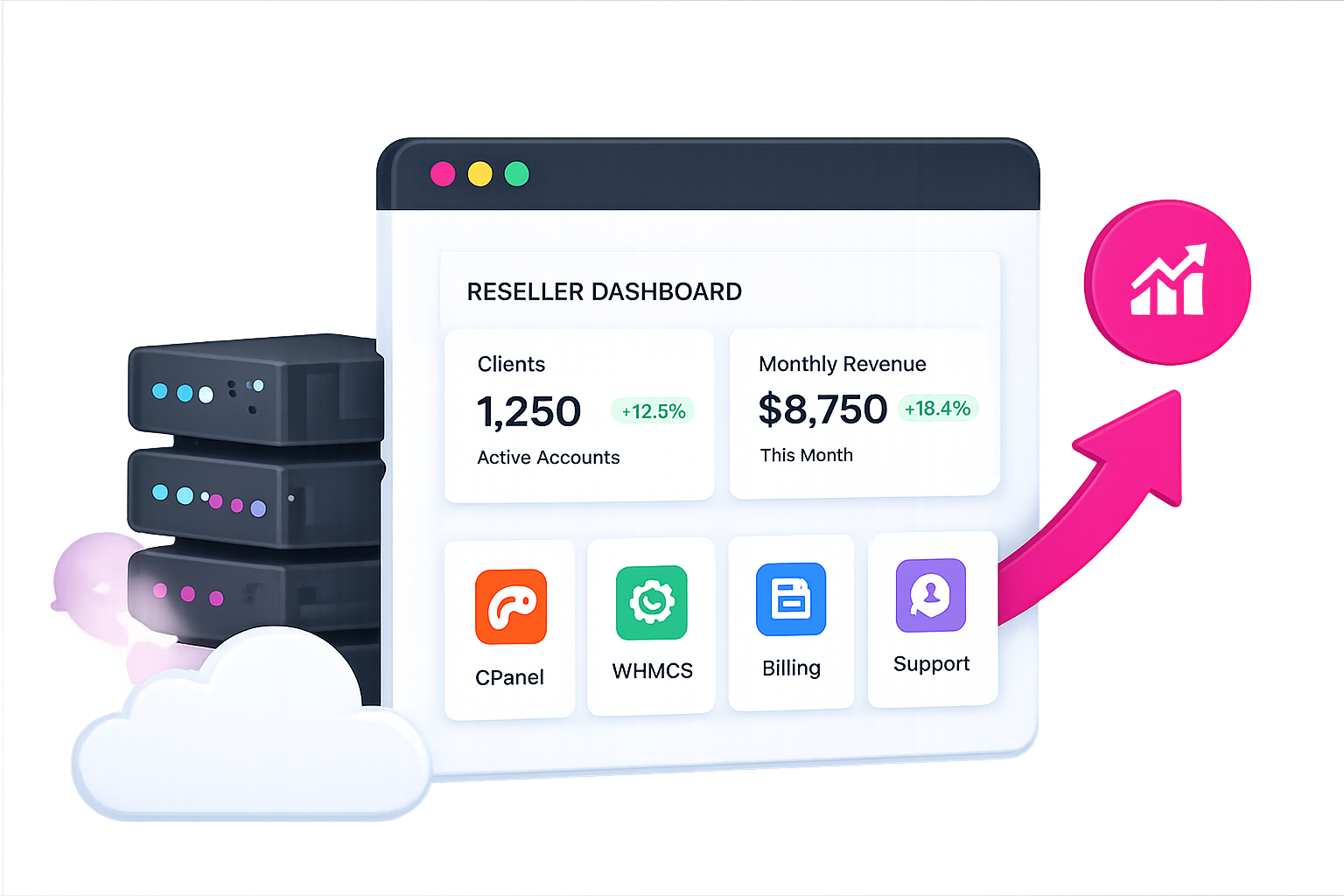
Reseller hosting gives each client store its own cPanel account, its own resources, and its own set of logins, all managed from a single WHM panel the agency controls. That separation is what keeps one client’s traffic spike, plugin conflict, or hacked account from touching anyone else’s store on the same server.
Creating separate hosting accounts for each client
Every client gets a dedicated cPanel account under the agency’s WHM. That means separate file systems, separate databases, separate email, and separate resource allocations, even though all of it lives on infrastructure the agency is reselling from one provider. If a client’s store gets flagged for a plugin vulnerability, it stays contained to that one account instead of spreading across every other store on the server.
We set up new reseller accounts for agencies constantly, and the ones that succeed almost always keep a strict one client, one account policy from day one. Stuffing three client stores into a single cPanel account to save a few dollars a month tends to turn into a mess later, usually right when the agency needs to hand one client’s account over during an offboarding.
Managing updates, backups, and security efficiently
WordPress and WooCommerce both need regular updates, and running fifteen separate installs means fifteen separate update cycles unless the agency standardizes its process. Most agencies solve this with a staging step. Update on staging first, confirm nothing broke, then push to the live client site, one account at a time rather than all at once.
Backups matter even more with WooCommerce than with a static WordPress site, because a corrupted or lost order database is not an inconvenience, it is lost client revenue. Daily, account level backups are one of the reseller hosting features worth confirming before a single client goes live, not after the first bad plugin update.
Scaling resources as client stores grow
A new client store with a hundred products and light traffic barely uses any resources. The same store two years later, with five thousand products, a loyalty plugin, and a Black Friday spike, is a completely different load. Reseller hosting lets an agency move that one account up to a higher resource NVMe VPS without touching any other client on the server.
This is where a lot of agencies get caught flat footed. They price hosting as if every client store stays small forever, then scramble when one store outgrows the plan mid contract. Building a resource review into the client relationship, even just once a year, avoids that entirely.
Using white label hosting to strengthen your brand
A reseller account lets the agency put its own name, logo, and support email on every hosting interaction the client sees, right down to the branded domain registration that ships with the account. The client never has to know the agency is buying hosting from anyone else.
That branding is not cosmetic. A client paying an agency directly for hosting sees a service, not a markup. A client who discovers the agency is just reselling a cheaper plan for a large margin tends to ask for a discount, or worse, signs up directly with the underlying host and cuts the agency out entirely.
How Should You Package WooCommerce Hosting Services for Clients?
The agencies making real recurring revenue from WooCommerce hosting bundle it into a monthly care plan alongside design and maintenance, rather than billing hosting as a bare line item. A single invoice covering hosting, updates, and support reads as a service. Hosting alone, billed separately, reads as a markup a client can shop around.
Bundling hosting with website design and maintenance
Hosting sold on its own competes on price against every cheap shared hosting ad a client will eventually stumble across. Hosting bundled with plugin updates, uptime monitoring, and a monthly check in competes on nothing, because the client isn’t buying hosting anymore. They’re buying peace of mind that someone is watching their store.
The agencies we see retain clients longest never mention hosting as a separate cost at all. It gets folded into website care, store management, or whatever term fits the agency’s own brand, with hosting quietly sitting underneath as the infrastructure that makes the rest of the plan possible.
Creating monthly support and care plans
A basic care plan usually covers WordPress core and plugin updates, a weekly uptime check, and one round of minor content edits. A higher tier adds security scanning, a faster support response window, and store specific tasks like adding new products or reviewing abandoned cart reports. Pricing these in tiers gives a client a reason to upgrade instead of a reason to cancel.
Support response time matters more on a store than on a brochure site, because a broken checkout costs the client money every hour it stays broken. Reliable spam free client email is part of that same reliability promise. Order notifications and password resets that land in spam are just as costly as a slow checkout.
Automating billing and account provisioning with WHMCS
Manually invoicing fifteen clients every month, tracking who paid, and remembering to suspend an overdue account is the single fastest way for an agency to burn out on its own hosting business. WHMCS automated billing handles that by itself. It bills clients on schedule, provisions a new cPanel account the moment a client signs up, and suspends access automatically if an invoice goes unpaid past a set grace period.
We bundle WHMCS free with every reseller plan specifically because this is where new hosting resellers lose the most time in year one. An agency running client hosting without automated billing is running an unpaid part time job. WHMCS still needs a human for the messy parts though. A disputed chargeback or a client asking for a mid cycle proration still needs someone reading the ticket.
Building recurring revenue through managed hosting
The math is straightforward once an agency runs it. A design project might net a few hundred dollars once. A managed WooCommerce hosting client on an eighty dollar a month care plan, retained for three years, adds up to close to three thousand dollars from a single client the agency would otherwise have invoiced once and never billed again.
That recurring number compounds fast. Ten clients on that same plan is close to eight hundred dollars a month in revenue that requires no new sales calls and no new proposals, just consistent delivery on a plan the agency already built once.
What Common Mistakes Should You Avoid When Hosting WooCommerce Stores?
The most common and most damaging mistake is stacking every client store onto a single hosting account to save money, which turns one client’s problem into every client’s problem. Close behind that is ignoring backups and performance until a store is already down, at which point the fix costs far more than prevention would have.
Placing all client stores in a single hosting account
It looks efficient at first. One cPanel, one login, everything managed in one place. It stops looking efficient the moment one client’s plugin gets compromised and the malware spreads sideways into every other site sharing that same account, because they all share the same file system permissions.
We have seen this exact scenario play out. An agency ran four client stores under one account, one store’s outdated plugin got exploited, and the agency spent a weekend cleaning malware out of all four sites instead of one. Separate accounts through a real reseller setup would have contained it to a single afternoon.
Ignoring performance optimization and backups
A WooCommerce store gets slower every time a client adds products, images, and plugins, and nobody notices until checkout starts timing out during a sale. Caching, image compression, and database cleanup are not optional maintenance items on a store. They are the difference between a client keeping a sale’s revenue and losing carts to a slow checkout page.
Backups get ignored for the same reason. Nothing goes wrong until it does. An agency that only discovers its backup schedule was broken after a client’s order database gets corrupted has already lost that client’s trust, regardless of how the recovery goes.
Choosing hosting without room for future growth
A client’s first year on a small reseller plan feels generous. Year two, with three times the product catalog and double the traffic, that same plan starts throttling. Agencies that never plan an upgrade path end up either overselling a plan that cannot handle the load, or scrambling to migrate a live store onto a dedicated server under pressure once it’s already struggling.
Picking a provider with a clear step up path, reseller to master reseller to a dedicated server, avoids ever having to migrate a client to a different company mid crisis.
Failing to establish clear maintenance responsibilities
Nothing sours a client relationship faster than a disagreement over who was supposed to be watching the store when it broke. If the agency’s care plan does not spell out exactly what is covered, monthly updates, backup verification, uptime monitoring, and what is not, custom feature builds, third party app troubleshooting, a client will assume everything is covered and get angry when it isn’t.
A one page written scope, even an informal one, attached to every client’s hosting agreement removes almost all of this friction before it starts.
How Does SkyNetHosting.Net Inc. Help Agencies Host WooCommerce Stores Successfully?
SkyNetHosting gives agencies a white label reseller account with NVMe powered servers, a free WHMCS license for automated billing, and 24/7 support behind the scenes, all built on more than 20 years of running hosting infrastructure for over 700,000 websites. That combination covers both the technical and the business side an agency needs to host client WooCommerce stores without building either from scratch.
White label reseller hosting for agencies
Every reseller hosting account from SkyNetHosting comes with full white label branding built in. Custom nameservers, a branded client area, and a branded support portal all carry the agency’s name, not SkyNetHosting’s. A client logging into their store’s hosting panel sees the agency they hired, not the infrastructure company behind the scenes.
NVMe powered hosting optimized for WordPress and WooCommerce
SkyNetHosting runs Intel Dual Xeon servers with NVMe drives and LiteSpeed instead of Apache, which matters specifically for WooCommerce because a store’s checkout page hits the database on every cart update. Bundled CloudFlare CDN caches static assets closer to the shopper. We have seen client sites move from a shared SSD plan to NVMe and cut page load times by more than half, without a single line of code changing on the site itself.
WHM and WHMCS support for efficient client management
Every reseller and master reseller account includes WHM for provisioning and managing individual client cPanel accounts, plus a free WHMCS license worth $15.95 a month bundled in at no extra cost. New client sites get spun up fast with Softaculous one click WordPress and WooCommerce installs, so an agency can onboard a client the same day the contract is signed instead of days later.
Scalable reseller infrastructure for growing e-commerce businesses
An agency that starts on a reseller plan with five client stores has a direct upgrade path as those stores grow, through master reseller hosting for higher account limits, and eventually onto a dedicated server if a single client’s store outgrows shared reseller infrastructure entirely. That path exists on the same account with the same support team, so a growing agency never has to migrate providers mid client relationship.
One honest limitation worth stating plainly. A reseller plan is the right starting point for an agency managing a handful of client stores. It is not the plan to stay on once an agency is running fifty active WooCommerce accounts with real traffic. That’s when a master reseller or VPS setup starts paying for itself, and we tell agencies this directly rather than letting them oversell a plan that will eventually buckle.
How Can WooCommerce Hosting Become a Long-Term Revenue Stream for Your Agency?
WooCommerce hosting turns into a real revenue stream the moment an agency stops treating it as an afterthought to a design project and starts pricing it as its own recurring service line with its own margin. Agencies that get this right build predictable monthly income that survives slow months where no new design work comes in.
Increasing client lifetime value through managed hosting
A client who only ever paid for a one time build has a lifetime value that ends the day the invoice is paid. A client on a monthly hosting and care plan keeps paying for as long as the relationship lasts, and a well run WooCommerce store rarely gets migrated away once it’s stable and growing.
Switching hosts is genuinely painful for a busy store owner. Product data, order history, and payment gateway settings all have to move without downtime, and most clients would rather keep paying a familiar agency than deal with that migration themselves. That inertia is worth more to an agency’s retention numbers than any single feature on the hosting plan.
Expanding services beyond website development
Hosting is often the first recurring service an agency adds, but it opens the door to others. Store management, product photography, ongoing conversion optimization, and paid ad management all sit naturally next to a client an agency already hosts, because that agency already has the trust and the login access most other vendors would need to build from zero.
Building a predictable recurring revenue business model
Design revenue is lumpy. Some months bring three new projects, some bring none. Hosting revenue is not. A client paying eighty dollars a month for hosting and care pays it in January and pays it in July, whether the agency landed a new client that month or not. That baseline is what lets an agency plan hiring, plan its own growth, and stop treating every slow month as a crisis.
This is the shift that separates a freelancer from an agency with an actual business model. A freelancer chases the next project. An agency with forty client stores on managed hosting has a floor under its revenue before a single new proposal goes out, and that floor is what makes it possible to hire, take on bigger clients, and stop pricing every job like the business depends on it landing.
Agencies ready to host WooCommerce stores for clients on infrastructure built for exactly this need a plan that grows from five stores to fifty without a provider switch. SkyNetHosting’s Master Reseller Hosting gives an agency the white label branding, free WHMCS billing, and account headroom to do that from the first client onward.
