
Budget Reseller vs Free Hosting: Why One Is a Business and One Is a Trap
Budget reseller hosting gives a beginner their own branded packages, real account limits, and a system that can actually take on paying clients.
Free hosting gives a beginner a demo of what hosting looks like, with someone else’s ads, someone else’s branding, and no real path to selling anything to a real client. Both cost close to nothing to start. Only one of them is actually a business.
This comparison walks through how each model is built to work, why free hosting quietly caps a beginner’s growth almost immediately, how a budget reseller account turns the same small monthly cost into something a real client will pay for, and the mistakes that lead people to pick the wrong one.
None of this is an argument against ever using free hosting at all. It has a legitimate place for a hobby project with no commercial ambition. The argument is narrower and more specific: the moment a real client or real revenue is even a possibility, free hosting stops being the safe, cheap choice it looks like on the surface.
What Is the Difference Between Budget Reseller Hosting and Free Hosting?
Budget reseller hosting is a paid account that lets someone create and sell their own branded hosting packages to real clients. Free hosting is a no cost account meant for personal use, built by the provider to cover its own costs through ads or upsells rather than through anything the account holder ever gets to sell.
How each hosting model is designed to work
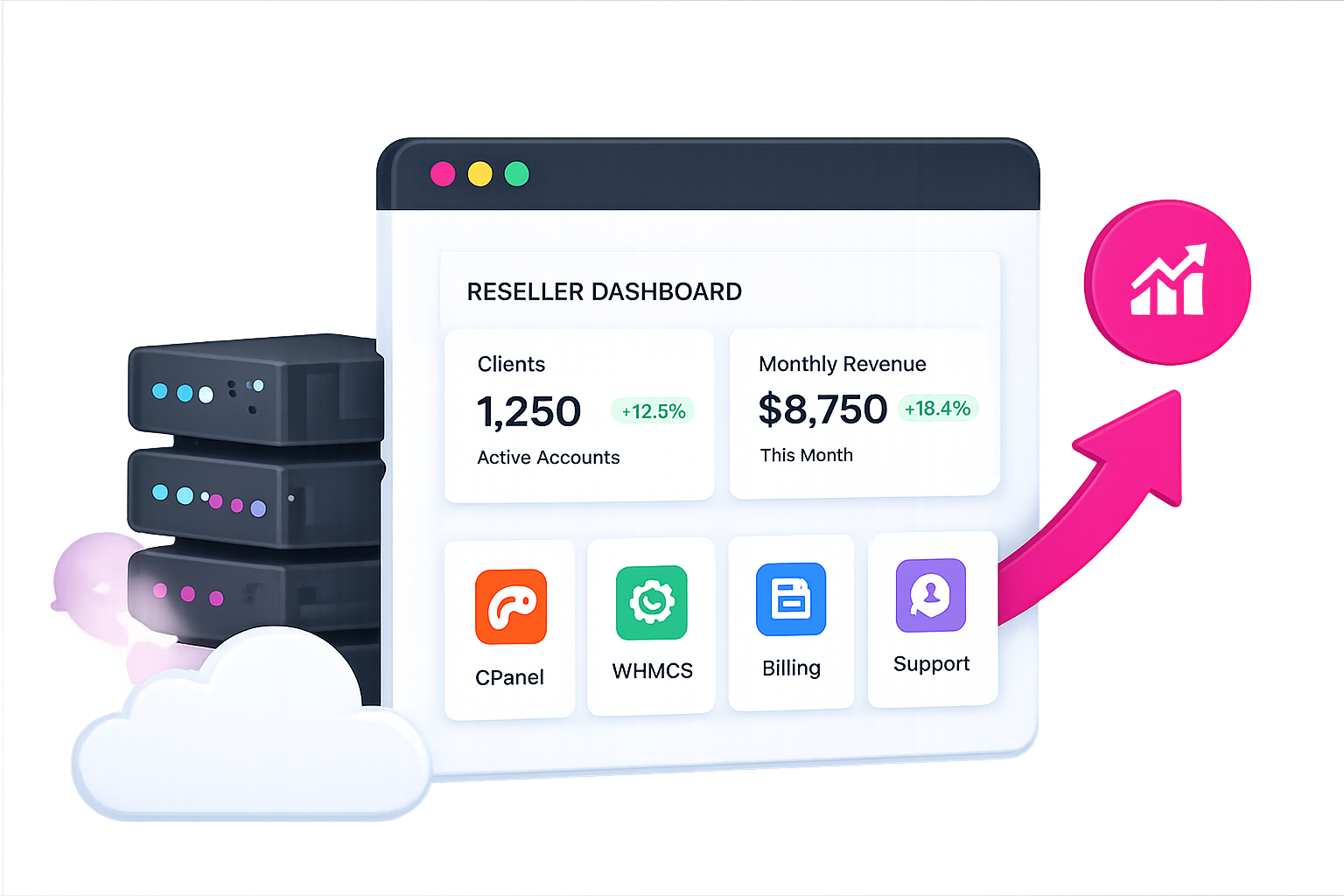
A reseller account sits between the hosting company and the end customer. The reseller buys server resources at a wholesale rate, packages them into their own plans, and sells those plans under their own brand. WHM gives the reseller full control over creating packages, adding customers, and managing their accounts, exactly like a small hosting company of their own.
A free hosting account is designed for exactly one user, the person who signed up, running exactly one site, usually with the provider’s own branding and often an ad banner attached somewhere on the page. There is no package creation screen, no client management panel, and no mechanism for selling the service to anyone else, because it was never built to be resold.
Neither model is inherently a scam or a mistake. They are simply built for different jobs. Free hosting was built to cost the provider almost nothing to run at scale, which only works because the account holder never becomes a paying customer generating revenue for anyone. Reseller hosting was built specifically so the account holder can generate that revenue themselves.
Who benefits most from each option
Free hosting genuinely suits a narrow use case well: a personal hobby project, a portfolio nobody depends on commercially, or a quick test of an idea before committing to anything real. For that use case, free hosting does exactly what it promises.
Budget reseller hosting suits anyone planning to host a client’s site, sell hosting as part of a broader service, or build something they intend to grow past a single personal project. The moment money or a real client relationship enters the picture, the free option stops fitting the job it was designed for.
This distinction is worth being honest about early, since it is far easier to start on the right side of it than to switch later. A beginner unsure which category they fall into is usually closer to the reseller side than they realize, especially if selling hosting has crossed their mind even once.
Understanding the long-term business impact
A beginner who starts on free hosting and later wants to actually sell hosting has to migrate every client to a new platform, a new set of nameservers, and often a new domain structure. A beginner who starts on a budget reseller account, even with just one or two clients, never has to make that jump, because the system was built to scale from day one.
That difference compounds over time. A year into running actual reseller hosting, a beginner who started correctly has a working business with paying clients. A beginner who started on free hosting and delayed the switch is often still rebuilding what the other person already has, just a year later and with more clients to migrate at once.
Why Does Free Hosting Often Create Challenges for Growing Businesses?
Free hosting creates problems the moment a site needs to look, perform, or behave like a real business rather than a hobby project. The restrictions that make free hosting sustainable for the provider are exactly the restrictions that block a beginner from ever using it commercially.
Limited resources and performance restrictions
Free hosting plans typically cap disk space, bandwidth, and processing power far below what even a modest business site needs once it gets real traffic. A site that loads fine during testing can slow to a crawl the moment a marketing campaign actually sends visitors to it, because the free tier was never sized for real usage.
We have seen a small business owner launch on free hosting, run a single social media promotion, and watch the site become unusable within hours because the account hit its resource ceiling almost immediately. The promotion that was supposed to bring in customers instead showed those same customers a broken page.
That kind of failure is invisible until it happens, since a free account looks perfectly functional right up until the moment real traffic actually arrives. A beginner has no way to know their site will buckle under a modest traffic spike until it already has, usually at the worst possible moment for the business behind it.
Branding and customization limitations
Most free hosting plans attach the provider’s own subdomain, branding, or an ad banner somewhere on the page, none of which a business can remove without upgrading to a paid tier anyway. A client visiting a site that says “hosted for free by” someone else’s brand questions the professionalism of the business behind it before reading a single word of content.
This is often the detail that finally pushes a beginner to upgrade, not a technical limit but a moment of genuine embarrassment showing a prospective client a page with someone else’s logo on it. By that point the beginner has usually already lost some credibility that a properly branded account from the start would have avoided entirely.
Reduced control over customer experience
A free host can change its terms, inject new ads, or shut down an account entirely with little notice, since the account holder is not a paying customer with any real standing to object. A business depending on that free account has effectively handed control of its own website to a provider with no obligation to keep the arrangement stable.
There is no support line to call when that happens either. Free accounts typically come with community forums at best, which is a reasonable tradeoff for a hobby project but a genuine risk for anything a real client or a real income depends on.
Scalability challenges as websites grow
A site that outgrows a free plan usually cannot simply add resources the way a paid account can. It has to migrate entirely, often under pressure, once the free tier’s limits are already causing visible problems for real visitors. That migration, done in a rush after something has already broken, is a far worse experience than planning an upgrade in advance ever would be.
A reseller account handles growth differently by design. Infrastructure built with overselling enabled WHM in mind gives even an entry level reseller plan real headroom for a client’s traffic spike, rather than the hard resource wall that defines a free account.
How Can Budget Reseller Hosting Help You Build a Real Hosting Business?
A budget reseller account gives a beginner the same tools a full hosting company uses, just at a smaller scale that matches where the business actually is right now. Nothing about the underlying system needs to change as the business grows, only the size of the packages and the number of clients on them.
Creating your own branded hosting services
A reseller account lets a beginner build hosting packages under their own company name, with their own nameservers and their own client portal through tools like MyCompanyWeb. A client never sees any trace of the underlying provider, which matters directly for anyone trying to look like an established business rather than someone reselling someone else’s product.
Bundling in a free domain reseller account lets a beginner offer domain registration alongside hosting under the same brand as well, removing one more reason a client would ever need to deal with a separate, unbranded provider.
Managing client accounts with WHM and cPanel
Every client account created through WHM gets its own cPanel dashboard, its own resource limits, and its own set of features, all controlled from one central reseller panel. Adding a second client, or a tenth, follows the exact same process as the first, which is exactly the kind of repeatable system free hosting never offers.
Comparing a provider’s reseller features against a free hosting control panel makes the gap obvious fast. One offers package creation, client billing integration, and white-label branding. The other offers a single site editor built for one person, never designed to manage anyone else’s account at all.
Generating recurring monthly revenue
A reseller account turns hosting into a monthly line item a beginner actually gets paid for, rather than something given away for free as part of a one time project. Even a handful of clients paying $15 to $30 a month builds a small but genuinely recurring income stream that a free hosting account structurally cannot produce, since there is nothing to charge a client for on a free plan.
This is the core difference that makes one path a business and the other a dead end. Free hosting has no billing mechanism at all built in, because it was never meant to generate income for the person using it. A reseller account is built around exactly that transaction from the very first screen.
Scaling your services as your customer base expands
A reseller account that starts with two or three clients can grow to dozens without switching platforms, simply by adding packages or upgrading the underlying plan. Once client volume grows enough to justify it, some resellers move up to master reseller hosting, reselling reseller accounts of their own, a path that never exists on a free hosting plan built for exactly one site.
What Mistakes Should Beginners Avoid When Choosing Between Free and Budget Hosting?
The mistakes that trap beginners on free hosting longer than they should stay almost always come down to evaluating the decision on cost alone, without asking what the account actually needs to be able to do six months or a year from now.
Choosing only based on upfront cost
Free costs nothing today, which makes it an easy first choice for anyone starting out on a tight budget. The real cost shows up later, in migration time, lost credibility with early clients, and the resource ceilings that show up right when the business is finally gaining traction.
Ignoring long-term business requirements
A beginner planning to eventually sell hosting to clients but starting on a free personal account is planning around today’s budget instead of tomorrow’s business. The gap between what free hosting supports and what an actual hosting business requires does not close gradually. It just becomes a hard wall the moment the first real client shows up wanting an account.
That wall arrives with no warning, since a free account gives no signal that it is about to become the wrong tool. One day it hosts a personal blog fine. The next, a friend asks to be hosted too, and the entire structure required to say yes simply does not exist.
Overlooking customer support and reliability
Free hosting rarely comes with any real support beyond a help article or a community forum, which is fine for a personal project but a serious liability the moment a paying client’s site goes down. A budget reseller account backed by actual support turns a technical problem into a quick fix instead of a client emergency with no one to call.
A beginner who has never had to manage a client through an actual outage sometimes underestimates how much this matters until the first time it happens. Knowing a real support team is reachable is worth more at that moment than almost any other feature on a hosting plan.
Underestimating future growth and upgrade needs
A beginner who assumes their first project will stay small forever often gets surprised by how quickly one client turns into three, or one small site turns into a real business needing real infrastructure. Starting on a system built to grow, even at the smallest and cheapest tier, avoids a painful and disruptive migration exactly when the business can least afford the interruption.
Growth rarely announces itself in advance. A single referral from a happy early client can double a small reseller’s account count in a week, and the beginner who already has room to grow handles that moment easily, while the one still on a free plan has to scramble.
How Does SkyNetHosting.Net Inc. Help New Resellers Start Professionally?
SkyNetHosting.Net offers budget reseller plans that give a genuine beginner the same WHM, WHMCS, and white-label tools used by established reseller businesses, just sized to a smaller starting budget. It is built as an actual entry point into the hosting business rather than a stripped down demo account with a ceiling baked in from the start.
Affordable reseller hosting plans for beginners
An entry level reseller plan costs a small monthly fee, often less than a single client’s hosting invoice would bring in, which means the account can become profitable from the very first paying customer rather than requiring a large client base just to break even.
That first client alone often covers the entire monthly cost of the plan, with everything after that representing genuine profit. It is a far lower bar to clear than most beginners assume when they first look at reseller pricing next to a free alternative.
WHM and WHMCS support for business automation
A free WHMCS license comes bundled with every reseller plan, giving even a brand new reseller automated billing and account provisioning from day one, the exact infrastructure a free hosting account has no version of at any price.
White-label hosting for building your own brand
Every part of the client facing experience, nameservers, the support portal, invoices, can run under the reseller’s own name rather than SkyNetHosting’s, which is the single biggest practical difference between a reseller account and a free hosting account that exists purely under someone else’s brand.
Scalable infrastructure that grows with your business
NVMe storage and LiteSpeed give even the smallest reseller account real performance headroom, and a reseller who outgrows the entry tier moves to a larger plan or NVMe VPS resources without migrating clients to a different provider, something free hosting simply has no equivalent path for.
How Can You Choose the Right Hosting Model for Long-Term Success?
Choosing correctly comes down to being honest about what the site or business actually needs to become, not just what it costs to start today. A personal hobby project and the beginning of a real hosting business look identical on day one, but they need entirely different foundations underneath them.
Matching your hosting choice to your business goals
Anyone with even a loose intention to eventually sell hosting, host client sites, or build a recurring income stream should start on a reseller account, even the smallest and cheapest one available, rather than a free plan that will need to be abandoned entirely the moment that intention becomes real.
The intention does not need to be fully formed yet either. Someone who is only fairly sure they might eventually take on a client still benefits from starting on infrastructure that supports that outcome, rather than one that actively blocks it.
Evaluating value instead of simply comparing prices
A budget reseller plan costing a few dollars a month more than free is not competing with free on price. It is competing with the cost of migrating clients later, the credibility lost to a branded free account, and the revenue a free plan structurally cannot generate. Measured that way, the comparison is not close.
Put in concrete terms, a few dollars a month spent on a reseller account against the potential of even a single $20 a month client is not really a cost at all, it is closer to an investment with a fast, obvious return once that first client signs up.
Building a sustainable hosting business from the start
A beginner who starts on the right foundation, even a small one, spends their time growing the business instead of rebuilding it later on a platform that should have been the starting point all along. The small monthly cost of a budget reseller account is what buys that head start.
None of this requires guessing right on the first try either. A reseller plan can start small and grow exactly alongside the actual client count, which means there is no real downside to starting correctly even before the business model is fully proven out.
Ready to start on a foundation that actually grows with you? Explore SkyNetHosting’s budget reseller plans and get white-label WHM and a free WHMCS license from your very first client.
