How SkyNetHosting.net Lets You Launch Your Own Branded Web Hosting Company in 24 Hours
SkyNetHosting.net lets you launch a fully branded web hosting company in 24 hours by combining a white-label reseller account, WHM for account management, and a free WHMCS license for billing and provisioning into one setup that does not require you to own or manage any server hardware. Your clients see your logo, your domain, and your nameservers. They never see SkyNetHosting’s name anywhere in the process.
Twenty four hours gets your business configured, branded, and technically live, ready to take a real order. It does not mean a fully polished company with a marketing engine and a loyal client base by the next morning. That part still takes the work every business takes.
What Do You Actually Need to Launch a Branded Hosting Company?
At a minimum, launching a branded hosting company requires a reseller hosting account, a domain for your brand, a basic website explaining what you sell, and a clear understanding of what you actually own versus what you are renting. Everything past that, automation, advanced branding, scaling, builds on top of those four pieces.
Choosing a reseller hosting infrastructure
A reseller account is what makes this whole 24 hour timeline realistic in the first place. Instead of buying and configuring a physical or virtual server yourself, a reseller plan gives you a slice of pre configured WHM and cPanel infrastructure you can immediately start dividing into client accounts.
SkyNetHosting’s reseller hosting plans run on CloudLinux with LiteSpeed and NVMe storage, which matters less for your launch day and more for the months after, once client sites start actually generating real traffic and the underlying performance either holds up or does not.
Registering a domain for your hosting brand
Your brand needs a domain before anything else can be branded around it. This is also the moment to decide whether you plan to sell domains to your own clients later, since setting up a domain reseller account now saves a separate configuration step down the line.
A free domain reseller account bundled with a SkyNetHosting reseller plan means you are not paying a separate registrar markup on top of your hosting costs, and it keeps domain sales inside the same WHMCS billing flow as your hosting packages instead of a disconnected side system.
Setting up your brand identity and website
You do not need a finished, polished company site on day one. You need a domain, a logo, and a page explaining your hosting packages clearly enough that someone can decide to buy. That basic version can go live in an hour with a simple builder or a handful of static pages, and it can be replaced with something more elaborate later without affecting anything already configured underneath it.
A logo does not need to be commissioned from a designer before launch either. A clean wordmark built in an hour, applied consistently across the WHM branding, the WHMCS email templates, and the storefront, reads as more professional to a client than an elaborate logo used inconsistently or not at all across those three places.
Understanding the difference between owning a brand and owning server infrastructure
This is the distinction worth being honest with yourself about before anything else. A reseller hosting company owns the client relationship, the pricing, the support, and the brand. It does not own the physical servers, the network, or the underlying uptime, all of which SkyNetHosting is responsible for behind the scenes.
That tradeoff is exactly what makes a 24 hour launch possible. Building your own data center infrastructure would take months and real capital. Renting proven infrastructure under your own brand takes a signup form and a few configuration steps.
How Can You Configure Your SkyNetHosting Reseller Account?
Configuring a SkyNetHosting reseller account means activating the plan, setting up WHM to manage client accounts, pointing private nameservers at your domain, and deciding how you will structure hosting packages before your first client ever signs up.
Activating your reseller hosting account
Signup and activation for a SkyNetHosting reseller plan typically completes within minutes of payment, after which WHM access arrives by email along with the server details needed for the next steps. This is usually the fastest part of the entire 24 hour process, since it is largely automated on SkyNetHosting’s side already.
Which reseller tier to start on is worth a moment of real thought rather than a default click to whichever plan sits in the middle of the pricing table. A Standard reseller plan is the right starting point for most new hosting businesses, since it is easy to upgrade later once actual client demand tells you whether you need more resources than a scaled down VIP or Corporate tier assumes from day one.
Setting up WHM and creating hosting packages
WHM is where you define what you are actually selling: disk space, bandwidth, email accounts, and which features like Softaculous or SSL come included at each tier. Most new resellers start with two or three packages, a basic tier, a standard tier, and a higher tier for larger sites, rather than trying to cover every possible client need on day one.
WHM runs on the same cPanel interface your future clients will use directly, which means the packages you build here define exactly what shows up in their control panel later. Getting this structure right at launch avoids having to migrate early clients between packages once you realize the original tiers do not quite fit real demand.
Configuring private nameservers
Private nameservers are what let a client’s domain point to ns1.yourbrand.com instead of a generic SkyNetHosting nameserver, and they are one of the more technical steps in the whole process, involving glue records at your domain registrar and matching A records inside WHM.
Concretely, that means creating two nameserver records at your registrar, ns1 and ns2, pointing to the IP addresses your reseller account was issued, then registering those same nameservers as glue records so the wider internet knows to trust them. WHM needs matching A records configured on its side before the pair actually resolves correctly for a client’s domain.
This step is also easy to get subtly wrong on a first attempt, since nameserver propagation can take a few hours to fully clear across the internet. Starting this configuration early in your 24 hour window, rather than leaving it for hour twenty, gives propagation time to finish quietly in the background while you work on other parts of the setup.
Creating the account structure for your future clients
Beyond the hosting packages themselves, WHM lets you decide how resources get allocated across client accounts as your business grows. Overselling, offering more combined disk space and bandwidth across packages than the server technically holds, is a standard practice in reseller hosting, since most individual sites use only a fraction of their allotted resources.
SkyNetHosting reseller plans come with overselling enabled by default, which gives you real pricing flexibility from day one. The tradeoff worth understanding honestly is that overselling assumes typical usage patterns, and a plan built entirely around resource heavy sites needs more conservative package limits than a plan built around typical small business sites.
How Can You Make Your Hosting Business Look Completely Branded?
A hosting business looks completely branded when a client can go through signup, hosting setup, billing, and support without ever encountering SkyNetHosting’s name anywhere in that journey. That requires attention to nameservers, visual identity, the client portal, and outbound communication, not just a logo on a homepage.
Applying your company name and visual identity
WHM and cPanel both support custom branding, your logo, your color scheme, your company name, replacing the default interface a client would otherwise see. This is a configuration step inside WHM rather than a design project, and it takes far less time than most new resellers expect going in.
The details worth checking carefully are the ones a client actually sees regularly: the login screen, the top of their cPanel dashboard, and any error pages the system generates. A generic default logo left in even one of those spots is usually the first thing that gives away that a client is not actually dealing with an independent hosting company.
Using private nameservers under your own domain
Once private nameservers are configured and propagated, every client site technically points back to your brand’s domain rather than SkyNetHosting’s infrastructure. This is arguably the single most important piece of white-label branding, since it is the one technical detail a curious client could actually check by looking up their own domain’s nameservers.
Most clients never think to check this, but the ones who do, often a more technical client migrating from another host, notice immediately if nameservers point to a name that gives away a parent hosting company. Getting this configured correctly before your first sale avoids that awkward conversation entirely.
Creating a branded client-facing experience
Beyond WHM and cPanel branding, clients need somewhere to log in, view invoices, and open support requests that also carries your brand rather than a third party’s. SkyNetHosting includes MyCompanyWeb storefront templates with reseller plans specifically for this, giving new resellers a branded client portal and storefront without building one from scratch.
Configuring professional billing and communication
Every automated email a client receives, a welcome message, an invoice, a renewal reminder, is a branding touchpoint as much as the control panel itself. WHMCS lets you customize these templates with your company name and voice rather than shipping default, generic wording.
Reliable delivery of those emails matters just as much as their wording, since a branded welcome email that lands in spam undermines the professional impression before a client even opens it. SkyNetHosting includes MailChannels email delivery with reseller plans, which handles the deliverability side so your automated communications actually reach the inbox.
How Can WHMCS Automate Your Hosting Business Before Your First Sale?
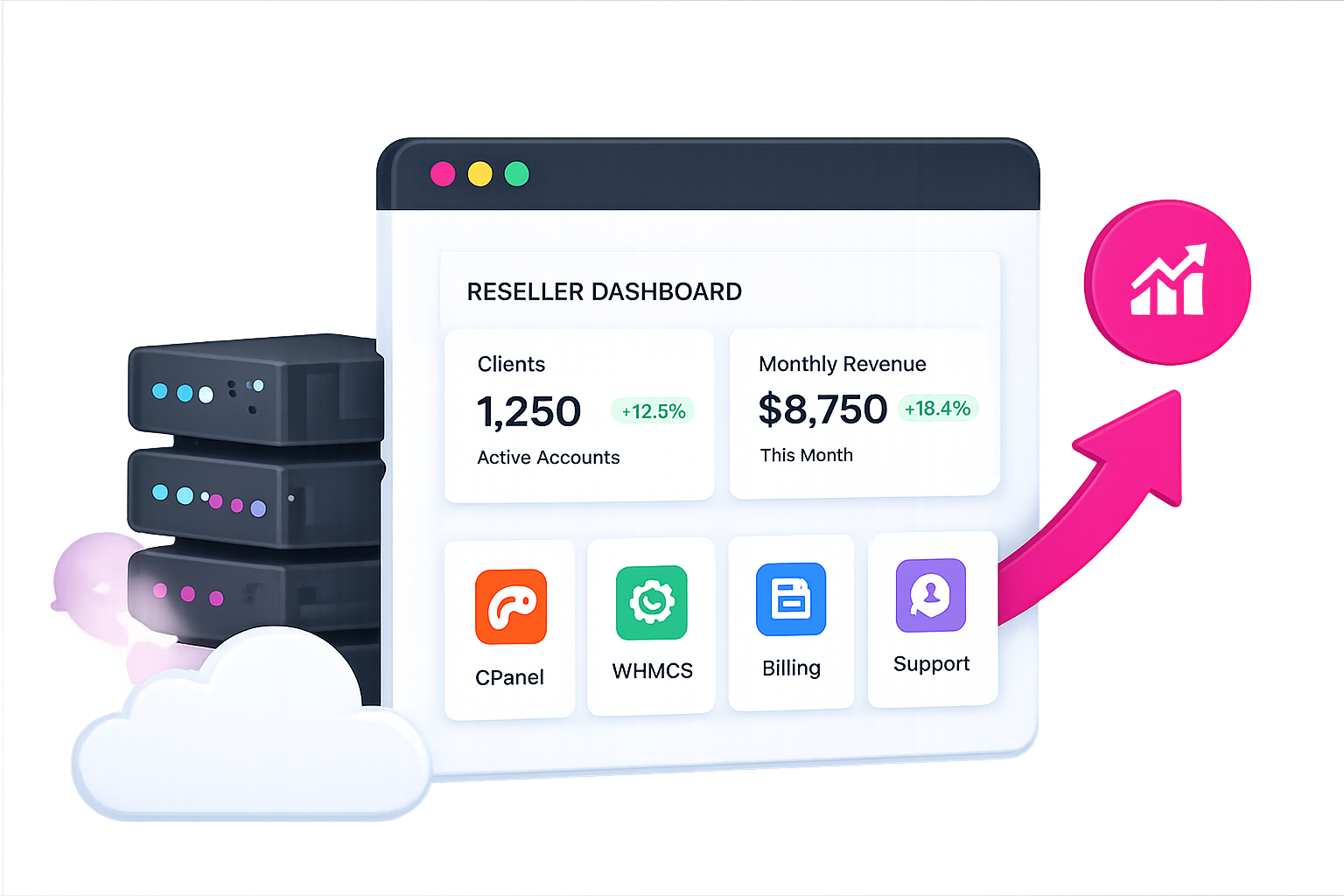
WHMCS automates the entire commercial side of a hosting business: connecting your packages to sellable products, provisioning new accounts automatically after payment, handling invoices and renewals, and giving clients a self service portal, all configured before you ever process a real order.
Connecting WHMCS with your hosting packages
WHMCS connects to your WHM server directly and maps each hosting package you created earlier to a sellable product with its own pricing, description, and billing cycle. This is the step where your technical WHM configuration turns into an actual storefront a client can browse and buy from.
Naming matters more here than it seems like it should. The package name you gave something inside WHM, often a short technical label, is not necessarily what you want a client to see listed as a product they are paying for. Renaming a package like pkg1 to something like Starter Hosting at the WHMCS product level, while leaving the underlying WHM package name untouched, keeps the technical and customer facing sides cleanly separated.
SkyNetHosting bundles a free WHMCS license with every reseller plan rather than requiring a separate monthly subscription, which removes what is normally one of the larger recurring costs in setting up this kind of automation from scratch.
Automating account provisioning after payment
Once connected, WHMCS creates the actual cPanel account in WHM automatically the moment a client’s payment clears, with no manual step required on your end. That single piece of automation is what genuinely makes a 24 hour launch realistic, since without it, every single order would need someone manually logging into WHM to create the account by hand.
Testing this specific flow before launch matters more than almost any other single check in the whole process. Placing a real order through your own storefront and confirming the account actually appears in WHM within a minute or two catches a misconfigured package mapping before a paying client ever hits it.
Setting up invoices, renewals, and service notifications
WHMCS handles the ongoing billing lifecycle automatically once configured: generating invoices ahead of a renewal date, sending payment reminders, and suspending or reactivating accounts based on payment status, all without you tracking any of it manually in a spreadsheet.
The default timing on these notifications, how many days before renewal an invoice generates, how many reminders go out before a suspension, is worth reviewing rather than leaving on whatever WHMCS ships with by default. A schedule that feels right for a large, established hosting company can feel aggressive or confusing to a client used to smaller, simpler services.
Creating a self-service client management system
Beyond billing, WHMCS gives clients a portal to manage their own services: upgrading a package, updating payment details, opening a support ticket, without needing to email you directly for routine requests. That self service layer is what lets a hosting business grow past a handful of clients without support volume growing at the same pace.
For a one person hosting business in particular, this is not a nice to have feature. Every request that a client can resolve themselves through the portal, a password reset, an invoice download, a plan upgrade, is a support interaction that never has to interrupt whatever else you are working on that day.
SkyNetHosting’s existing documentation confirms that WHMCS connects products directly to WHM packages and provisions accounts automatically once payment clears, which is the specific mechanism behind everything described in this section.
How Does SkyNetHosting.net Help You Launch Within 24 Hours?
SkyNetHosting compresses a 24 hour launch timeline down from what would otherwise take weeks by bundling the pieces that normally require separate vendors, white-label infrastructure, WHMCS licensing, domain reselling, and scalable server capacity, into one reseller account configured from a single dashboard.
White-label reseller infrastructure for your own brand
Every SkyNetHosting reseller tier, from Budget Reseller plans up through the higher VIP and Corporate tiers, includes white-label servers and private nameservers as a standard feature rather than a paid add-on, which matters since white-labeling is not optional for a genuinely branded hosting business, it is the entire point.
WHM and WHMCS tools for managing and automating client accounts
WHM and WHMCS together cover both sides of the business: WHM for the technical account and resource management, WHMCS for the commercial billing and provisioning side. Having both included and pre integrated on the same platform is what removes the usual multi vendor setup process most new hosting businesses have to piece together themselves.
Piecing that same stack together independently usually means evaluating a separate billing platform, confirming it actually integrates cleanly with whichever control panel you chose, and troubleshooting that integration yourself the first time a provisioning request fails silently. Starting from a pre integrated pairing skips that entire evaluation and debugging phase.
Free WHMCS licensing included with reseller plans
A standalone WHMCS license runs a genuine monthly cost on top of hosting, and SkyNetHosting including it free with reseller plans removes that expense entirely from a new hosting business’s early overhead, right when cash flow matters most before any recurring client revenue exists yet.
Domain reseller capabilities for selling domains alongside hosting
A free domain reseller account bundled with your hosting plan lets you sell domain registrations alongside hosting packages through the same WHMCS storefront, which is a meaningful additional revenue stream for very little extra setup work once the hosting side is already configured.
Scalable infrastructure for growing your hosting business
The reseller tier you launch on does not need to be the tier you stay on. As a client base grows past what a Standard reseller plan comfortably supports, moving up to a Master Reseller account adds the ability to create and resell sub accounts to other resellers, which is a natural next step rather than a full infrastructure migration.
SkyNetHosting currently states that its reseller plans include white-label infrastructure, a free WHMCS license, and a free domain reseller account as standard, with private nameservers and a branded client experience described consistently across its published material, which is the specific combination this entire launch timeline depends on.
What Can You Realistically Complete During Your First 24 Hours?
A realistic 24 hour timeline front loads the slow, propagation dependent steps early, handles technical configuration through the middle of the day, and leaves the final hours for branding and testing rather than critical infrastructure work that needs time to settle.
Hours 1–4: Setting up your reseller account and domain
Sign up for a reseller plan, register or point your brand domain, and start the private nameserver configuration immediately, since this is the step most likely to need propagation time later. Getting this moving in the first few hours means it is quietly finishing in the background while you work on everything else.
Hours 5–8: Configuring WHM and hosting packages
With WHM access in hand, build your initial hosting packages, two or three tiers is usually enough for launch, and apply your basic branding, logo and company name, inside WHM and cPanel. This block is mostly deliberate decision making rather than technically difficult work.
Hours 9–12: Setting up WHMCS and automated provisioning
Connect WHMCS to your WHM server, map your packages to sellable products with pricing, and confirm automated provisioning actually works by walking through the flow yourself. This block is the technical core of the entire launch, and it deserves the most careful attention of any single stretch in the day.
Hours 13–18: Branding your client experience
Customize WHMCS email templates, set up your MyCompanyWeb storefront or basic marketing site, and confirm private nameservers have finished propagating by checking them from an external lookup tool rather than assuming they are ready.
Hours 19–24: Testing orders, emails, DNS, and account creation
Place a real test order through your own storefront, confirm the welcome email actually arrives and does not land in spam, verify the new cPanel account gets created automatically, and check that a fresh domain resolves correctly through your private nameservers. Finding a broken step now, while it only affects a test order, is considerably better than a real client finding it first.
A 24 hour launch only holds together if the reseller infrastructure underneath it can actually support what you are promising your first client: real uptime, real storage headroom, and white-label tools that work the way this timeline assumes they will. See exactly what each SkyNetHosting reseller tier includes on the Compare Reseller Features page before picking the plan your launch day is built on.
