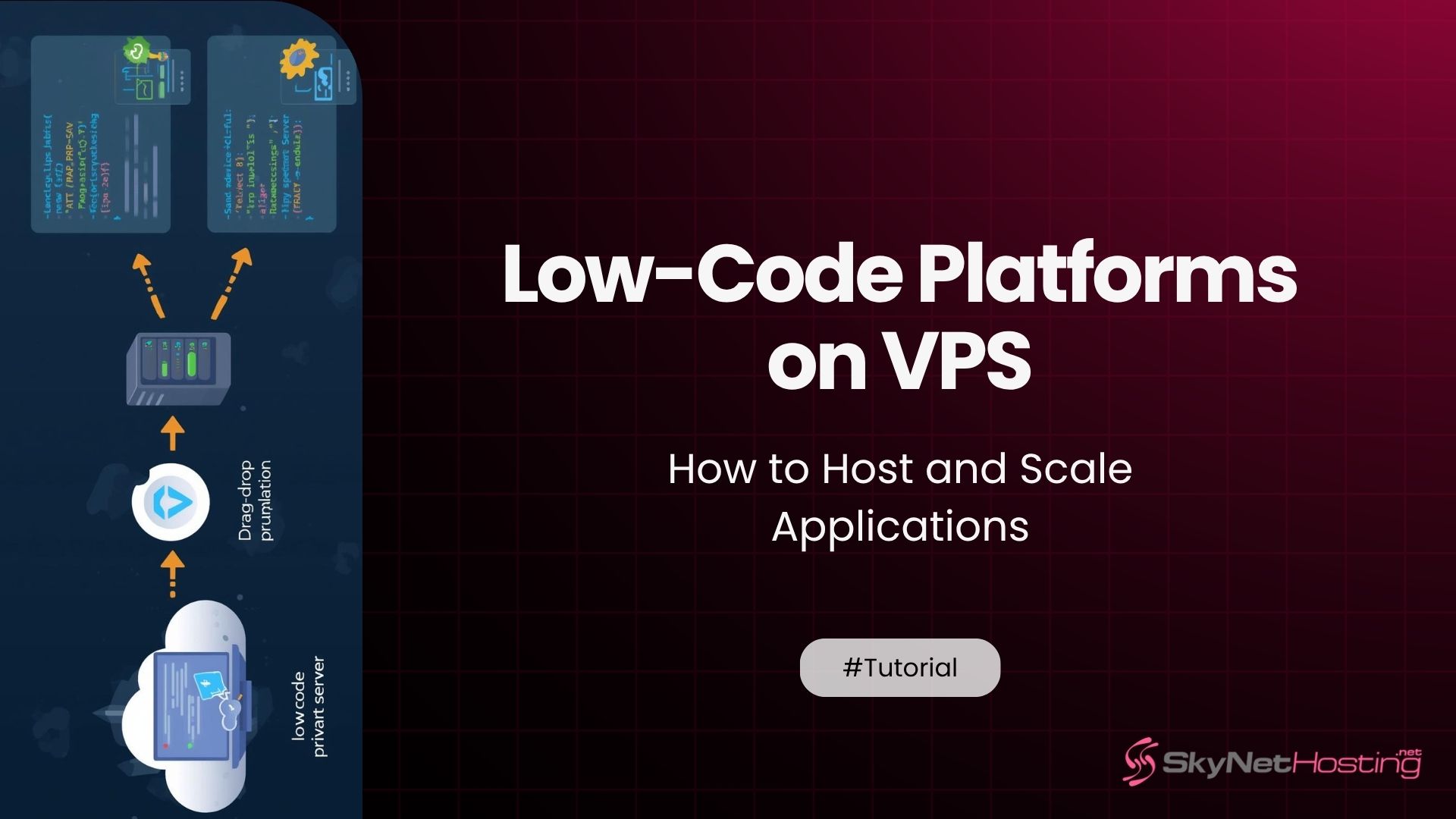
Low-Code Platforms on VPS: How to Host and Scale Applications
I have worked in the web hosting industry for over 10 years. During this time, I have watched how people build websites and applications change entirely.
You no longer need a huge team of expensive developers to launch a software product. App builders and no-code development tools have completely changed the game. You can now drag and drop your way to a fully functional application in a matter of weeks.
But there is a catch. The software you build is only as good as the server it runs on.
If you put a complex low-code application on a cheap shared hosting plan, it will crash. I see this happen all the time. That is why choosing VPS hosting for low code platforms is absolutely critical.
In this guide, I will show you exactly how to host low code apps properly. We will look at why a Virtual Private Server (VPS) is the best choice, what features you need, and how to scale your application successfully.
What Are Low-Code Platforms and How Do They Work?
Before we talk about servers, let us make sure we understand the tools we are hosting.
Definition of low-code and no-code platforms
Low-code and no-code platforms are visual software development tools. They allow you to build applications without writing thousands of lines of raw code.
Instead of typing out commands in a programming language, you use a visual interface. You drag buttons, text boxes, and data tables onto a canvas.
The platform writes the complex code for you in the background. It is a massive shortcut for rapid application development.
How businesses use low-code tools
Businesses love these tools because they save time and money.
Hiring a full engineering team is incredibly expensive. Low-code hosting solutions allow a single tech-savvy employee to build tools that would normally take a whole team to create.
Startups use them to launch minimum viable products (MVPs) quickly. Large agencies deploy client solutions in half the usual time.
Popular use cases for rapid application development
I see businesses using these platforms for almost everything.
Many use them to build custom Customer Relationship Management (CRM) systems. Others create internal employee portals or inventory tracking dashboards.
I also see a lot of workflow automation tools designed to move data automatically between different marketing apps.
Why Host Low-Code Platforms on VPS Instead of Shared Hosting?
You have built your app. Now you need a place to put it. This is where many people make a massive mistake.
Resource isolation and performance benefits
Shared hosting is like living in a crowded apartment. You share CPU, RAM, and storage with hundreds of other users. If your neighbor gets a sudden spike in traffic, your app slows down.
A VPS gives you your own private space. Your resources are totally isolated. No one else can steal your RAM or CPU power.
This isolation is why I always tell my clients to migrate from shared hosting to NVMe VPS when their apps start growing. It guarantees consistent performance.
Improved scalability and flexibility
Shared hosting limits what you can do. You are stuck inside a rigid box.
Low code deployment on VPS is completely different. A VPS lets you scale up instantly. If your app goes viral and you suddenly need double the RAM, you can add it with a few clicks.
You control the environment completely.
Enhanced security and customization
Security is a massive deal for business applications. On shared hosting, you are at the mercy of the server’s general security rules.
With a VPS, you get full root access. You can install custom firewalls and specific security tools.
If you want total control over these security features, you might want to look into unmanaged VPS hosting. It lets you configure your security rules exactly how your app needs them.
What Are the Benefits of Using VPS for Low-Code Applications?
Let us look closely at why VPS for no code platforms is the smartest choice for your project.
Dedicated resources for better performance
Low-code apps can be heavy. They run a lot of background processes to make that visual drag-and-drop magic work.
When you use a VPS, your app has dedicated resources. It does not have to wait in line to process a task.
This means your buttons click instantly, your pages load fast, and your users stay happy.
Faster database and API response times
Every time a user searches for something in your app, it queries a database.
On a standard server, database queries can take a long time. This makes your app feel sluggish.
Modern NVMe VPS hosting solves this. NVMe drives process thousands of requests at the same time. They can cut your database response times by up to ten times.
Ability to scale applications as usage grows
You might only have 10 users today. But what happens when you have 10,000 users next year?
Your hosting needs to grow with you. A major benefit of scalable hosting for low code apps is that you never outgrow your server. You just upgrade your plan.
There is no need to rebuild your application from scratch just because you got popular.
Which Low-Code Platforms Work Best on VPS?
Not every platform needs its own server, but some absolutely thrive on a VPS.
Workflow automation tools
Tools like n8n or Node-RED are perfect for VPS hosting.
These platforms run constantly in the background. They listen for triggers and move data between your APIs.
Because they run 24/7, they need the stable environment that a VPS provides.
Internal business applications
Self-hosted platforms like ToolJet, Appsmith, or Budibase give you total control over your business data.
Many companies do not want their sensitive customer data sitting on a public cloud. Hosting these internal tools on your own VPS keeps your data private and secure.
SaaS and customer-facing platforms
If you are building a product to sell to other people, performance is everything.
Customers will not pay for a slow application. A VPS ensures your SaaS product remains fast, responsive, and professional looking at all times.
What VPS Features Are Important for Low-Code Hosting?
If you want to host low code apps successfully, you need to look at the server specifications closely.
CPU, RAM, and storage requirements
You cannot run a robust app on 1GB of RAM. It will crash.
For most basic low-code deployments, I recommend starting with at least 2 CPU cores and 4GB of RAM. If you run a database-heavy app, you will need more.
If you are unsure how to check your resource usage, reading a detailed VPS management and setup guide is a great first step.
NVMe storage for high performance
Do not settle for old SATA hard drives or basic SSDs. You need NVMe storage.
NVMe connects directly to your server’s processor. It delivers nearly 10 times more Input/Output Operations Per Second (IOPS) than older drives.
For database performance, NVMe is non-negotiable. It makes your app feel incredibly fast.
Network speed and uptime guarantees
A fast server means nothing if your network connection is slow.
Look for a VPS provider offering at least a 1Gbps network uplink. You also want a 99.9% uptime guarantee.
Your app needs to be online when your users need it. Fast DNS updates also matter. If you are curious about how network routing affects your site, checking out DNS propagation time details can be very helpful.
How Does SkyNetHosting.Net Inc. Support Low-Code Platforms on VPS?
Finding the right host takes a lot of guesswork out of deployment. SkyNetHosting.Net provides infrastructure built exactly for these heavy workloads.
High-performance VPS infrastructure
SkyNetHosting.Net runs on the latest Intel Dual Xeon CPUs. Their servers use pure NVMe storage.
They also offer over 25 global data center locations. This means you can host your application physically close to your actual users, cutting down network delay significantly.
Scalable hosting solutions for growing apps
You can start with a small plan and grow seamlessly.
Upgrading your RAM or CPU capacity does not require you to migrate servers. You avoid long periods of downtime. It is completely straightforward.
If you are planning a big move, learning how to smoothly move a site to VPS hosting will save you major headaches.
Reliable uptime and developer-friendly environment
With a 99.9% uptime guarantee and deep DDoS protection, your app stays online.
You also get full root access. You can configure your environment exactly as your low-code platform requires. You can even set up secure remote access to VPS for your development team to manage things safely.
What Challenges Should You Expect When Hosting Low-Code Apps?
It is not all perfectly smooth sailing. You need to be prepared for a few technical hurdles.
Managing integrations and APIs
Low-code apps rely heavily on APIs to talk to other software.
If your server has a slow connection, these API calls will time out. Your app will break. You must ensure your server has a strong, stable network connection to handle hundreds of external requests a minute.
Scaling applications efficiently
If you do not monitor your server, you will run out of memory.
You need to set up tools to watch your RAM and CPU usage. If your app is constantly hitting 90% RAM usage, you must scale up before it crashes.
Security and access control considerations
Because you are managing the server, security is on your shoulders.
You have to change default SSH ports. You have to configure firewalls like UFW. You should install Fail2Ban to block hackers from guessing your passwords.
If you skip these steps, your application is vulnerable.
How to Choose the Right VPS for Low-Code Platforms
Picking the right provider is half the battle. Here is how I narrow down the options.
Matching resources to application needs
Do not overbuy, but do not under-provision either.
Look at the minimum requirements for your specific low-code tool. Then, double it. This gives your app breathing room for traffic spikes.
Take your time to research and choose the best VPS hosting plan for your actual budget and needs.
Evaluating performance and scalability
Read the fine print. Make sure you are actually getting NVMe storage, not just standard SSDs.
Check if they allow seamless resource upgrades. Finding the best VPS hosting provider in 2026 means looking past the marketing talk and checking the actual hardware specs.
Selecting a provider with strong support
If your server crashes at 3 AM, who are you going to call?
You need a provider with 24/7 expert support. Sometimes you might want to handle the software yourself, but have experts manage the hardware. In that case, exploring co-management hosting models is a smart middle ground.
Building Your Next Big Idea on the Right Foundation
Choosing the right infrastructure makes all the difference.
VPS hosting provides flexibility and scalability for low-code platforms
A VPS gives you the isolation, speed, and control you simply cannot get on a shared server.
Your application gets its own dedicated resources. You get faster database queries and instant scaling when you need it.
Ideal for businesses building apps without full development teams
You do not need a massive team of engineers to build something great anymore.
By combining powerful visual app builders with a fast virtual server, a small team can launch enterprise-grade software. It is the ultimate productivity hack.
SkyNetHosting.net offers reliable VPS solutions for modern low-code applications
If you want hardware that actually keeps up with your ideas, you need NVMe storage and robust network connectivity.
SkyNetHosting.Net gives you the exact tools required to host low-code apps successfully. Build your app, put it on a fast server, and watch your business grow.
Meta data
Meta title
Low-Code Platforms on VPS: Hosting & Scaling Apps in 2026
Meta description
Learn how to host and scale low-code platforms on VPS. Discover why NVMe storage, dedicated resources, and scalable infrastructure are vital for your app.