
10 Mistakes New Reseller Hosting Businesses Make in Their First Year
Starting a reseller hosting business feels straightforward at first. You sign up for a reseller plan, set up a few hosting packages, and you are in business. The technical side is manageable. The real challenges tend to show up a few months in, and they almost always trace back to decisions made in those first weeks.
The good news is that these mistakes follow predictable patterns. The same problems keep appearing in the same order for new reseller hosting businesses everywhere. That means you can see them coming, understand why they happen, and avoid them entirely rather than learning the hard way.
This guide covers the ten mistakes that most commonly derail new hosting businesses in their first year, with practical advice on how to sidestep each one.
Why Many New Reseller Hosting Businesses Struggle
Before getting into the specific mistakes, it helps to understand the broader context. Reseller hosting is a genuinely accessible business model, and that accessibility is both its strength and its challenge.
Low Barriers to Entry
Anyone can start a reseller hosting business in an afternoon. The low barrier to entry is what makes it appealing, but it also means many people launch without thinking carefully about how they will run and grow the business over time. Getting started is easy. Building something sustainable requires more intention than most people bring to those first few days.
Competition in the Hosting Industry
There are over 330,000 hosting providers worldwide, and a large portion of them are resellers just like you. The ones competing purely on price are in a race they cannot win because there will always be someone willing to go cheaper. The businesses that build real staying power are the ones competing on service quality, niche expertise, and genuine client relationships.
Importance of Operational Planning
Most new resellers focus on the technical setup — control panels, hosting packages, payment gateways. What trips them up is the operational side: how they handle support, how they price their services, how they attract clients beyond their immediate personal network. The ten mistakes below are almost all operational, not technical. Get the operations right and the technology takes care of itself.
Mistake #1: Choosing the Cheapest Upstream Provider
This is where most reseller hosting businesses go wrong before they sign up a single client. The upstream provider you choose is the foundation everything else is built on, and the cheapest option almost always has a reason for being the cheapest.
Poor Performance and Downtime Risks
Cheap reseller plans exist because corners were cut somewhere. Overcrowded servers, aging hardware, slow support response times, or limited network redundancy are common trade-offs. When your upstream provider has a server issue at 2am, your clients call you — not them. And if your provider takes eight hours to respond to a critical outage, that eight hours of downtime lands entirely on your reputation.
Hidden Limitations in Cheap Plans
Cheap reseller plans often advertise unlimited everything and deliver something much more constrained in practice. Unlimited storage with acceptable use policies that throttle heavy accounts, unlimited bandwidth that gets shaped during peak hours, or shared IP ranges already flagged by spam blacklists. Always read the terms of service carefully and ask direct questions about what unlimited actually means before committing.
Importance of Infrastructure Quality
Your upstream provider’s infrastructure quality determines the ceiling of what you can offer your clients. You cannot promise reliable performance if your provider’s servers are outdated or overcrowded. Choose your upstream provider the way you want your clients to choose you — based on documented uptime records, responsive support, modern storage technology, and honest pricing. Getting this decision right from the start makes everything else easier.
Mistake #2: Overselling Hosting Resources
Overselling means allocating more resources across client accounts than your hosting plan can comfortably support. Done carelessly, it causes performance problems that affect every client on your server at the same time.
CPU and RAM Bottlenecks
When too many active websites share a server that does not have the headroom to support them all simultaneously, CPU utilization climbs, RAM fills up, and sites slow down noticeably. A page that normally loads in one second can suddenly take six or eight. Your clients notice this immediately, even if they cannot explain the technical cause.
Client Performance Complaints
Performance complaints are the early warning sign of overselling, and new resellers often miss what they mean. Multiple clients complaining about slow sites in the same period is almost never a coincidence — it is a resource problem at the server level. Monitor your server’s CPU and RAM utilization regularly and upgrade your plan before you hit the ceiling, not after clients start pushing back.
Maintaining Stable Hosting Environments
The safest approach is to build in a buffer. Know what your reseller plan includes in terms of actual resources and stop adding accounts well before you approach those limits. A hosting business with 40 satisfied clients on a plan that supports 60 is in a healthy position. A business with 80 frustrated clients on a plan designed for 50 is one bad week away from a mass cancellation event.
Mistake #3: Ignoring Customer Support Quality
You can have fast servers, clean branding, and competitive pricing. If your support is slow or hard to reach, clients will leave. Support quality is the single factor that most determines whether a client stays for one year or five.
Slow Response Times
Small business owners are not patient when their website is down. Every hour a site is offline is an hour of lost business for them, and they expect someone to respond quickly when they reach out. A reply that arrives the next business day is not support — it is abandonment. Set realistic response time targets and stick to them, especially for urgent issues like downtime or email failures.
Losing Long-Term Clients
Poor support is not just a client experience problem — it is a revenue problem. A client who leaves after one year takes their monthly recurring income with them permanently. Replacing that client requires marketing effort, time, and onboarding work. Keeping the clients you already have costs only the time it takes to respond to their questions well. The math on retention versus acquisition strongly favors keeping people happy.
Building Trust Through Support
The hosting businesses that build genuinely loyal client bases do so through support, not pricing or features. When something goes wrong and a client reaches someone who responds quickly, understands the problem, and resolves it effectively, that interaction builds more trust than months of smooth sailing. Treat every support interaction as an opportunity to strengthen a relationship that keeps a client paying you for years.
Mistake #4: Weak Branding and Positioning
Browse a dozen reseller hosting websites and you will see the same thing repeated: generic stock photos of server racks, vague taglines about reliability and speed, and identical feature lists that tell you nothing about why this provider is any different from the next one.
Generic Reseller Websites
A generic hosting website does not just fail to attract clients — it actively makes the decision harder for anyone considering you. When your website looks and reads like every other hosting provider, the only differentiator left is price. And competing on price against providers with larger scale and lower cost structures is a race you will lose every time.
Failure to Differentiate
Differentiation does not require inventing something new. It requires being honest about who you serve best and saying it clearly. A hosting provider that explicitly focuses on WordPress hosting for creative agencies is more compelling to a creative agency than a generic host that serves everyone. You do not lose clients by niching down — you lose the clients who were never a good fit and attract the ones who feel specifically understood.
Building a Niche-Focused Brand
Think about the clients you have already served or the industry you know best. A web designer who has built twenty restaurant websites understands the hosting needs of that audience better than any generic provider can. That expertise, made visible through targeted messaging, becomes a genuine competitive advantage that price alone can never replicate.
Mistake #5: Not Automating Billing and Provisioning
In the early days, handling billing manually feels manageable. You have five clients, you send invoices when you remember, and you create accounts by hand when someone signs up. Then you grow to twenty clients, then forty, and the manual workflows that were slightly inefficient at five accounts become genuinely unsustainable.
WHMCS and Hosting Automation
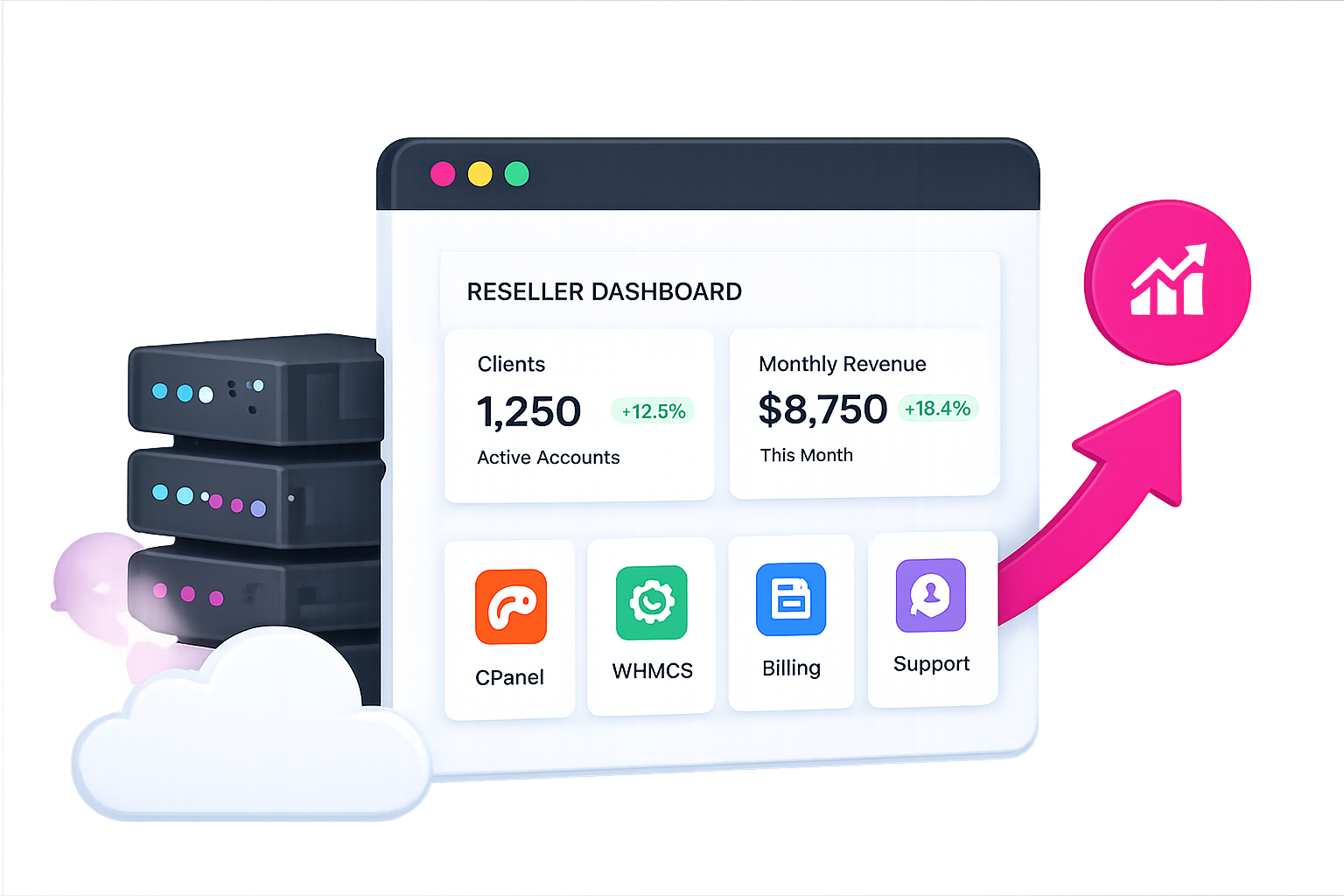
WHMCS is the industry-standard billing and automation platform for hosting businesses, and it solves every one of these manual workflow problems. It sends invoices automatically, collects payment through integrated gateways, provisions cPanel accounts the moment payment clears, suspends non-paying accounts, and reactivates them when payment arrives. SkyNetHosting.Net includes WHMCS free with every reseller plan, removing the licensing cost that can otherwise be a barrier for new businesses.
Manual Workflow Problems
Manual billing creates predictable problems. Invoices sent late mean payments arrive late and cash flow becomes unpredictable. Missed renewals mean clients whose hosting silently expires while they assume everything is fine. Manual account provisioning means clients wait hours for an account they expected immediately. Every one of these problems damages your professional reputation, and all of them are solved by a proper automation setup.
Scaling Operations Efficiently
Automation is not just about fixing problems — it is about building a business that scales without proportionally increasing your administrative time. A hosting business with automated billing and provisioning can grow from ten clients to a hundred without adding meaningful overhead. A business relying on manual processes hits a ceiling where growth just means more work rather than more revenue.
Mistake #6: Pricing Services Too Cheaply
New resellers almost universally underprice their services. Starting low feels like the safe approach — attract clients quickly, raise prices later. In practice it attracts the wrong clients, creates unsustainable margins, and makes raising rates later far harder than expected.
Low Profit Margins
Consider the numbers honestly. If you are charging eight dollars a month for hosting and your reseller plan costs you six dollars for ten accounts, you are making two dollars per client per month. At twenty clients that is forty dollars a month — not enough to cover the time you spend on support and administration, let alone represent meaningful income. Sustainable pricing starts at fifteen to twenty dollars per month for entry-level plans, with higher tiers going further.
Attracting Difficult Customers
Price-sensitive clients are the most demanding and the least loyal. They chose you because you were the cheapest option available. The moment someone offers them something cheaper, they leave. In the meantime, they submit the most support tickets, push hardest against plan limits, and are least understanding when something goes wrong. Clients who choose you based on value and service quality behave completely differently — they stay longer, refer others, and upgrade their plans as their needs grow.
Creating Sustainable Pricing Structures
Price your plans to reflect the actual value you deliver, not just the cost of your upstream infrastructure. You are not reselling server space — you are providing managed hosting with personal support and a relationship that matters when something needs attention. Research what comparable service-oriented hosting providers charge, position yourself at or above the midpoint of that range, and review your pricing annually as your reputation grows.
Mistake #7: Ignoring Security and Backups
Security and backup failures are the fastest way to permanently damage a hosting business’s reputation. A slow website frustrates clients. A compromised website or lost data creates a crisis that good service afterward cannot fully recover from.
Website Compromise Risks
Hosting environments are constant targets for automated scanning and exploitation attempts. Outdated WordPress installations, weak admin passwords, and misconfigured server settings are the most common entry points. As a hosting provider, you have a responsibility to maintain a secure server environment and to keep clients informed about their own security responsibilities. An unpatched installation that gets compromised reflects on your hosting platform, even when the vulnerability was in the client’s own software.
Backup and Disaster Recovery Importance
Backups are the safety net for almost every hosting disaster scenario. Hacked site, accidentally deleted database, plugin update that broke everything — all of these become manageable problems with a recent backup available. Without one, each scenario becomes a potentially devastating recovery effort. Configure automated daily backups for all client accounts from the moment your hosting environment is live, and store them somewhere independent of the primary server.
Client Trust and Reputation Damage
When a client’s website is compromised or data is lost and you have no backup to restore from, the trust damage is immediate and severe. Clients talk to each other and to their networks. A story about a hosting provider who lost a business’s entire website with no recovery option spreads quickly. Security and backups are not optional features — they are the minimum standard of professional responsibility that clients assume you are operating above.
Mistake #8: Failing to Plan for Growth
Most new resellers focus entirely on getting their first clients, which makes sense. But the businesses that build something sustainable think about where they are heading before they get there, not after they have already outgrown their infrastructure.
Resource Scalability Problems
A reseller plan that works perfectly for fifteen clients may become strained at thirty and genuinely problematic at fifty. If you have not thought about your upgrade path in advance, you will be making that decision under pressure — with frustrated clients already experiencing the consequences of an overloaded environment. Know before you need it what your next infrastructure step looks like and at what client count it makes sense to take it.
Upgrade Path Limitations
Some upstream providers make upgrading straightforward. Others require migrations, downtime, and significant reconfiguration every time you move between plan tiers. This is worth evaluating before you commit to a provider, not when you urgently need to upgrade at midnight because your server is struggling. Ask directly: what does upgrading involve, how long does it take, and is there any client-facing downtime? The answer tells you a great deal about how the relationship will work as you grow.
Long-Term Infrastructure Planning
A rough growth projection — even an imprecise one — forces you to think through these questions before they become urgent. At your current growth rate, how many clients will you have in twelve months? What plan will you need? What will your revenue look like? Hosting businesses that scale smoothly are the ones that anticipated their own growth and prepared for it. The ones that hit problems are the ones that were surprised by success.
Mistake #9: Depending Only on Friends and Local Clients
Getting your first clients from your personal network is smart — it is the fastest and lowest-cost way to prove the model works. But it is a starting point, not a long-term business strategy. A hosting business built entirely on personal connections has a finite ceiling and zero momentum when those connections run dry.
Lack of Scalable Marketing
Word of mouth from friends and existing clients is valuable but unpredictable. Some months bring referrals, others bring nothing. A business that depends entirely on that inconsistency for new client acquisition cannot grow predictably or sustain itself through a slow period. Scalable marketing means building systems that generate leads consistently — whether or not you are actively networking that particular week.
SEO and Content Marketing Opportunities
The hosting industry is one of the best niches for content marketing because the questions people ask about hosting are specific, searchable, and answered directly by the kind of content a reseller can produce. How-to guides, comparison articles, and beginner explanations attract exactly the audience a reseller wants — people actively researching hosting solutions. A single well-written guide that ranks for a relevant search can generate consistent leads for years with no ongoing effort.
Building Recurring Lead Generation Systems
The goal is to build systems that work while you are not actively working. A blog that generates search traffic. A LinkedIn presence that establishes credibility in your niche. A referral program that incentivizes existing clients to recommend you. None of these happen overnight, but all of them compound over time. Hosting businesses that are still growing in year three built these systems in year one.
Mistake #10: Trying to Compete Only on Price
This deserves its own section because it is the mistake that most completely limits what a hosting business can become. Price competition is a strategy that sounds sensible in theory and fails in practice for resellers at almost every scale.
Commodity Hosting Trap
You cannot beat GoDaddy on price. They have billions in infrastructure investment producing cost efficiencies you will never match at reseller scale. Competing primarily on price does not just hurt your margins — it puts you in direct competition with providers who have structural cost advantages you cannot overcome. The commodity trap is not just financially unsustainable. It is exhausting, because every client relationship is inherently fragile when price is the only reason they chose you.
Importance of Value-Added Services
The way out of the commodity trap is value. What do you offer that a five-dollar-a-month shared hosting plan does not? Personal service, fast knowledgeable support, proactive monitoring, WordPress optimization, monthly maintenance, performance reporting — these are things generic hosting providers structurally cannot offer because their business model requires minimal human involvement per account. Your business model, built around relationships and bundled services, makes these things your competitive advantage.
Building Premium Positioning
Premium positioning is not about charging the highest price in the market. It is about being clearly worth more than the generic alternative. When a potential client reads your website or gets a recommendation from someone who uses your service, they should understand that they are not choosing between you and a cheaper option. They are choosing between an impersonal commodity and a service that genuinely takes care of their website. Build that perception deliberately and consistently, and you will never need to compete on price again.
How Does SkyNetHosting.Net Inc. Help New Reseller Hosting Businesses Succeed?
Avoiding the mistakes above requires good decisions from the beginning. The right upstream provider makes a significant portion of those decisions easier by giving you the right foundation to build on.
Reliable Reseller Hosting Infrastructure
SkyNetHosting.Net’s reseller plans run on NVMe SSD storage and LiteSpeed web server technology, giving every client account on your server a performance foundation that holds up under real load. Uptime is backed by a 99.9 percent SLA, and when something needs attention at the infrastructure level, the 24/7 live support team is available with real humans rather than next-business-day ticket queues. Your clients’ sites perform well and stay online — which is the baseline your business reputation is built on.
White-Label and Scalable Solutions
Every SkyNetHosting.Net reseller plan includes complete white-label branding, so your logo, your company name, and your nameservers appear at every client touchpoint. WHMCS is included free, handling billing automation and account provisioning from day one without an additional monthly license fee. As your business grows, plans scale with you through a clear upgrade path within the same platform — no disruptive migrations, no rebuilding your environment from scratch.
Stable Performance and Support Systems
The most important thing SkyNetHosting.Net provides is something you cannot see directly but your clients feel constantly: stability. Servers that do not go down unexpectedly. Storage that performs consistently. Network connectivity that handles traffic without degradation. Support that responds when something needs attention. That stability lets you make promises to clients and keep them — which is what builds the kind of hosting business that grows through referrals and long-term relationships rather than constant client churn.
Conclusion
Most Reseller Hosting Failures Come From Operational and Strategic Mistakes
Look back at the ten mistakes in this guide and notice something they all have in common. Not one of them is a technical problem. Every single one is a business decision — who you chose as your provider, how you priced your plans, whether you automated your billing, how you handled support, how you positioned your brand. The technical side of reseller hosting is manageable. The business side is where most operators struggle, because most people focus on getting the setup right and assume the business will figure itself out from there. It does not.
Automation, Branding, and Infrastructure Quality Are Critical for Success
Three things separate the reseller hosting businesses that are still growing in year three from the ones that quietly shut down in year one. First, automation — billing, provisioning, and communication handled systematically so the business runs without constant manual involvement. Second, branding — a clear identity and specific positioning that attracts the right clients. Third, infrastructure quality — an upstream provider whose reliability lets you make promises and keep them. Get those three things right from the beginning and the other mistakes become much less likely.
SkyNetHosting.Net Provides Reseller-Friendly Infrastructure for Long-Term Business Growth
Starting your reseller hosting business on SkyNetHosting.Net means starting with the right foundation. NVMe performance, free WHMCS automation, complete white-label branding, 24/7 live support, and a clear upgrade path as your client base grows. The ten mistakes in this guide are all avoidable — you have just read exactly what they are and why they happen. The next step is choosing infrastructure that makes avoiding them easier rather than harder.
Your first year in reseller hosting does not have to be a series of expensive lessons. It can be the year you built something that pays you reliably for the next ten.
