
How to Maximise Profit From a Budget Reseller Plan Without Upgrading
There is a common assumption in reseller hosting that more profit requires more spending. Bigger plan, more accounts, more revenue. But the relationship between plan cost and profit is not that simple, and plenty of hosting businesses are leaving money on the table not because their plan is too small, but because they are not using what they already have efficiently.
A budget reseller plan, managed well, can generate genuinely meaningful recurring income. The key is understanding where the profit actually comes from — and it rarely comes from cramming as many accounts onto a server as possible.
This guide walks through the practical strategies that make a budget reseller plan more profitable without touching your upgrade button.
Why Many Budget Reseller Hosting Businesses Struggle With Profitability
Most profitability problems in budget reseller hosting are not caused by the plan itself. They come from decisions made about how to use it.
Low Pricing Traps
The instinct to price low to attract clients is understandable, but it creates a trap that is genuinely hard to escape from. When your plans are priced at five or eight dollars a month, you need a large number of clients just to cover your infrastructure cost, let alone generate meaningful profit. And a client base built on low pricing is fragile — those clients are the quickest to leave when a cheaper alternative appears.
Repricing upward after launch is possible, but it creates friction and often leads to cancellations from exactly the clients who were most price-sensitive in the first place. Getting the pricing right from the start is far easier than fixing it later.
Overspending on Unnecessary Upgrades
The opposite problem is upgrading too early. When server performance feels sluggish or a few clients complain, the instinct is to move to a larger plan. Sometimes that is the right call. But often the real issue is inefficient resource use — one or two clients consuming far more than their fair share — rather than a plan that is genuinely too small for the client base.
Diagnosing the actual problem before spending more money on infrastructure is always worth the effort. A single resource-heavy client causing issues for others is a client conversation problem, not an upgrade problem.
Poor Resource Management
Budget reseller plans have real limits on CPU, RAM, storage, and inodes. When those limits are not managed actively, they fill up unevenly. Some accounts sit nearly empty while others consume far more than their allocated share. The result is a plan that feels exhausted long before it should be, pushing resellers toward upgrades that a better-managed environment would not require.
Understand the Real Limits of Your Reseller Plan
Before you can optimize your plan, you need to understand exactly what it includes and where the real constraints are. Most resellers know their storage allocation but are much hazier about the limits that actually cause problems.
CPU, RAM, and Inode Restrictions
Storage is the number that gets advertised prominently, but it is rarely the first limit you hit on a budget reseller plan. CPU usage, RAM allocation, and inode counts are the limits that cause real-world performance problems and hosting account failures. Inodes in particular — the count of individual files on the server — fill up quickly on WordPress installations with lots of plugins, cache files, and email.
Log into WHM and check your current resource usage across all accounts. Most resellers are surprised by where they actually stand. Knowing which accounts are using the most resources lets you have informed conversations with clients and make decisions about allocation before problems surface.
Account Allocation Planning
Think of your reseller plan as a fixed budget that you are distributing across client accounts. If you give every client generous allocations on paper, you will hit resource limits long before every client comes close to their allocated maximum. The trick is setting account limits based on what clients actually use, not what they might theoretically need.
Monitor resource usage across your accounts for a month and then set limits that reflect real usage patterns with a reasonable buffer above. This lets you fit more accounts on the same plan without the performance problems that come from naive over-allocation.
Avoiding Resource Abuse
One heavy user can make life difficult for everyone else on your server. A client running an unoptimized WordPress site with hundreds of plugins, sending bulk emails, or storing enormous media libraries creates resource pressure that affects performance across all accounts. Setting clear usage limits in WHM and having a straightforward acceptable use policy gives you the tools to address these situations before they become a wider problem.
Focus on High-Value Clients Instead of High Volume
This is probably the single most impactful shift a budget reseller can make. Chasing volume — filling the plan with as many clients as possible at low prices — produces thin margins and high support overhead. Focusing on fewer, higher-value clients produces better margins with less operational complexity.
Why Fewer Premium Clients Can Be More Profitable
Consider the math. Ten clients paying twenty dollars a month generates two hundred dollars in revenue. Five clients paying forty dollars a month generates the same revenue with half the accounts to manage, half the support questions, and half the server resource consumption. The premium clients are also typically lower maintenance — they tend to be more established businesses with clearer needs and less time to spend chasing small issues.
Higher pricing also signals a higher level of service, which attracts clients who are genuinely investing in their online presence rather than looking for the cheapest possible option. These clients stay longer, grow their accounts over time, and refer others in their network.
Niches With Low Support Requirements
Not all client types are equally demanding. A local professional services firm with a simple brochure website generates almost no support requests after the initial setup. An early-stage ecommerce operation with a complex WooCommerce store generates support questions constantly. On a budget plan where your time is your most valuable resource, choosing client niches that require minimal ongoing attention dramatically improves your effective hourly return.
Think about the clients you currently serve and which ones are genuinely easy to manage. Look for patterns in industry, website type, or technical sophistication. Then deliberately seek more clients who fit the easy-to-manage profile.
Building Long-Term Recurring Revenue
A client who stays for three years at twenty dollars a month is worth seven hundred and twenty dollars in revenue from a single acquisition. A client who stays for three months and leaves is worth sixty dollars. The lifetime value difference is enormous, and it is what makes client retention the most important profitability lever in reseller hosting.
Focus on clients who have stable, established businesses rather than early-stage startups that may not survive their first year. Serve them well, communicate proactively, and make switching providers feel like more trouble than it is worth. Long-term clients are the financial foundation that makes everything else in the business work.
Bundle Hosting With Other Services
Hosting alone is a commodity that clients can find anywhere. Hosting bundled with services that solve real problems for their business is something much more valuable and much harder to walk away from.
Website Maintenance Packages
A monthly maintenance package on top of hosting typically includes WordPress core and plugin updates, security scanning, uptime monitoring, and a monthly report. For clients who do not want to think about their website’s technical health, this is an easy yes. For you, it is twenty to fifty dollars of additional monthly revenue per client with minimal additional time once the processes are in place.
The maintenance bundle also deepens the client relationship significantly. A client paying you for both hosting and maintenance has two reasons to stay. They are also giving you regular touchpoints that keep the relationship active and make them more likely to come to you first when other digital needs arise.
SEO and Digital Marketing Add-Ons
Clients who are serious about their online presence are natural prospects for SEO services, Google Business Profile management, or basic digital marketing support. These services command meaningful monthly fees and pair naturally with hosting because the website you are hosting is the platform their marketing is built on.
You do not need to offer these services yourself from day one. White-labelling the work through a specialist partner is a legitimate way to offer the service, earn the margin, and deliver the result without building internal capability before you have the client volume to justify it.
Email Hosting and SSL Upsells
Professional email hosting — an address at the client’s own domain rather than a Gmail account — is something most small business clients want and many are happy to pay for separately. SSL certificates, backup services, and domain privacy are all additional products that sit naturally alongside hosting and require almost no extra effort to offer through WHMCS once they are configured.
These add-ons individually seem small, but they compound across a client base. Five clients each paying an extra fifteen dollars a month for email hosting and backups is seventy-five dollars in additional monthly revenue that costs you nothing in extra infrastructure.
Use White-Label Branding to Increase Perceived Value
One of the most underused advantages available to resellers on any plan is white-label branding. It costs nothing to implement and directly affects how much clients are willing to pay.
Professional Hosting Identity
When your clients log into a control panel that shows your logo, your company name, and your contact details, their experience is of using your hosting company. When they see a generic provider’s branding or, worse, the name of your upstream provider, the illusion breaks and they realise they are using a resold service. That perception shift immediately affects how much they value what you are offering and, by extension, what they think it is worth paying for.
Setting up white-label branding in WHM takes less than an hour. Your logo, your company name, and your colour scheme replace the default branding throughout the cPanel interface every client uses. That consistency makes your service feel premium even when your plan cost is budget-level.
Private Nameservers Setup
Private nameservers complete the white-label picture at the DNS level. Instead of clients seeing your upstream provider’s nameserver names in their domain settings, they see nameservers that carry your brand name — something like ns1.yourhostingbrand.com and ns2.yourhostingbrand.com. This requires registering the nameservers with your domain registrar and a few minutes of configuration in WHM, but it ensures that nothing in your clients’ DNS records reveals who is providing the underlying infrastructure.
Building Trust and Retention
Professional, consistent branding builds trust in a way that is hard to articulate but easy to feel. A client who receives invoices with your company logo, logs into a control panel with your branding, and contacts support through your domain feels like they are dealing with a real, established hosting company. That feeling increases their confidence in your service and makes them less likely to shop around when renewal time comes.
Automate Everything Possible
On a budget reseller plan, your time is the most expensive resource you have. Every hour spent on manual billing, account creation, or routine administration is an hour not spent growing the business or improving client relationships. Automation is how you scale without proportionally scaling your workload.
WHMCS Billing Automation
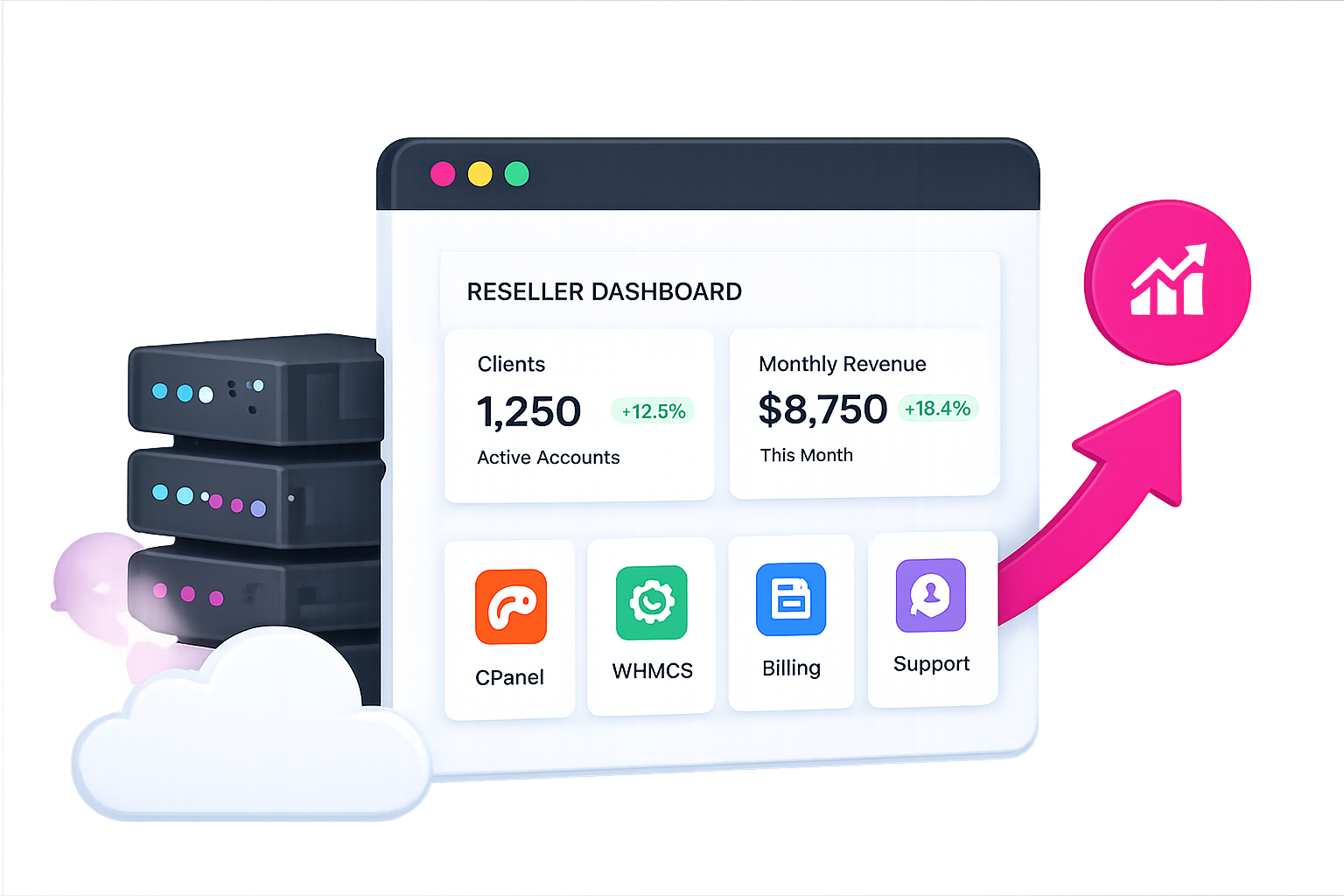
WHMCS handles invoice generation, payment collection, renewal reminders, and failed payment follow-up automatically once it is configured correctly. This replaces what would otherwise be hours of manual work each month for a client base of any meaningful size. SkyNetHosting.Net includes WHMCS free with reseller plans, which means this automation layer is available without any additional monthly cost.
The key is configuring WHMCS properly at the start rather than relying on it partially. Set up your payment gateway, configure your invoice timing, write your email templates, and test the full client journey from order to provisioned account before you bring on your first client.
Automatic Account Provisioning
When a client orders hosting and pays through your WHMCS storefront, the system should automatically create their cPanel account, send them their login credentials, and have their hosting active within seconds — all without any manual involvement from you. This is the provisioning automation that makes it possible to run a hosting business without being available around the clock.
Test this workflow thoroughly after setup. Order a plan through your own storefront and watch what happens. If anything requires manual intervention, find and fix it before real clients experience the gap.
Reducing Support Workload
A significant portion of hosting support requests are routine and predictable. Softaculous handles application installations that clients used to call about. A clear knowledge base with answers to common questions reduces the same questions coming in repeatedly. Automated cPanel tutorials built into the welcome email give new clients the information they need without requiring a support ticket.
Map out the support requests you receive most often and look for ways to address them proactively. Every repeat question you eliminate through better documentation or automation is time returned to more valuable uses.
Optimize Client Resource Usage
How your clients use the resources on your plan directly affects how many accounts you can support and how well those accounts perform. A few targeted optimizations can meaningfully extend the useful capacity of a budget plan.
Caching and Performance Optimization
LiteSpeed web server, which SkyNetHosting.Net runs as standard, includes built-in caching that dramatically reduces the CPU and RAM consumed by WordPress sites on your server. A WordPress site serving cached pages uses a fraction of the server resources of one generating every page dynamically. Enabling LiteSpeed Cache for WordPress clients is one of the highest-leverage optimizations available on cPanel hosting.
Encouraging clients to use a caching plugin and guiding them through the basic configuration takes fifteen minutes per client and can cut their resource footprint by 60 to 80 percent. That resource saving is directly available to support more accounts on the same plan.
Encouraging Lightweight Websites
A WordPress site with 50 active plugins, unoptimized images, and several resource-intensive page builder tools consumes dramatically more server resources than a lean, well-built site. You cannot control every client’s development choices, but you can communicate clearly about what constitutes responsible resource use and include that in your terms of service.
Recommending lightweight themes, setting reasonable storage limits that discourage storing excessive media on the server, and flagging accounts that are consistently high-resource users gives you the tools to maintain a balanced environment without constantly running into capacity issues.
Preventing Resource-Heavy Abuse
Some resource consumption patterns are not just inefficient — they are actively abusive. Clients running cron jobs every minute, storing tens of thousands of files that push inode limits, or hosting video content that should be on a CDN instead can make life genuinely difficult for everyone else sharing the server resources.
WHM gives you visibility into which accounts are consuming the most resources and the ability to set hard limits that prevent any single account from dominating shared resources. Use these tools proactively rather than reactively. The time to address a resource-heavy account is before other clients start complaining, not after.
Avoid the Biggest Budget Reseller Mistakes
Some specific patterns consistently undermine the profitability of budget reseller plans. Recognising them makes them easier to avoid.
Selling Ultra-Cheap Hosting Plans
Pricing your hosting at three or five dollars a month might attract signups, but it creates a business with no margin for error and no room to deliver quality service. At those price points, a single client who submits a support ticket every week is not profitable. You need volume to cover your costs, and volume at the bottom of the market means managing a large number of accounts generating almost no margin each.
Set your minimum plan price at a level where a client who needs occasional support is still profitable. For most resellers, that means a floor of fifteen dollars per month for the simplest plan. It is a smaller client base to build, but a far more sustainable one.
Overloading Servers With Too Many Accounts
Cramming accounts onto a plan until performance degrades for everyone is a short-term revenue strategy that produces long-term client loss. Performance problems trigger complaints, complaints trigger cancellations, and cancellations undo the revenue gain that came from overfilling the plan in the first place. It is a cycle that always ends in the same place.
Manage your account count relative to your actual resource limits, not relative to some theoretical maximum. Leave headroom. A plan running at 70 percent capacity performs well and has room for new accounts. A plan running at 110 percent creates problems for everyone.
Ignoring Customer Retention
Acquisition gets most of the attention in business conversations, but retention is where recurring revenue businesses actually make their money. A client who stays for two years is worth twenty-four months of revenue. A client who leaves after three months is worth three months of revenue and the same acquisition cost.
Check in with clients periodically. Let them know about new features or improvements. Respond to support requests faster than they expect. Small gestures of attentiveness make clients feel valued and make switching providers feel like more disruption than it is worth.
When Should You Actually Upgrade Your Reseller Plan?
Optimization has limits. There are genuine signals that indicate your plan has reached its practical capacity and that upgrading is the right move, not just the easy one.
Signs of Resource Exhaustion
When CPU usage regularly exceeds 80 percent, when inode counts are approaching the plan limit, or when RAM pressure is causing PHP processes to time out, you have moved past the optimization phase and into genuine resource exhaustion. Performance problems that persist after you have addressed inefficient accounts and optimized caching are telling you something real about your capacity.
The other clear signal is when you are turning away clients you could otherwise serve because you do not have the headroom to add their accounts. Turning down revenue because your plan is full is exactly the situation where upgrading makes clear financial sense.
Growth vs Profitability Balance
Upgrading your plan increases your fixed cost. Before making that move, model what the new plan costs against the revenue from the accounts you plan to add. If the additional revenue more than covers the cost increase and leaves better margins than your current setup, upgrading is genuinely worth it. If you are upgrading speculatively before the client base is there to justify it, you are paying for capacity you are not using.
The right time to upgrade is when you have already optimized everything you can and your current plan is genuinely constraining your revenue, not when performance gets bumpy and an upgrade feels like the easiest way to make the problem go away.
Planning for Scalability
When you do decide to upgrade, choose your upstream provider’s next tier rather than jumping to the largest available option. Each upgrade should add enough capacity to serve your projected client growth for the next six to twelve months, without buying resources that will sit idle for years. This approach keeps your fixed costs proportional to your revenue at every stage of growth.
Also consider whether staying with your current provider for the upgrade makes sense or whether a different provider might offer better value at the next tier. The time to evaluate alternatives is before you need to upgrade urgently, not when performance problems are already affecting clients.
How Does SkyNetHosting.Net Inc. Support Budget Reseller Businesses?
Getting more from a budget reseller plan depends heavily on the quality of the underlying infrastructure and the tools included with it. Here is where SkyNetHosting.Net’s reseller offering is specifically relevant.
Affordable Reseller Infrastructure
SkyNetHosting.Net’s reseller plans start at an accessible price point and include NVMe SSD storage and LiteSpeed web server technology as standard. NVMe storage delivers significantly faster read and write speeds than traditional SSD, which means the WordPress sites and databases on your plan load faster and consume fewer CPU cycles doing it. Faster infrastructure effectively extends the usable capacity of a budget plan by reducing the resource overhead of normal operation.
WHMCS is included free with every reseller plan, removing the billing platform cost that would otherwise be a fixed monthly expense. That saving goes directly to your margin without requiring you to manage a separate billing subscription.
White-Label Compatible Hosting
Complete white-label branding is a standard feature of every SkyNetHosting.Net reseller plan, not a premium add-on. Your logo, company name, and private nameservers can be configured through WHM to create a fully branded experience for every client. The perceived value increase that comes from professional, consistent branding applies equally whether you are on a budget plan or a premium one — and it costs nothing beyond the time to set it up.
Scalable Upgrade Paths for Growing Businesses
When you have genuinely maximised what your current plan can do and growth is demanding more capacity, SkyNetHosting.Net’s upgrade path stays within the same platform. You move to a larger reseller plan without migrating to a new provider, without rebuilding your WHM configuration, and without disrupting existing client accounts. That continuity matters because every migration introduces risk and operational complexity that a well-structured upgrade avoids entirely.
For budget resellers who are serious about growing their hosting business over time, starting with a provider that scales in a straight line upward means you only ever need to have the conversation once about infrastructure. The path from your first plan to a plan supporting hundreds of clients runs through the same platform.
Conclusion
Budget Reseller Hosting Can Remain Highly Profitable With the Right Strategy
The path to better margins on a budget reseller plan runs through better decisions, not bigger infrastructure. Premium clients over volume. Bundled services over standalone hosting. Automated operations over manual workflows. Optimized resource use over unnecessary upgrades. None of these strategies require you to spend more — they require you to think more carefully about what you are already spending and what you are getting for it.
A hosting business generating fifteen hundred dollars a month from thirty well-chosen clients on a budget plan is a more sustainable and more enjoyable operation than one generating the same revenue from a hundred price-sensitive clients on a maxed-out server. The revenue looks the same on a spreadsheet but the experience of running each business is completely different.
Automation, Client Quality, and Smart Resource Management Matter More Than Constant Upgrades
The resellers who extract the most value from budget plans share three habits. They automate their operations so that revenue grows faster than their time commitment. They are selective about the clients they take on and price their services to reflect genuine value. And they manage their server resources actively rather than assuming everything will sort itself out until something breaks.
These habits cost nothing to implement and produce compounding returns over time. Start with whichever one your current operation needs most and build from there.
SkyNetHosting.Net Provides Scalable Reseller Hosting for Sustainable Long-Term Growth
SkyNetHosting.Net gives budget resellers the infrastructure quality, the included tools, and the upgrade path that make it possible to build a genuine business without overinvesting in infrastructure before the client base justifies it. NVMe performance, free WHMCS, complete white-label branding, and a clear path upward as the business grows combine to create a foundation that supports the strategies in this guide at every stage.
The plan you start on does not have to be the plan you stay on forever. But maximising what it can do before you leave it is always the smartest first move.
