
How to Use Reseller Hosting to Add Recurring Revenue to Your Digital Marketing Agency
Reseller hosting adds recurring revenue to a digital marketing agency by letting the agency bill its own hosting under its own brand every month, instead of handing that ongoing income to whatever host the client happened to pick on their own. A single website design project pays once.
That same client, hosted and maintained by the agency for years afterward, pays every single month, often for less work than the original project took.
This guide covers why agencies are adding hosting to their service list, how to package and price it so it actually holds a healthy margin, the mistakes that undercut the whole strategy, and what a reseller platform like SkyNetHosting.Net changes about how fast an agency gets this running.
Why Are Digital Marketing Agencies Adding Reseller Hosting to Their Services?
Agencies are adding hosting because project based income is unpredictable by nature, and hosting is one of the few services a client needs indefinitely rather than once. Reseller hosting turns a single sale into a recurring line item without requiring the agency to build any of the underlying infrastructure itself.
The challenge of relying only on one-time project income
A web design project might bring in a solid payment, but once the site launches, the revenue stops unless the client comes back for another redesign or a new campaign. An agency’s monthly income under that model swings entirely on how many new projects close that month, which makes payroll, hiring, and any kind of forward planning harder than it needs to be.
We have talked to agency owners who describe this as feast or famine, three great months followed by a quiet one where nothing closes. Hosting does not fix sales entirely, but it puts a floor under the bad months that pure project work never provides.
It also changes the emotional weight of a slow month. An owner watching the pipeline dry up for a few weeks reacts very differently when there is still a base of recurring hosting revenue arriving regardless, versus an owner whose entire income depends on the next deal closing before the end of the month.
How recurring hosting revenue creates business stability
A hosting client paying $25 to $60 a month does not sound significant next to a five figure project fee. Multiply that across 80 or 100 clients accumulated over a few years of project work, and it becomes a base of monthly revenue that covers fixed costs before a single new project even closes.
That predictability changes how an agency operates. Payroll stops depending entirely on this month’s closed deals. Slow sales months stop threatening the business the way they used to, because the recurring base is still coming in regardless of how the pipeline looks that particular month.
It also changes how an owner can plan hiring. A base of recurring revenue that comfortably covers a new hire’s salary makes that hiring decision far less risky than betting entirely on project pipeline holding steady for the next twelve months.
Why clients prefer one provider for marketing and hosting
Most small business clients do not want to manage a hosting account, a domain registrar, an SEO contract, and a design agency as four separate relationships with four separate invoices. One provider handling everything removes friction the client feels every time something breaks and they have to figure out which vendor is actually responsible.
This preference works directly in an agency’s favor. A client who calls the agency about a slow loading page, instead of trying to figure out who their host even is, stays a client far longer than one juggling four separate vendor relationships and four separate points of blame.
How Can You Package Reseller Hosting With Your Digital Marketing Services?
Reseller hosting works best bundled into existing service lines rather than sold as a standalone product most clients never asked about. Attaching hosting to a website build, a maintenance retainer, or an SEO package turns an easy yes into an easier one, since the client is already paying for something related.
Bundling hosting with website design and SEO
The natural moment to introduce hosting is the same conversation as the website build itself. “Hosting is included for the first year” or “we handle hosting so you never have to deal with a separate host” removes a decision the client would otherwise have to make on their own, often badly, by picking whatever host shows up first in a search result.
SEO clients are an equally natural fit, since page speed and uptime directly affect the rankings an agency is already being paid to improve. Bundling hosting into an SEO retainer means the agency controls a variable that actually impacts the results it is accountable for, instead of hoping the client’s unrelated host performs well.
This also removes an awkward conversation that comes up constantly in SEO work: explaining to a client that their rankings are suffering because of a slow, unreliable host the agency has no control over. Bundling hosting in from the start means that excuse never has to come up in the first place.
Creating website maintenance and hosting plans
A maintenance plan that includes hosting, backups, plugin updates, and a small monthly block of support hours reads as one cohesive offer rather than four separate line items a client has to evaluate individually. Most agencies price this somewhere between $50 and $150 a month depending on site complexity and how much hands on support is bundled in.
This is usually the single highest margin service line an agency runs, because the actual hosting cost is a small fraction of what the client pays, and most months require little to no active work once the site is stable.
Tools like the Softaculous auto installer make routine maintenance faster to deliver on, since core software and common plugins can be updated in a few clicks rather than a manual file by file review. That efficiency is part of what keeps a $75 a month maintenance plan profitable instead of quietly eating into an agency’s billable hours.
Offering white-label hosting under your own brand
A client should never see a third party host’s name anywhere in their experience. Support emails, the client facing portal, even the nameservers, can all run under the agency’s own brand through a properly configured white-label hosting setup, which keeps the agency positioned as a full service provider rather than a reseller of something else.
Building service tiers for different client needs
A single brochure site client and a growing ecommerce client have almost nothing in common in terms of hosting needs, and pricing them identically either overcharges one or underpays for the other. Three tiers, a basic plan for simple sites, a business plan for active small businesses, and a premium plan for stores or membership sites, cover most agency client bases without becoming confusing to sell.
Naming the tiers around outcomes rather than technical specs helps non technical clients pick the right one without needing an explanation of disk space or bandwidth. A tier labeled for a growing business reads more clearly to most owners than one labeled purely by gigabytes.
How Can You Price Your Hosting Packages for Long-Term Profitability?
Price hosting by working backward from the actual reseller cost per account plus support time, then adding a real margin, rather than copying whatever number a competitor happens to advertise. A monthly price that looks reasonable on a proposal can still lose money every single month if the underlying cost was never actually calculated.
Choosing sustainable monthly pricing models
A common structure charges a flat hosting fee separately from a maintenance retainer, so a client who only wants hosting can buy that alone, and a client who wants full support pays for both. Bundling everything into one number simplifies the sale but makes it harder to explain a price increase later, since the client cannot see which part actually went up.
A reasonable starting range for a basic hosting line sits around $20 to $35 a month for a simple business site, with maintenance and support priced separately on top. Agencies just getting started with reselling often build their entry tier on one of the budget reseller plans to keep underlying costs low while margins are still being tested against real client pricing.
These numbers should shift based on local market rates and how saturated an agency’s own region already is, not copied wholesale from a national average. What works in a competitive metro market will look overpriced in a smaller town, and the reverse is just as true.
Balancing customer value with healthy profit margins
The reseller cost of hosting a typical small business account is a small fraction of what most agencies charge for it, which is exactly why the margin on this service line tends to be higher than almost anything else an agency sells. The temptation is to price it low as a loss leader for other services, which works occasionally but usually leaves real money on the table across a large enough client base.
A useful gut check: if hosting alone would not be worth selling as a standalone product at the price being charged, the number is probably too low. Recurring revenue only strengthens a business when each account is actually profitable, not just present on the books.
Upselling premium hosting and maintenance services
A client on a basic hosting plan who mentions slow page loads or an upcoming traffic spike from a campaign is an obvious upsell opportunity, not just a support ticket to close quickly. Moving that client to a premium tier with more resources solves their immediate problem and increases the account’s monthly value at the same time.
The best moment for this conversation is right before a launch the agency is already running for the client, a new ad campaign, a product launch, a press mention. Tying the upgrade to a specific upcoming event makes the extra cost feel justified rather than arbitrary.
Increasing customer lifetime value through bundled services
A client paying for hosting, maintenance, and SEO together is far less likely to leave over any single service line underperforming, since canceling means unwinding three relationships instead of one. That bundling effect alone often extends average client lifetime by a year or more compared to a client buying only a single service.
Run the math on a specific example. A client paying $75 a month across bundled services who stays four years instead of two represents an additional $1,800 in lifetime value from that account alone, without the agency doing any additional selling beyond the original bundle.
What Mistakes Should Agencies Avoid When Selling Reseller Hosting?
The mistakes that turn hosting from a profit center into a headache are almost always avoidable: competing purely on price, selling hosting with no real support process behind it, skipping automation, and picking a reseller provider that cannot handle growth.
Competing only on the lowest price
A client who chooses an agency’s hosting purely because it undercuts a $3 a month budget host by a dollar is a client who will leave the moment a cheaper option appears. Competing on service, reliability, and the convenience of one provider handles far more durable retention than competing on a price point anyone can undercut.
Agencies that win this way tend to attract the least profitable and least loyal clients in their market, since the entire relationship was built on being marginally cheaper rather than on any actual value the client cannot get elsewhere for the same price.
Selling hosting without a support process
Hosting brings support tickets, uptime questions, and the occasional suspended account, and an agency that never planned for that ends up handling these ad hoc, usually poorly, in between actual project work. A short written process for common issues, even a one page internal guide, prevents this from becoming a drain on the team’s actual billable time.
This does not need to be complicated. A simple decision tree covering the three or four most common client questions, a slow site, a suspended account, a billing question, gives whoever answers support tickets a clear next step instead of improvising a response every time.
Ignoring automation for billing and account management
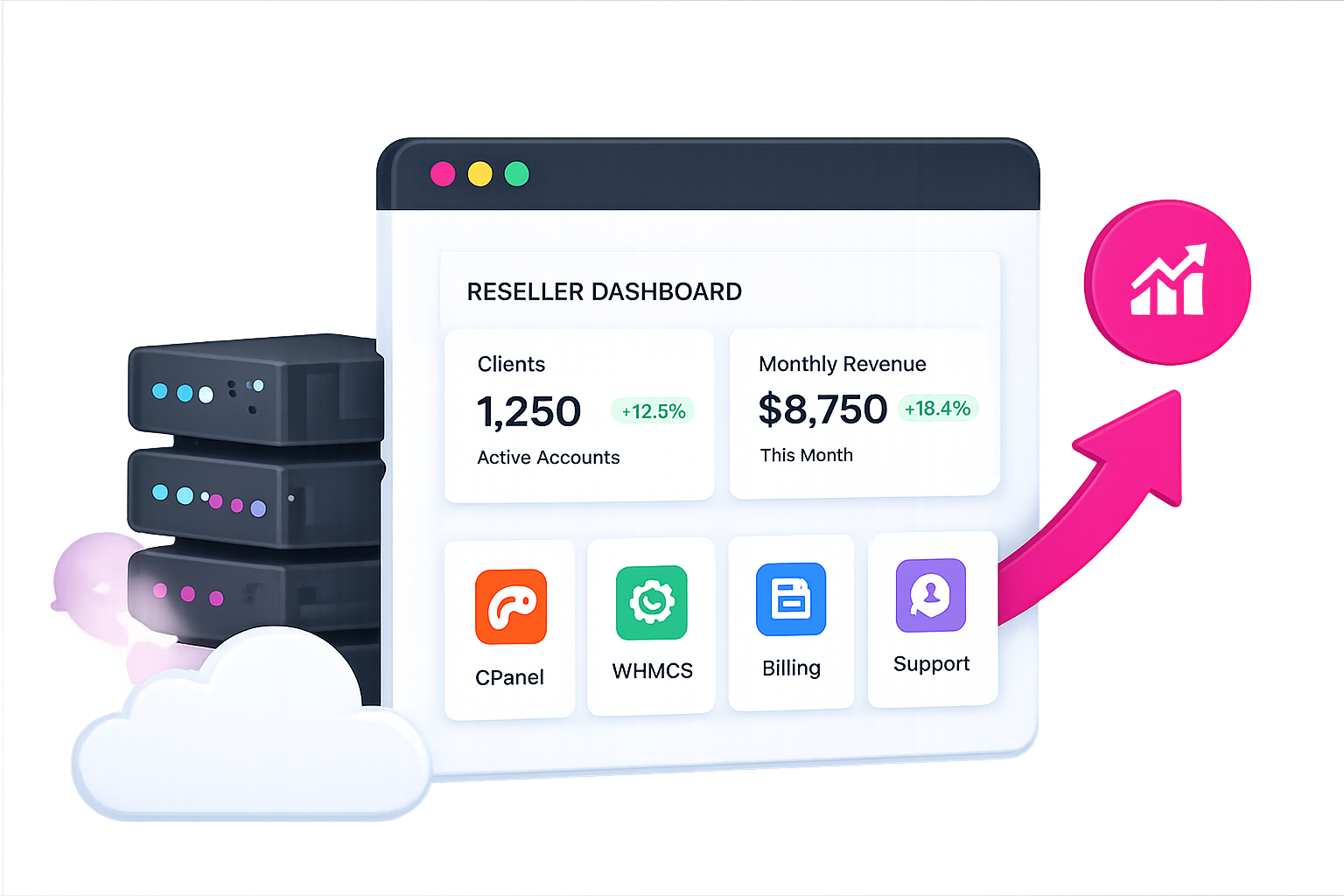
Manually invoicing hosting clients every month does not scale past a small handful of accounts before something gets missed, a renewal, a price change, a client who quietly stopped paying months ago. Automated billing through WHMCS handles renewals, suspensions, and invoicing without anyone at the agency manually tracking a spreadsheet of due dates.
Choosing a provider that cannot scale with your agency
An agency that starts with ten hosting clients and grows to two hundred needs infrastructure that grows with it, not a provider that requires switching platforms halfway through. Checking a provider’s reseller features against realistic five year growth, not just today’s client count, avoids a painful migration later once hundreds of live sites are involved.
How Does SkyNetHosting.Net Inc. Help Digital Marketing Agencies Build Recurring Revenue?
SkyNetHosting.Net gives agencies full white-label reseller hosting, WHM and WHMCS running together, and infrastructure built on over 20 years of hosting operations across 25 worldwide server locations. A free WHMCS license comes bundled with every reseller plan, so the billing automation an agency needs to run hosting as a real recurring revenue line is already connected before the first client account is even created.
White-label reseller hosting for agency branding
Every part of the client facing experience, support tickets, the MyCompanyWeb client portal, and nameservers, can run entirely under the agency’s own brand. A client should never discover their agency is technically a reseller of someone else’s infrastructure, and this is the layer that keeps that discovery from ever happening.
WHM and WHMCS support for automated client management
Account creation, billing, and suspension all live inside the same connected system when WHM is paired with WHMCS, which means an agency team member can check a client’s hosting status, payment history, and support history in one place instead of piecing it together across three different tools.
Scalable reseller plans that grow with your client base
An agency starting with a handful of hosting clients can begin on a standard reseller plan and move up to master reseller hosting once the client base grows large enough to justify reselling reseller accounts of its own, without ever migrating to a different provider along the way.
Reliable infrastructure that supports long-term customer relationships
NVMe storage and LiteSpeed keep client sites fast enough that hosting never becomes the reason a client’s own marketing results underperform, which matters directly to an agency whose reputation is tied to the results it delivers. NVMe VPS resources give an agency room to move a growing client up a tier without a painful migration, keeping that client’s history and settings intact the whole way.
How Can Reseller Hosting Become a Long-Term Growth Engine for Your Agency?
Reseller hosting becomes a real growth engine once it stops being an afterthought attached to a project and starts being sold, priced, and supported as its own service line with its own retention numbers to track.
Building predictable monthly recurring revenue
Every hosting client added is a small, permanent increase to an agency’s monthly floor, the amount of revenue that arrives regardless of how the sales pipeline looks that particular month. Track this number separately from project revenue, and it becomes one of the clearest indicators of whether the agency’s overall health is actually improving year over year.
A useful target for agencies just starting to track this: aim for recurring hosting and maintenance revenue to cover core fixed costs, rent, base salaries, software subscriptions, within the first two to three years of adding it as a service line. Once that threshold is hit, new project revenue becomes growth capital instead of survival income.
Increasing client retention through integrated services
A client whose hosting, maintenance, and marketing all run through the same agency has almost no reason to shop around, since switching any one piece means unwinding a relationship that touches everything else. That integration is what turns an average client relationship into one that lasts five years instead of one.
It also changes how a client experiences problems. A billing question, a hosting issue, and a marketing question all go to the same point of contact, which feels like a relationship rather than a vendor arrangement, and clients consistently stay longer with providers who feel like a relationship.
Expanding into a full-service digital solutions business
Hosting is often the first step toward an agency describing itself as a full service digital partner rather than a project shop that occasionally handles maintenance. Once hosting, maintenance, and marketing sit under one roof, adding adjacent services, email marketing, ongoing content, ecommerce management, becomes a natural extension rather than a hard pivot.
Agencies that make this shift often find their positioning in sales conversations changes too. A prospect comparing a project only shop against a full service partner tends to see more long term value in the partner, even at a somewhat higher price, because the relationship is already framed as ongoing rather than transactional.
Ready to add a recurring hosting line to your agency’s services? Explore SkyNetHosting’s reseller hosting plans and get white-label WHM and a free WHMCS license running under your own brand.
