SkyNetHosting Dedicated Servers vs Hetzner vs OVH: 2026 Comparison for SMEs
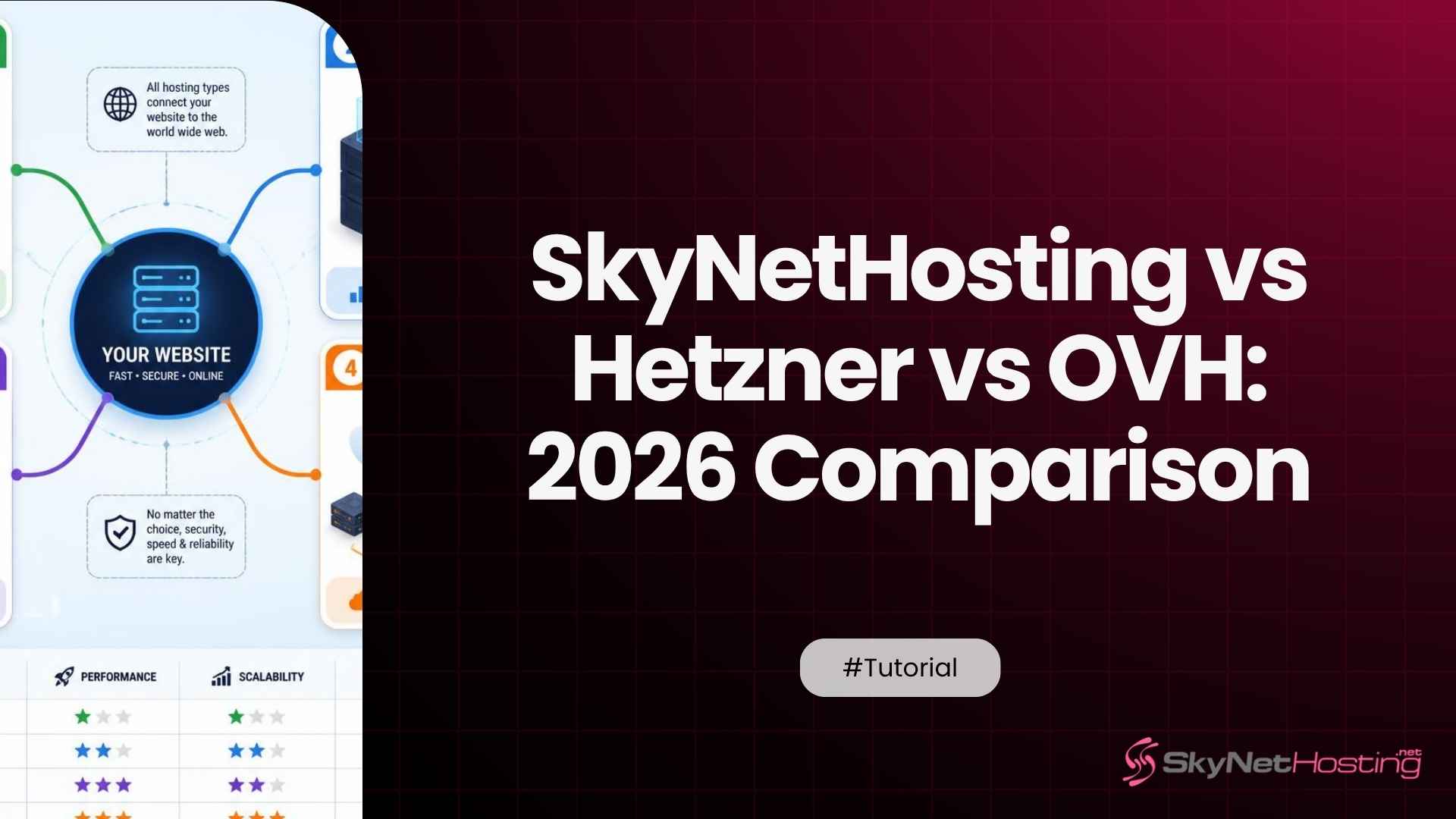
Hetzner and OVH both compete primarily on raw hardware value and large-scale, self-service infrastructure spread mostly across European data centers with expansion into the US and Asia, while SkyNetHosting competes on personalized support and configurations built around the specific needs of a growing SME rather than a one-size-fits-all catalog. None of the three is universally better.
The right choice depends on whether your business values the lowest possible per-core price and is comfortable managing infrastructure yourself, or whether it values a provider that will actually help size and support that infrastructure as the business grows.
This comparison is built on each provider’s publicly documented positioning, data center footprint, and general market reputation as of mid-2026. Specific prices for any provider, SkyNetHosting included, are worth confirming directly at the time of purchase, since dedicated server pricing across the industry has been unusually volatile through 2026 amid broader hardware component cost pressures.
Why Are SMEs Comparing SkyNetHosting, Hetzner, and OVH in 2026?
SMEs are comparing these three providers because dedicated server requirements have become more specific and less forgiving than they were even a few years ago, and the gap between a bare metal price sheet and what a growing business actually needs has become an expensive one to get wrong.
Hetzner and OVH are both large, well-established European providers with strong reputations for hardware value. SkyNetHosting sits at a different point on the map, built specifically around SMEs rather than the widest possible customer base.
How dedicated server requirements have changed for SMEs
A small business dedicated server used to mean one modest configuration that rarely changed for years. Today, the same business might run an e-commerce storefront, a SaaS backend, and an internal application on the same infrastructure, each with different performance and compliance needs.
Many SMEs also arrive at this comparison from a USA VPS plan that has simply run out of room, rather than starting the search from scratch. That starting point matters, since a business migrating off a VPS already has real usage data to size a dedicated server against, instead of guessing at requirements from zero.
That shift means the provider comparison is no longer just about who has the cheapest core. It is about who can actually support a business running several different workloads on infrastructure that needs to keep evolving alongside it.
The key factors businesses compare before buying
CPU and RAM configuration, storage type and RAID setup, data center location and network quality, uptime history, support responsiveness, and total cost including add-ons all factor into a real comparison. Leaving any one of these off the list is how a business ends up with a server that looks great on paper and underperforms in practice.
Weigh these factors against your own team’s technical capacity too, not just against each other. A configuration that is perfect on paper still fails the business if nobody on staff has the time or expertise to manage it day to day without help.
Looking beyond hardware specifications alone
Hetzner and OVH both earn their reputations largely on hardware specifications and price. That reputation is well deserved on the hardware side, and it is also only part of the picture for a business that will eventually need a support ticket answered quickly or a configuration adjusted without a lengthy self-service process.
A server sitting idle because a support ticket has gone unanswered for two days is not actually the bargain its monthly price suggested. Factor realistic support response time into the comparison from the start, not as an afterthought once something has already gone wrong.
How Do SkyNetHosting, Hetzner, and OVH Compare Across the Features That Matter Most?
Hetzner and OVH generally lead on raw price-to-performance for standardized hardware configurations, both operate primarily out of European data centers with growing footprints elsewhere, and both run largely self-service support models. SkyNetHosting competes by tailoring configurations and support to SME needs specifically, backed by infrastructure across 25 worldwide server locations.
Hardware performance and server configurations
Hetzner is well known for AMD EPYC dedicated server lines and a server auction offering discounted, previously configured hardware, which gives strong performance per euro for businesses comfortable choosing from a fixed set of configurations. OVH offers a broad bare metal range spanning AMD Ryzen and other processor families across several product tiers, from budget-oriented Eco servers to higher-resilience options.
SkyNetHosting’s USA Dedicated Servers run on Intel Dual Xeon hardware with NVMe storage, positioned less around picking from a large fixed catalog and more around configuring a server to match a specific SME workload from the outset.
For a business not yet ready for a full dedicated server, our NVMe VPS line offers a similar storage performance profile at a smaller scale, which is a more natural stepping stone for an SME than jumping straight to a bare metal comparison before the workload actually justifies it.
Comparing raw hardware alone, Hetzner’s per-core pricing on its standard AMD EPYC lineup is genuinely hard to beat for a business that knows exactly which configuration it wants. OVH’s broader tier structure gives more flexibility for businesses uncertain where they land on the performance spectrum, at a generally higher price point for comparable specifications.
Data center locations and global connectivity
Hetzner’s primary data centers sit in Nuremberg and Falkenstein in Germany and Helsinki in Finland, with more recent expansion into Singapore and the United States. OVH, headquartered in Roubaix, France, operates across a wider spread of countries including France, Germany, Poland, the UK, Canada, the US, Australia, and Singapore.
Both are strong choices if your customer base is concentrated in Europe. A business whose customers are mostly in North America or spread globally should weigh network latency to its actual audience rather than assuming a European-anchored provider automatically performs the same everywhere. SkyNetHosting’s multi-location hosting footprint spans 25 worldwide locations built around serving a geographically distributed customer base directly.
Test actual latency from your real customer locations before assuming any provider’s data center map matches your audience. A provider with excellent European performance can still add a noticeable delay for customers in Australia or South America if the nearest facility is thousands of miles away.
Network reliability, uptime, and security features
Both Hetzner and OVH publish solid uptime track records and include baseline DDoS protection on their infrastructure, which is standard and expected at this point in the industry rather than a differentiator either way. Where providers actually separate is in how quickly a genuine security or network incident gets a human response rather than an automated ticket queue.
Layering CloudFlare CDN and a proper SSL reseller program on top of any dedicated server, regardless of provider, adds a meaningful layer of protection that a bare metal plan alone does not include by default.
Ask any provider directly what happens during a genuine DDoS event beyond the marketing description of baseline protection. The difference between automated mitigation and a human actively monitoring an attack in progress matters more than most comparison charts let on.
Pricing, scalability, and overall value for SMEs
Hetzner has a strong reputation for aggressive pricing on standardized configurations, and OVH’s catalog spans budget Eco servers through higher-end resilience tiers with fairly predictable monthly pricing once add-ons are accounted for. Both are worth serious consideration purely on cost for a business that can self-manage its infrastructure.
The value comparison changes once you factor in support time. A slightly higher monthly rate that comes with faster, more personal support can be cheaper overall than a lower rate that costs a business several hours of internal staff time resolving something a provider’s support team could have handled directly.
Calculate a rough hourly cost for whoever on your team would end up troubleshooting a hosting issue, then weigh that against the price difference between providers. For many SMEs, that comparison flips the outcome once support time is priced in honestly rather than assumed to be free.
Which Dedicated Server Provider Is Best for Different Business Types?
The best provider depends heavily on business type: e-commerce stores need consistent checkout performance and payment support, SaaS companies need predictable scaling and database performance, agencies need flexibility across many client projects, and every business type eventually needs a clear path to scale without a disruptive migration.
Best option for e-commerce businesses
An e-commerce store benefits from a provider that treats checkout uptime as business-critical, not just another workload. SkyNetHosting’s dedicated servers paired with a free merchant account give a store both the infrastructure and the payment processing support in one place, rather than juggling separate vendors for hosting and payments.
Hetzner and OVH both offer perfectly capable hardware for an online store, but neither is built specifically around the payment and checkout side of e-commerce the way a hosting provider that also offers merchant account support can be.
A store choosing between the three should weigh how much value comes from consolidating hosting and payment support with one provider versus managing them separately with specialists in each. There is no universally correct answer, only a trade-off between consolidation and specialization.
Best choice for SaaS and software companies
A SaaS company running a growing customer base needs predictable database performance and a straightforward upgrade path more than it needs the absolute cheapest per-core price. Hetzner’s dedicated vCPU options and OVH’s Advance and higher-resilience ranges both work well for this, provided the team has the in-house expertise to manage scaling themselves.
A smaller SaaS team without dedicated infrastructure staff often gets more real value from a provider willing to walk through scaling decisions directly rather than a purely self-service dashboard, even if the sticker price is slightly higher.
This is less about raw hardware capability and more about how much internal engineering time gets spent on infrastructure versus product. A team spending a day a month on server management that a different provider’s support team could have absorbed is paying an invisible cost that never shows up on the hosting invoice itself.
Best fit for agencies and developers
Agencies managing several client projects on the same infrastructure benefit from flexible configurations and a provider that understands reseller-style account structures. SkyNetHosting’s background in reseller-friendly features makes this a more natural fit for an agency than a purely bare metal catalog built for single-tenant workloads.
A developer or agency comfortable managing raw bare metal directly, without needing reseller-specific tooling, may still prefer Hetzner or OVH purely for the hardware value, especially for projects where client-facing account structures are not a factor at all.
Which provider offers the easiest long-term scalability
Hetzner and OVH both support scaling within their own catalogs, though moving between tiers can mean provisioning a new server rather than a seamless in-place upgrade. SkyNetHosting’s approach favors configuring a server around where a specific SME is headed, which can mean fewer full migrations as the business grows.
Ask any provider directly, ours included, exactly what an upgrade looks like in practice: whether it requires downtime, whether existing configuration and IP allocations carry over, and how far in advance you would need to request it. The clarity of that answer says as much about a provider as the price sheet does.
What Mistakes Should SMEs Avoid When Comparing Dedicated Server Providers?
The costliest mistakes are anchoring the entire decision on the lowest sticker price, assuming infrastructure reliability without checking support quality, missing hidden costs that show up after signup, and comparing providers on CPU and RAM alone while ignoring storage, network, and support together.
Choosing based only on the lowest monthly price
Both Hetzner and OVH can be excellent value, and both also illustrate why price alone is an incomplete comparison. A lower headline price that assumes a business can fully self-manage its own infrastructure is not actually the cheaper option for a business that cannot.
Price a full year of ownership, including your own time, before deciding a lower monthly rate is automatically the better deal. The comparison looks very different once every real cost is actually on the table.
Ignoring support quality and infrastructure reliability
Large, high-volume providers generally run ticket-based, self-service support models rather than a dedicated account contact, which works well for technically capable teams and less well for a small business without in-house infrastructure staff. Check what support actually looks like day to day before assuming it will be there when you need it.
Reading recent customer reviews specifically about support response time, not just uptime percentages, gives a more honest picture than the provider’s own marketing page. Reviews are also where the gap between different providers’ support models tends to show up most clearly.
Overlooking upgrade flexibility and hidden costs
Setup fees, additional IP addresses, backup storage, and premium support tiers can all add meaningfully to a headline price across almost any dedicated server provider, Hetzner and OVH included. Ask for the full monthly total with the add-ons your business will actually need, not just the base configuration price.
Get this in writing before signing up wherever possible. A verbal estimate of add-on costs during a sales conversation is not the same as a documented total, and the gap between the two is where budget surprises tend to originate.
Focusing only on CPU and RAM instead of overall performance
A strong CPU and RAM allocation paired with a network location poorly matched to your actual customer base still delivers a worse real-world experience than a more modest configuration closer to your users. Evaluate the full picture, not just the two numbers that are easiest to compare on a spec sheet.
Why Do Many Growing Businesses Choose SkyNetHosting.Net Inc. Over Larger Global Providers?
Growing businesses choose SkyNetHosting over larger global providers because personalized support, transparent configuration pricing, and infrastructure built to scale specifically with an SME often matter more day to day than shaving a few dollars off a raw hardware price.
Personalized support and customer-focused service
Our End User Support and Live Sales Chat give a business direct access to a real person during the sizing and buying decision, not just after something breaks. That access is exactly what a large, high-volume provider’s self-service model is not built around.
This matters most in the exact moment a business is deciding between configurations and does not yet have the internal expertise to make that call confidently. A conversation before purchase often prevents the more expensive mistake of buying the wrong configuration in the first place.
Flexible server configurations and transparent pricing
A configuration built around what your specific business actually runs, rather than picked from a fixed catalog of standardized tiers, removes the guesswork of trying to map your workload onto someone else’s predefined server class.
Transparent pricing also means fewer surprises on the first renewal invoice, since the add-ons a business actually needs are discussed up front rather than discovered later buried in a billing portal.
Infrastructure designed to scale with business growth
With more than twenty years hosting over 700,000 websites, our infrastructure has been built and rebuilt around real customer growth patterns rather than a single fixed catalog meant to serve every possible customer identically.
Solutions tailored for SMEs rather than one-size-fits-all deployments
Hetzner and OVH both serve an enormous range of customers, from individual developers to large enterprises, which is part of what keeps their prices competitive. That same breadth means neither is built specifically around the SME segment the way a provider focused on that segment can be.
Which Dedicated Server Provider Is the Right Choice for Your Business in 2026?
The right choice matches your infrastructure to your actual business goals and team capacity, not to whichever provider has the lowest number on a comparison chart. A technically self-sufficient team chasing the best possible price per core may be well served by Hetzner or OVH. A growing SME that wants a partner in sizing and supporting that infrastructure often gets more real value from a provider built around exactly that.
Matching your infrastructure to your business goals
Define what the business actually needs the server to do, handle checkout traffic, run a SaaS backend, support an agency’s client sites, before comparing providers. The right fit follows from that definition far more reliably than starting from a price comparison and working backward.
Write this definition down in a sentence or two before requesting quotes from any provider. It keeps the comparison anchored to actual business needs instead of drifting toward whichever spec sheet looks most impressive at the moment.
Evaluating total value instead of headline pricing
Add support quality, configuration flexibility, and the real cost of every add-on your business will actually need to the base price before calling any comparison final. The provider with the lowest sticker price is not always the one with the lowest total cost once support time and hidden fees are counted.
Planning for future growth before making your investment
Whichever provider you choose, confirm what happens when your business outgrows its current configuration before you need the answer. If your team wants a partner in that process rather than a self-service upgrade path alone, our USA Dedicated Servers team can help size a configuration around where your business is headed, not just where it stands today.
A dedicated server decision made carefully once tends to hold up far longer than one made quickly on price alone. Take the time this comparison deserves, whichever of the three providers you land on.
