
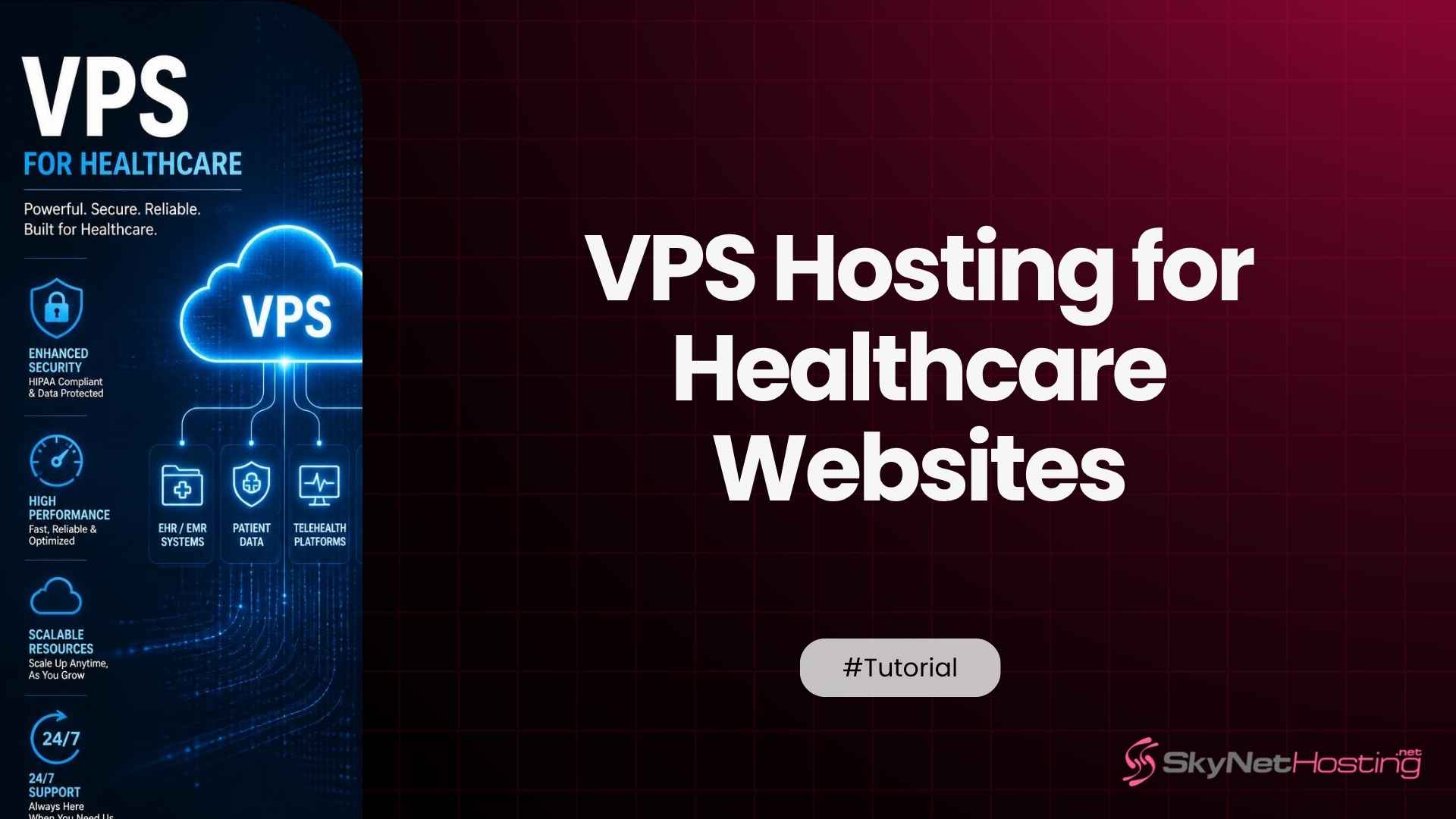
VPS Hosting for Healthcare and Medical Websites: HIPAA Considerations and What to Ask
VPS hosting can support a HIPAA compliant medical website, but no hosting plan is HIPAA compliant by itself. Compliance depends on whether the provider will sign a Business Associate Agreement, how the server is secured, and how the healthcare organization configures encryption, access controls, and backups on top of that infrastructure.
A generic VPS plan built for a personal blog will not meet the same bar as one configured specifically for protected health information. Before a clinic, hospital, or health tech company signs a hosting contract, there is a short list of direct questions worth asking. Skipping them is how organizations end up explaining a data breach to a regulator instead of a customer.
Why Do Healthcare and Medical Websites Choose VPS Hosting?
Healthcare organizations choose VPS hosting because it provides dedicated resources and enough server level control to apply the specific security settings that protected health information needs. Shared hosting puts a patient portal on the same physical server as hundreds of unrelated websites. Most compliance officers won’t accept that once they understand what it actually means for isolation and risk.
Performance and dedicated resources for healthcare applications
A patient portal, an appointment scheduling tool, or a telehealth video widget all need consistent CPU and RAM that don’t disappear because a neighboring account on the same server is running a traffic spike. VPS hosting allocates dedicated resources to each account, so a clinic’s intake form loads the same way at 8am and at 2pm on a Monday.
We have seen sites move from a shared plan to an NVMe backed VPS and cut page load times from around four seconds down to under one, without touching a single line of application code. For a healthcare website, that speed difference matters for more than user experience.
Slow loading forms get abandoned mid fill, and a patient who gives up halfway through an intake form leaves data sitting in a partially submitted, unencrypted browser session instead of a secured database. If you’re weighing storage types, our breakdown of NVMe drives compared to SSDs covers the practical difference in more detail.
Greater control compared to shared hosting
Shared hosting bundles security decisions into one plan for every customer on that server. VPS hosting hands over root access, which means a healthcare IT manager can configure firewall rules, install specific encryption libraries, and control the patch schedule directly instead of waiting on a shared hosting company’s timeline.
That control cuts both ways. A misconfigured firewall rule on a VPS is the account owner’s problem to fix, not the host’s. Any organization considering VPS for a medical site needs someone on staff, or a contracted admin, who actually knows how to manage a Linux server. VPS is not a set and forget upgrade from shared hosting.
Supporting secure and scalable medical websites
Patient volume rarely grows in a straight line. A clinic that adds telehealth, or a health tech startup that lands a new enterprise client, can see traffic double in a matter of weeks. VPS hosting lets an organization add CPU, RAM, or storage to an existing server rather than migrating to new infrastructure mid growth spurt, which is exactly the kind of rushed migration that introduces new security gaps.
Data residency plays into this decision too. Some healthcare organizations, especially ones operating across state lines or serving international patients, need to know exactly which physical location a server sits in, and whether that location has its own data protection rules layered on top of HIPAA. A VPS host with server locations spread across multiple regions gives an organization the option to choose, instead of accepting whatever data center a shared hosting plan happens to default to.
What HIPAA Requirements Should You Consider Before Choosing a VPS Hosting Provider?
HIPAA does not certify or approve hosting providers directly. But if a VPS host will store, process, or transmit protected health information on a healthcare organization’s behalf, that host is functioning as a business associate under HIPAA.
It needs to meet the Security Rule’s safeguards and be willing to sign a Business Associate Agreement. A provider that hedges on that question, or has never heard the term BAA, is not ready for medical workloads, no matter what the sales page claims.
Understanding the hosting provider’s role in protecting PHI
Protected Health Information, usually shortened to PHI, includes anything that ties a patient’s identity to their health status, treatment, or payment history. Once PHI touches a server, whoever operates that server has a role in protecting it, even if they never look at the data directly.
Hosting responsibility splits into two layers. The provider secures the physical and network infrastructure: the data center, the hypervisor, the firewall at the network edge. The healthcare organization secures everything running on top of that infrastructure: the application code, the database permissions, the admin passwords.
Confusing these two layers is one of the more expensive mistakes in this space. An organization can hold a fully secured VPS and still leak PHI through a poorly configured plugin that has nothing to do with the server underneath it.
Security safeguards that support compliance objectives
HIPAA’s Security Rule groups safeguards into three categories: administrative, physical, and technical. On the hosting side, the technical piece matters most day to day. That means encryption for data at rest and in transit, firewalls between the server and the open internet, intrusion detection that flags unusual access patterns, and multi factor authentication on any account with server access.
None of this is exotic. Most of it is standard practice for any security conscious VPS setup, healthcare related or not. The difference for a medical website is that these features stop being nice to have and become the baseline a provider has to confirm in writing, not just imply in a features list.
Encryption itself splits into more than one bucket, and it’s worth knowing the difference before asking a provider about it. Encryption in transit protects data as it moves between a patient’s browser and the server, which is what an SSL certificate handles.
Encryption at rest protects data sitting on the server’s storage drives. Full disk encryption is the broadest version of that, while database level encryption protects specific fields even if someone gets past the disk layer. A provider should be able to describe which of these they support without reaching for a single blanket term like just “encrypted.”
The importance of Business Associate Agreements (BAAs)
A Business Associate Agreement is a signed contract between a covered entity, like a clinic, and any vendor that handles PHI on its behalf. It spells out how the vendor will protect that data and what happens if something goes wrong. If a VPS provider will not sign one, PHI should not go on that server. Full stop.
Ask for a copy of the actual BAA before signing a hosting contract, not after. A vague privacy policy on a hosting company’s website is not the same document, and “we take security seriously” language on a marketing page carries no legal weight if there’s ever a breach investigation.
Why compliance depends on both the provider and the organization
Compliance isn’t something a healthcare organization purchases once and forgets. A hosting provider can lock down the server perfectly, and an organization can still fall out of compliance through an unpatched CMS plugin, an admin who shares a login with three coworkers, or a backup that never gets tested.
This part gets glossed over in most hosting sales conversations. A provider selling a plan as HIPAA ready is describing infrastructure. The organization still has to configure, monitor, and maintain everything running on top of that infrastructure, on an ongoing basis, not as a one time setup task.
What Questions Should You Ask Before Purchasing Healthcare VPS Hosting?
Before signing a contract, ask a provider directly whether they will sign a BAA, how encryption and backups actually work on their servers, what access logging and monitoring exists, and what their documented process is the moment a security incident gets detected. A sales rep who can’t answer these in plain language, without redirecting to a generic features page, is telling you something important.
How is patient data protected?
Ask specifically whether data is encrypted at rest on the server’s storage, not just in transit between the browser and the server. TLS handles the transit piece, and any provider offering an SSL reseller program or free certificates has that covered. Encryption at rest is the part that’s easier to skip, and it’s the part that matters most if a physical drive is ever stolen or improperly decommissioned.
Also ask about network segmentation. Does the VPS sit isolated from other customer accounts at the network layer, or just at the file system level? The answer changes how much a compromised neighboring account could actually see.
What backup and disaster recovery options are available?
Ask how often backups run, where they’re stored, and how long they’re retained. A backup stored on the same physical server it’s protecting isn’t a real disaster recovery plan. It’s a false sense of security. Our reseller features page outlines the uptime and backup baseline we build into our own infrastructure, and any provider worth considering should be able to show you the equivalent.
Here’s the detail most organizations skip asking about: how often does the provider actually test a restore, not just confirm the backup file exists. A backup that’s never been restored is a backup nobody has verified actually works. That gap has burned more than one organization during an actual emergency, when the moment they needed the backup was also the first time anyone tried to use it.
What monitoring, logging, and access controls are provided?
HIPAA audits ask a specific question: who accessed this data, and when? A hosting environment needs to support that answer with real access logs, not a vague “we monitor for security” statement.
Ask whether multi factor authentication is available on server access accounts, whether roles can be restricted so a junior staff member doesn’t get full root access by default, and whether there’s real time alerting for unusual login patterns. Two or three of these features covers most of what a compliance review will actually check.
Ask specifically how long access logs get retained. A log that’s overwritten after seven days is close to useless if a suspicious login pattern only gets noticed a month later during a routine review. Ninety days is a more reasonable minimum for a healthcare workload, and some organizations keep logs considerably longer to satisfy their own internal audit policies.
How are security incidents handled?
Ask for the incident response process in writing. HIPAA’s breach notification rule generally requires notifying affected individuals within 60 days of discovering a breach, and a hosting provider’s cooperation during that window matters as much as anything they say about prevention beforehand.
A provider with an honest answer here describes an actual process: detection, containment, notification, and a documented post incident review. A provider that just says “we’ve never had a breach” hasn’t answered the question, because that’s a statement about the past, not a plan for what happens next time.
What Common Mistakes Can Put Healthcare Data at Risk?
The most common mistakes are assuming any VPS plan is automatically HIPAA ready, reusing weak or shared passwords across admin accounts, letting software updates pile up unpatched for months, and skipping encryption because a clinic’s website feels too small to be a target. Every one of these mistakes is avoidable, and every one of them has caused a real breach somewhere for an organization that assumed it wouldn’t happen to them.
Assuming every VPS host is HIPAA-ready
HIPAA readiness isn’t a checkbox a hosting company ticks once. It requires a signed BAA, specific technical safeguards, and ongoing configuration on the organization’s side. A provider advertising “secure hosting” or “enterprise grade security” is describing general infrastructure quality, not a HIPAA specific commitment, unless a BAA is explicitly part of the offer.
Weak user access and password management
Small clinics and health tech startups often share one admin login across a small team because it’s convenient. That single shared password becomes a single point of failure. If one team member leaves on bad terms, or reuses that password somewhere else, the entire environment is exposed. Individual accounts with multi factor authentication cost almost nothing to set up and remove this risk almost entirely.
Ignoring software updates and vulnerability management
A VPS gives an organization control over patch timing, which is a benefit until updates get deprioritized because nobody owns that task. An unpatched CMS plugin is one of the most common entry points into an otherwise well configured server.
It’s also one of the easiest problems to prevent with a basic update schedule and someone assigned to actually run it, not just a calendar reminder everyone ignores.
Failing to encrypt sensitive information
Encryption at rest gets skipped more often on smaller medical sites than larger ones, usually because someone assumes a small patient list isn’t worth the extra configuration step. A stolen or improperly wiped drive doesn’t care how many patients are on the list. If PHI touches storage anywhere, it needs to be encrypted there, not just in transit.
This mistake also shows up in backups. It’s common for a site to encrypt its live database while leaving an old backup file sitting unencrypted on a separate volume, forgotten after a migration. An auditor checking for encryption coverage will ask about backups specifically, not just the production database, and a gap there counts the same as a gap anywhere else.
How Does SkyNetHosting.Net Inc. Support Businesses Looking for Secure VPS Hosting?
SkyNetHosting provides NVMe backed VPS infrastructure, server level security features, and 24/7 support that a healthcare organization can build a secure environment on top of.
That said, any organization handling protected health information should confirm BAA terms and specific compliance documentation directly with our team before deployment, since compliance requirements differ by use case. We’re not going to pretend a general hosting plan covers every regulatory detail on its own.
High-performance VPS infrastructure for business-critical websites
Over 20 years in business, we’ve hosted more than 700,000 websites across 25 server locations worldwide. Our VPS plans run on Intel Dual Xeon servers with NVMe drives and LiteSpeed instead of Apache. For a healthcare application where a slow loading intake form directly affects patient experience, that infrastructure difference shows up immediately, not just on a benchmark chart.
Flexible server configurations and security features
Root access on our VPS plans means a healthcare IT team can configure firewall rules to match their own security policy instead of working around a fixed shared hosting template. We also offer CloudFlare CDN for an additional layer of network protection, an SSL reseller program for certificate management, and MailChannels for corporate email that needs to stay spam free and properly authenticated.
A useful way to think about the decision: VPS hosting is the right fit for most single practice or small health tech workloads, where dedicated resources and root access already solve the isolation problem without the cost of a full physical server.
Dedicated hosting becomes worth the jump once an organization is running multiple applications with heavy, unpredictable traffic, or once internal security policy specifically requires no shared hardware whatsoever, even at the hypervisor level.
Scalable hosting solutions for growing organizations
A VPS plan that fits a single clinic’s website today may not fit a multi location health system in two years. Our infrastructure supports scaling resources on an existing VPS, and for organizations that eventually outgrow VPS entirely, our dedicated servers give full physical server control without starting the security configuration over from scratch.
Working with customers to evaluate hosting requirements before deployment
We’d rather have the compliance conversation before a contract is signed than after an incident. Our end user support and live sales chat teams can walk through specific server requirements for a healthcare workload. For anything involving a formal BAA or a specific regulatory framework, that conversation should happen directly with our team in writing, not assumed from a features page.
How Can You Choose the Right VPS Hosting Solution for a Healthcare Website?
Choosing the right VPS solution starts with matching server resources to the actual application, not a generic plan tier. From there, evaluate the provider’s security and support answers directly, and plan for the compliance and growth needs the organization will have in a year, not just the ones it has today.
Matching server resources to application requirements
A static informational website for a small practice needs far less CPU and RAM than a telehealth platform running video sessions for thousands of patients. Undersizing a VPS causes slow performance under load, which pushes teams toward workarounds that often weaken security, like disabling a resource heavy security scan just to keep the site responsive during a busy afternoon.
Evaluating security, reliability, and support
Everything covered earlier in this article, encryption, BAAs, backups, monitoring, and incident response, should be evaluated with direct questions and actual documentation, not a sales page’s confidence. Reliability matters too. A VPS advertised at 99.9% uptime still allows for roughly nine hours of downtime a year. That’s a real number worth asking about rather than assuming.
Planning for future compliance and business growth
Regulatory requirements around healthcare data don’t stay static, and neither does patient volume. Choosing hosting with room to add resources, and a provider willing to have an ongoing conversation about compliance rather than a one time sales pitch, saves a painful mid growth migration later. If you’re ready to compare configurations, our Next-Gen NVMe VPS page shows current plans, or you can reach out through live sales chat with specific questions about your compliance requirements before you commit.
