
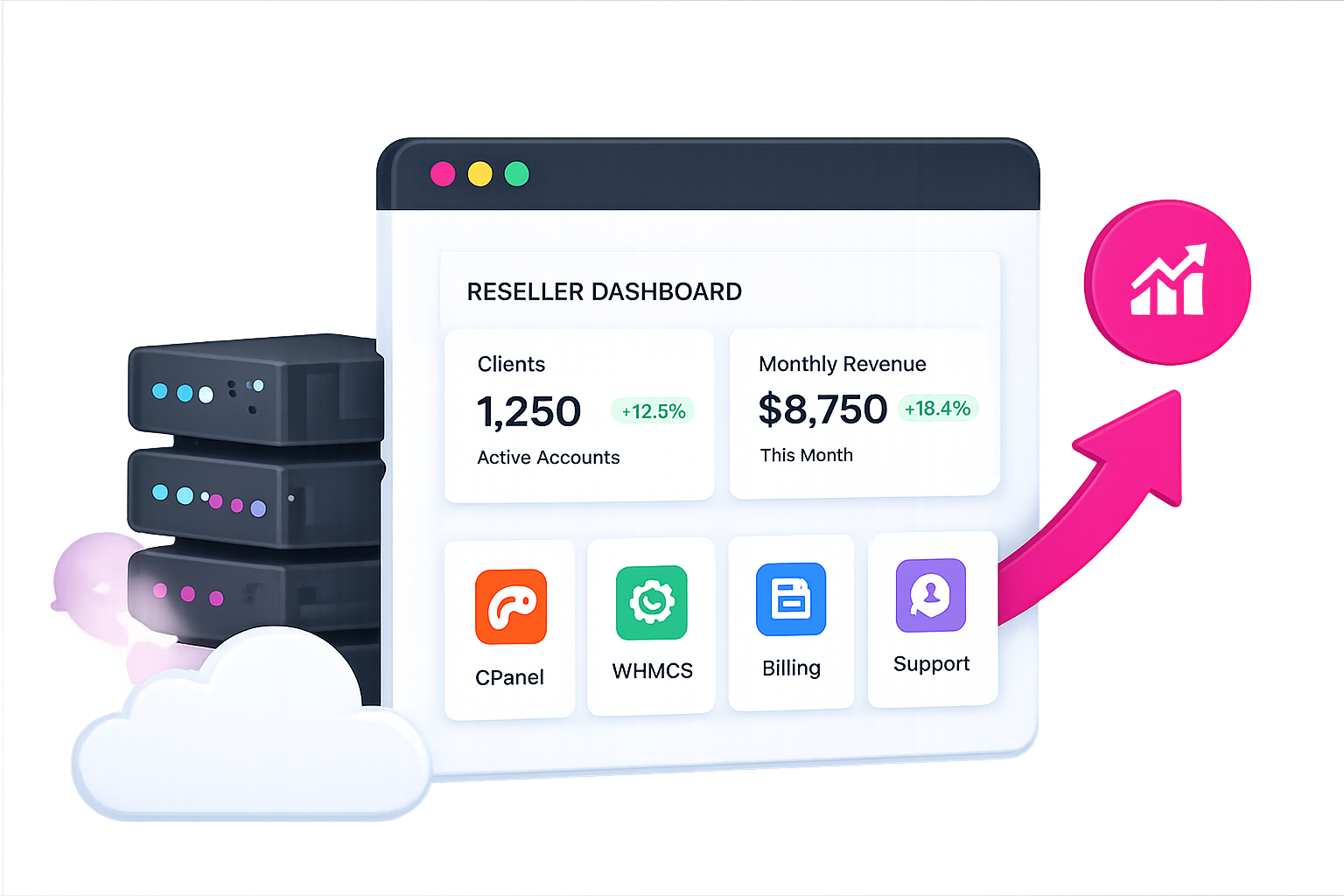

How the Web Hosting Reseller Business Model Actually Works
Quick answer: The web hosting reseller business model lets you buy server resources in bulk from a hosting company, split them into smaller packages, and sell them to clients under your own brand. You keep the difference as profit. You never own the servers, yet you earn monthly recurring revenue from every client you sign.
Let me tell you something I wish someone had told me ten years ago.
You don’t need a data center to run a hosting company. You don’t need a tech degree. You don’t even need to know how to configure a server.
I’ve spent the last decade in this industry, and I’ve watched freelancers, web designers, and total beginners build real income streams from reseller hosting. Some treat it as a side hustle. Others turn it into a full-time business.
In this guide, I’ll walk you through exactly how the model works—how the money flows, who actually owns the servers, and what it takes to get started. No fluff. Just the real picture, the way I’d explain it to a friend over coffee.
What Is the Web Hosting Reseller Business Model?
Simple explanation for beginners
Here’s the easiest way to think about it.
Imagine you rent a large apartment building. You don’t own it. But the landlord lets you divide it into smaller units and rent those units to your own tenants.
You set the rent. You choose the tenants. You handle the relationship. The building owner just keeps the structure running.
Reseller hosting works the same way. You rent a big chunk of server space from a hosting provider. Then you split it into smaller hosting plans and sell them to your clients.
You’re the landlord. The hosting company is the building owner.
How resellers differ from hosting providers
A hosting provider owns and maintains the physical servers. They handle hardware, security patches, network uptime, and all the heavy technical work.
A reseller doesn’t touch any of that.
As a reseller, your job is branding, pricing, and customer relationships. You focus on sales and support while the provider keeps the engine running behind the scenes.
That split is the whole point. You get to run a hosting business without the technical headache.
Why the model remains popular
The numbers explain a lot. According to Fortune Business Insights, the global web hosting services market was valued at $149.30 billion in 2025 and is projected to reach $178.76 billion in 2026.
That’s a massive, growing pie.
Every new business needs a website. Every website needs hosting. And most small business owners would rather pay someone they trust than figure out servers themselves.
Reseller hosting fits right into that gap.
How Reseller Hosting Works Step by Step
Purchasing reseller resources
First, you sign up for a reseller hosting plan. This gives you a pool of resources—disk space, bandwidth, and a set number of accounts you can create.
Think of it as buying wholesale. You’re getting a large quantity at a lower per-unit cost.
If you’re still figuring out what’s included, this beginner’s guide on what reseller hosting includes breaks it down clearly.
Creating hosting packages
Next, you slice that pool into smaller plans.
Maybe you create a “Starter” plan with 5 GB of space and a “Business” plan with 20 GB. You decide the limits, the features, and the price.
This is where your strategy starts to matter. Good packages match what your specific clients actually need.
Just keep an eye on your account limits so you don’t oversell. This guide on reseller hosting account limits explains things like inodes and CPU caps in plain English.
Selling hosting under your own brand
Now comes the fun part. You sell those packages as if they were your own product.
Your clients see your company name, your logo, and your support email. They have no idea a larger provider sits behind the scenes.
That’s white-label branding. To your customers, you are the hosting company.
Who Provides the Actual Servers?
Understanding upstream hosting providers
Behind every reseller sits an upstream provider. This is the company that owns the infrastructure and rents you the resources.
They handle server maintenance, network security, and uptime. You handle clients.
It’s a partnership. They do the technical work, you do the business work.
The role of data centers and infrastructure
The actual servers live in data centers—secure buildings packed with hardware, backup power, and cooling systems.
These facilities cost millions to build and staff. That’s exactly why you don’t want to own one.
The upstream provider absorbs that cost and spreads it across many resellers and clients. You get enterprise-grade infrastructure for a tiny fraction of the price.
Why resellers don’t need to own hardware
This is the beauty of the model.
You skip the biggest expense in the entire industry. No buying servers. No hiring system admins. No 3 a.m. emergency calls about a failed hard drive.
You rent the muscle and focus on growing your business. That’s a smart trade for almost anyone starting out.
How Resellers Make Money
Monthly recurring revenue explained
Here’s what I love most about this business: the revenue keeps coming.
When a client signs up, they don’t pay once. They pay every single month, year after year, as long as their website stays online.
That’s monthly recurring revenue. Ten clients paying $15 a month is $150 monthly, on autopilot. A hundred clients? You can do the math.
Recurring income is what makes this a real business, not just a one-time gig.
Pricing and profit margins
Your profit is simple. It’s the gap between what you pay the provider and what you charge your clients.
Say your reseller plan costs $25 a month, and it lets you host 30 client accounts. If you charge each client $10 a month, that’s $300 in revenue against $25 in cost.
Your margin sits in that difference. As you fill more accounts, your profit per plan climbs.
Upselling additional services
The hosting plan is just the start.
You can add SSL certificates, daily backups, domain registration, website maintenance, and SEO services. Each add-on raises your average revenue per client.
This is where freelancers really shine. You’re already building the website—why not host it, secure it, and maintain it too?
What Tools Are Needed to Run a Reseller Hosting Business?
WHM and cPanel
Two tools sit at the heart of most reseller setups: WHM and cPanel.
WHM (Web Host Manager) is your master control panel. You use it to create accounts, set limits, and manage your clients.
cPanel is what your clients use to manage their own websites—files, emails, and databases.
If the difference still feels fuzzy, this simple guide on WHM vs cPanel clears it up fast.
WHMCS automation
WHMCS is the brain of your operation. It handles billing, invoices, signups, and account suspensions—all automatically.
Without it, you’d be sending invoices by hand and chasing late payments. With it, the whole process runs itself.
I always tell new resellers: set up WHMCS reseller automation early. It saves you hundreds of hours.
And if your invoices ever stop firing, this guide on troubleshooting WHMCS cron job failures will save your day.
Private nameservers and white-label branding
Private nameservers make your business look fully independent. Instead of your clients seeing the provider’s name, they see yours (like ns1.yourcompany.com).
This is what separates a hobby from a real brand. White-label branding builds trust, and trust keeps clients paying.
Why Freelancers and Agencies Often Become Resellers
Additional revenue opportunities
If you build websites for a living, you’re leaving money on the table without hosting.
You already deliver the site. Adding hosting turns a one-time project into ongoing income.
This guide to passive profit for freelancers shows exactly how that recurring income builds up over time.
Improved client retention
When you host your clients’ sites, they stick around longer.
They’re not just buying a website once and walking away. They’re tied to you month after month for hosting, support, and updates.
That ongoing relationship is gold. It’s far cheaper to keep a client than to find a new one.
One-stop digital service offerings
Clients love simplicity. They’d rather deal with one person for design, hosting, and maintenance than juggle three vendors.
Becoming a reseller lets you offer that complete package. For agencies especially, this is huge—check out this reseller hosting checklist for WordPress agencies to see how it fits together.
The Biggest Advantages of the Reseller Hosting Model
Low startup costs
You can launch a hosting business for the price of a few dinners out.
A reseller plan, a domain, and some time. That’s the basic startup kit. Compare that to the millions a real data center costs.
This walkthrough on starting a hosting company in 97 minutes even shows the real numbers behind it.
No server administration required
You won’t be patching servers or fighting cyberattacks. Your provider handles all of that.
This frees you to do what you do best—talk to clients and grow your brand. The technical risk stays with the people equipped to handle it.
That said, knowing the basics helps. Understanding common cPanel misconfigurations makes you a smarter business owner, even if you never touch the server yourself.
Scalable business growth
Start small with one plan. As clients grow, upgrade to a bigger plan or even a master reseller setup.
You scale at your own pace. No giant upfront bet. You only invest more once the revenue justifies it.
The Challenges of Running a Hosting Reseller Business
Customer support responsibilities
Let me be honest with you. You are the front line for your clients.
When a website goes down, they email you—not the upstream provider. So you need to either learn basic troubleshooting or pick a provider with strong backend support.
This is the part most people underestimate. Good support is what builds your reputation.
Competition in the hosting market
The market is big, but it’s also busy. Plenty of resellers are out there.
The good news? Most compete only on price. You can win by offering personal service, faster replies, and a niche focus—like hosting only for dentists or photographers.
Specializing beats competing on price every single time.
Choosing reliable infrastructure partners
Your business is only as good as your provider. If their servers go down often, your clients blame you.
So choose carefully. Look for solid uptime, fast servers, and responsive support. This is the single most important decision you’ll make.
How a Typical Reseller Hosting Business Grows
First customers and referrals
Your first clients usually come from people you already know. Friends, local businesses, past project clients.
Then word spreads. One happy client tells another. Referrals become your cheapest and best source of new business.
Treat those early customers like gold. They build your foundation.
Expanding through marketing
Once you’ve got a base, you start marketing. A simple website, some SEO, a few social posts, maybe local networking.
You don’t need a huge budget. Consistent, helpful content goes a long way in this space.
Slow and steady wins here. Each new client adds to that recurring revenue stack.
Upgrading infrastructure as demand increases
As you grow, you’ll outgrow your first plan. That’s a good problem to have.
You might move to a master reseller plan to manage more sub-accounts. This guide on choosing a master reseller plan helps you pick the right one for 50+ users.
Eventually, big resellers even graduate to dedicated servers for full control.
Common Myths About Reseller Hosting
“You need technical expertise”
You don’t. I’ve seen people with zero coding background run thriving hosting businesses.
The tools do the heavy lifting. WHM, cPanel, and WHMCS handle the technical side. You bring the business sense.
Of course, learning a little tech helps you support clients faster. But it’s not a barrier to starting.
“The market is too crowded”
Crowded isn’t the same as closed. The web hosting market is growing every year, and new websites launch constantly.
There’s always room for someone who offers better service or serves a specific niche. The big players can’t be everything to everyone.
That gap is your opportunity.
“Only large companies can succeed”
False. Small resellers often win because they’re small.
You can offer personal attention that big hosts can’t. You answer emails fast. You actually know your clients’ names.
That personal touch is a real competitive edge. Plenty of solo resellers earn solid, steady income.
How Does SkyNetHosting.Net Inc. Support Reseller Hosting Businesses?
White-label reseller infrastructure
SkyNetHosting.net provides fully white-label reseller hosting, so your clients only ever see your brand. Private nameservers, custom branding, and isolated client accounts come standard.
You look like a full hosting company from day one—because, to your clients, you are one.
WHMCS-compatible automation
Every SkyNetHosting.net reseller plan includes a free WHMCS license valued at $15.95 per month. That’s the billing automation tool I mentioned earlier, handed to you at no extra cost.
With it, you can automate your entire hosting business—signups, invoices, and account management run on autopilot.
Scalable hosting solutions for growth-focused entrepreneurs
SkyNetHosting.net runs on NVMe SSD infrastructure built for speed and reliability. As your client base grows, you can scale your plan to match demand without ever touching hardware.
It’s built for freelancers, agencies, and entrepreneurs who want to grow without limits.
Final Thoughts: Is Reseller Hosting Right for You?
Let me leave you with the honest truth.
Reseller hosting lets you build a recurring-revenue business without ever owning a server. That’s a rare combination of low cost and steady income.
But success isn’t automatic. It comes down to three things: strong branding, genuine customer service, and choosing the right infrastructure partner. Nail those, and you’ve got a real business.
SkyNetHosting.net gives you the white-label infrastructure, free WHMCS automation, and scalable plans to launch and grow your hosting business with confidence.
If you’ve been looking for a way to earn recurring income online, this might be your starting point. Take the first step today.
Frequently Asked Questions
How much does it cost to start a reseller hosting business?
Startup costs are low. You mainly need a reseller hosting plan, which often starts at a modest monthly fee, plus a domain name. With SkyNetHosting.net, the WHMCS billing license (worth $15.95/month) is included free, which removes a major cost most beginners face.
Is reseller hosting actually profitable?
Yes, mainly because of recurring revenue. You buy resources in bulk and sell smaller packages at a markup. With 30 clients each paying $10 a month against a $25 plan cost, you’d earn $300 in monthly revenue. Profit grows as you fill more accounts and add upsells.
Do I need technical skills to run a reseller hosting business?
No coding degree required. Tools like WHM, cPanel, and WHMCS handle the technical work for you. Basic troubleshooting knowledge helps with client support, but the upstream provider manages servers, security, and uptime.
How long does it take to launch a reseller hosting business?
Faster than most people expect. Once your reseller plan is active, you can set up packages, branding, and billing in a few hours. Some entrepreneurs launch in under two hours, though building a client base takes ongoing effort.
Who owns the servers in reseller hosting?
The upstream hosting provider owns and maintains the physical servers in their data centers. As a reseller, you rent resources and sell them under your own brand. You never buy or manage hardware yourself.
Who is reseller hosting best for?
Reseller hosting suits freelancers, web designers, digital agencies, and side-hustlers who want recurring income. It’s ideal if you already build websites for clients, since adding hosting turns one-time projects into ongoing revenue.
