
What Is a White-Label Hosting Storefront and How Does It Work?
Imagine running a hosting business where every client sees your logo, pays your invoices, and contacts your support team — but you never touch a single server. You set the prices. You build the brand. Someone else handles the infrastructure behind the scenes.
That is exactly what a white-label hosting storefront makes possible. It is one of the more underrated business models in the digital services space, and more freelancers, agencies, and entrepreneurs are building them than most people realize.
This guide explains what a white-label hosting storefront actually is, how the whole system works from a client placing an order to a hosting account going live, and what you need to build one that runs professionally from day one.
What Is a White-Label Hosting Storefront?
The concept sounds more complicated than it is. Once you understand the basic structure, the whole thing clicks into place quickly.
Definition and Basic Concept
A white-label hosting storefront is a branded online shop where you sell web hosting services under your own company name. Your customers visit your website, browse your hosting plans, and sign up through your checkout process. Everything they interact with — the domain, the branding, the billing emails, the client portal — carries your name and your identity.
Behind the scenes, the actual server infrastructure is provided by an upstream hosting company. They own the hardware, manage the data center, and keep the servers running. You lease resources from them at wholesale pricing, mark them up, and resell them to your own clients at retail. Your clients never know or need to know that anyone else is involved.
How White-Label Hosting Differs From Affiliate Marketing
This is a distinction worth making clearly because the two models get confused sometimes. With affiliate marketing, you send traffic to another company’s website and earn a commission when someone signs up. The customer belongs to that company, not to you. You have no ongoing relationship with them and no recurring income beyond the initial referral payout.
With a white-label storefront, the customer is yours. They signed up on your platform, they pay you directly, and they interact with your brand for as long as they remain a client. You handle billing, support, and the client relationship. The upstream provider is invisible infrastructure, not the business your client thinks they are using.
Why Businesses Use Hosting Storefronts
For web designers and digital agencies, offering hosting directly to clients creates a natural recurring revenue stream that extends the relationship beyond project work. Instead of finishing a website build and watching the client walk away to sign up with a random shared host, you keep them in your ecosystem and earn monthly revenue from their hosting for years.
For entrepreneurs who want to build a scalable online business, white-label hosting is attractive because the infrastructure investment is minimal, the recurring revenue model is predictable, and the business can be managed remotely without any physical operations. The combination of low overhead and steady monthly income is what draws people to this model.
How Does a White-Label Hosting Storefront Work?
The mechanics of a white-label hosting storefront involve several moving parts that work together automatically once the system is set up. Here is how the process flows from the moment a client lands on your site to the moment their hosting account is live.
Customer Ordering Process
A visitor arrives on your hosting website, browses your plan options, and selects the one that fits their needs. They go through your checkout process, enter their billing details, and complete payment. The entire experience happens on your domain, with your branding, and through your checkout flow. It looks and feels exactly like any other hosting company’s ordering process.
The client receives a welcome email from your company confirming their order and providing their login details for your client portal. At no point in this process does the upstream provider’s name appear anywhere. From the client’s perspective, they just signed up for hosting with your company.
Automated Hosting Account Provisioning
This is where the automation becomes genuinely impressive. The moment a client’s payment clears, the system automatically creates a hosting account for them on the server infrastructure, assigns resources according to their plan, and sends them everything they need to get started. No manual steps. No waiting for an administrator to log in and create the account. The whole process happens in seconds.
This automatic provisioning is handled through the integration between your billing platform and the upstream server infrastructure. When payment is confirmed, the billing system signals the server environment to create the account, and the server environment reports back when it is done. The client gets their login credentials without you doing anything.
Billing and Subscription Management
Once a client is on board, the billing system handles everything related to their ongoing subscription. It sends invoices before each renewal period, processes the payment when it is due, and automatically renews the hosting account. If a payment fails, the system sends reminders and follows the dunning process you configure — typically a few reminder emails before eventually suspending the account.
All of this happens without any manual involvement from you. Your role is to configure the system correctly at the start, handle the occasional support question, and collect your monthly revenue. The billing automation does the routine work that would otherwise consume hours of your time each month.
What Infrastructure Powers White-Label Hosting?
Understanding what sits underneath your storefront helps you make better decisions when choosing your upstream provider and setting up your environment.
Reseller and Master Reseller Hosting
The most common infrastructure arrangement for a white-label hosting storefront is reseller hosting. You sign up for a reseller hosting plan with an upstream provider, which gives you a pool of server resources that you can divide into individual hosting accounts for your clients. You control how those resources are allocated, what limits each account has, and what pricing you charge.
Master reseller hosting takes this a step further. With a master reseller account, you can create your own resellers underneath you, each with their own resource pools and client bases. This is typically for hosting businesses that have grown significantly and want to offer reseller accounts as a product, not just individual hosting accounts.
WHM and cPanel Integration
The control layer that makes all of this manageable is WHM — Web Host Manager. This is the administrator interface where you create client accounts, set resource limits, configure packages, and manage the server environment. Your clients never see WHM. It is your backend management tool.
Your clients interact with cPanel, which is the end-user interface for managing their individual hosting account. Email accounts, file management, database creation, SSL certificates, and application installations through Softaculous all happen through cPanel. The two systems work together: you manage everything from WHM, and your clients manage their own slice through cPanel.
Server Infrastructure Handled by Upstream Providers
The physical server infrastructure — the hardware, the data center, the network connections, the power and cooling — is entirely the upstream provider’s responsibility. They maintain the servers, handle hardware failures, manage network uptime, and apply security patches at the operating system level. You never need to think about any of that.
What this means practically is that you get the benefits of running a hosting business without the capital investment, technical complexity, and operational burden of actually owning and managing servers. The upstream provider handles the hard parts. You handle the client relationships and the business side.
What Tools Are Needed to Build a Hosting Storefront?
You do not need a large tech stack to run a white-label hosting storefront. The core toolset is actually quite lean, and most of what you need comes bundled with a good reseller hosting plan.
WHMCS for Automation and Billing
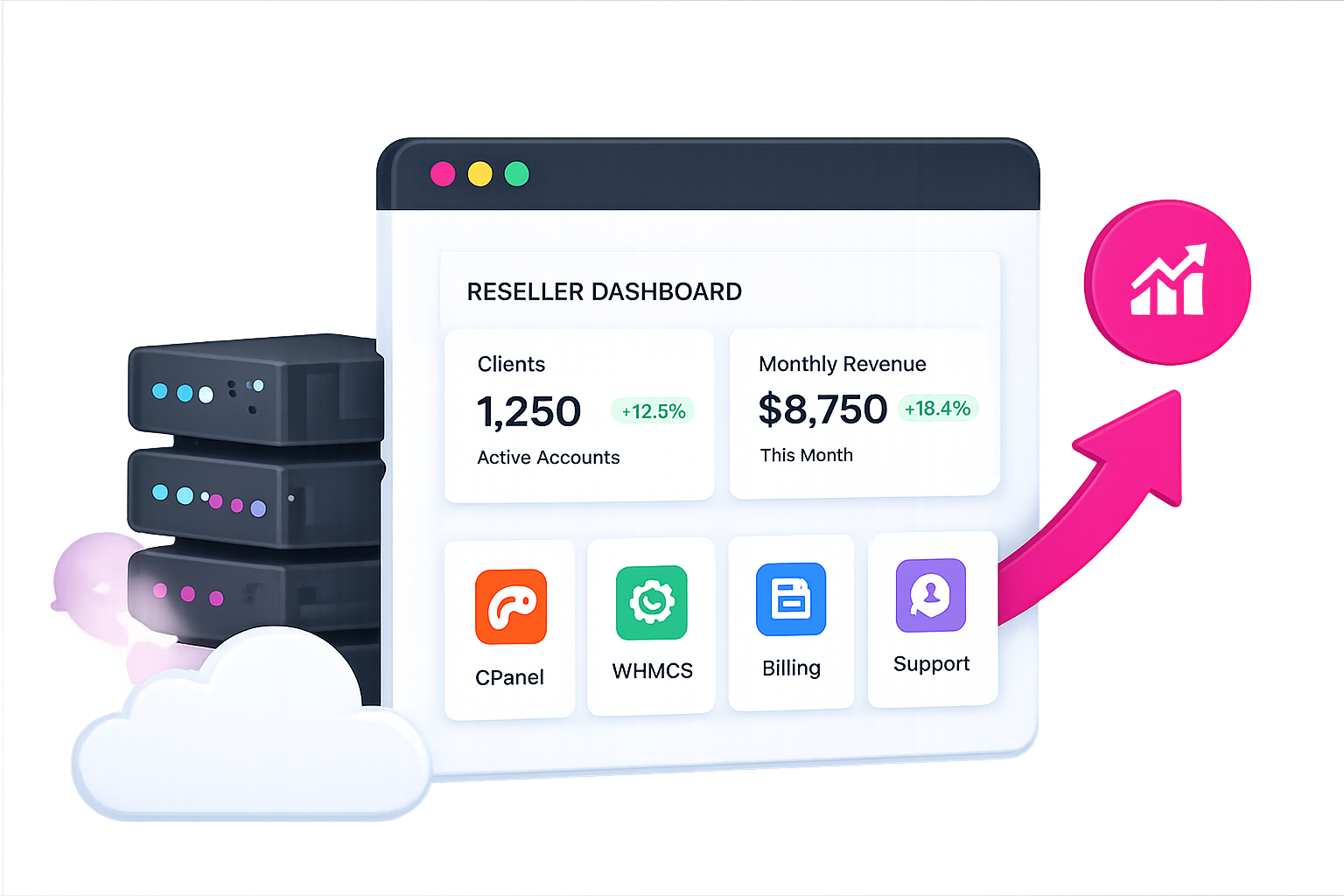
WHMCS is the industry-standard platform for hosting billing and automation. It is the engine that powers your storefront’s order processing, client management, invoice generation, payment collection, and account provisioning. When a client orders on your site, WHMCS handles the entire workflow from checkout to account creation automatically.
For most new resellers, WHMCS is the single most important tool in the stack. It replaces what would otherwise be hours of manual billing work each month and makes it possible to run a hosting business with dozens or even hundreds of clients without a dedicated administrative team. SkyNetHosting.Net includes WHMCS free with every reseller plan, which removes the licensing cost that can otherwise be a barrier for new businesses getting started.
Domain Registration Integration
Offering domain registration alongside hosting makes your storefront significantly more attractive to clients who want a one-stop setup experience. WHMCS integrates with domain registrars through their APIs, allowing you to offer domain search and registration directly on your website. When a client registers a domain through your storefront, WHMCS handles the registration and renewal automatically just like it handles hosting subscriptions.
This is also a meaningful additional revenue stream. Domain registration margins are not large, but domain renewals are predictable recurring revenue, and clients who register their domain through you are more likely to keep their hosting with you because moving both at once creates friction they would rather avoid.
Payment Gateway Setup
Your storefront needs to accept payments, and WHMCS connects with all the major payment gateways. Stripe, PayPal, and traditional credit card processing all integrate in a few clicks through the WHMCS gateway configuration. You set up your gateway, enter your API credentials, and payments start flowing through automatically.
Think about what payment methods your target clients are likely to use. If you are serving local small businesses, PayPal is familiar and trusted. If you are targeting more technical clients, Stripe offers a cleaner checkout experience. You can enable multiple gateways and let clients choose their preferred option at checkout.
How Branding Works in White-Label Hosting
The white-label part of white-label hosting is about more than slapping your logo on a control panel. Done properly, your brand appears consistently at every touchpoint your client encounters.
Custom Company Branding
Inside WHM, you can upload your company logo and set your company name so that both appear throughout the cPanel interface your clients use. Every page they see in their hosting control panel shows your branding, not the upstream provider’s. Welcome emails, invoice templates, and support portal communications all carry your company identity.
The goal is for your clients to have zero reason to know that anyone other than your company is involved in providing their hosting. When they think about their hosting, they think about your brand. That brand recognition is what makes them stay and what makes them refer others.
Private Nameservers
Nameservers are the DNS records that tell the internet which servers host a domain’s website. By default, if you did not configure custom nameservers, clients pointing their domains to your hosting would see your upstream provider’s nameserver names in their DNS records. That visibility breaks the white-label illusion.
Private nameservers solve this. You create nameserver records like ns1.yourbrand.com and ns2.yourbrand.com that point to your server’s IP address. When clients set their domain’s nameservers to yours, your company name appears in their DNS records and nowhere in that chain is your upstream provider’s name visible. Setting this up requires a nameserver registration with your domain registrar and a few minutes of configuration in WHM.
White-Label Support Systems
Support is where the white-label experience can break down if you are not careful. If a client submits a support ticket and the response comes from an email address that does not match your domain, or if they somehow end up on your upstream provider’s support page, the illusion is broken and trust takes a hit.
WHMCS includes a built-in support ticket system that runs under your domain and your branding. Configure it from the start so that all support communication comes from your company’s email address and stays within your client portal. For technical issues that escalate beyond your capability, you handle the communication with your upstream provider on the backend while presenting the resolution to your client under your own name.
How Customers Experience the Hosting Storefront
Putting yourself in your client’s shoes when thinking about the storefront experience is one of the most valuable exercises you can do. The smoother their journey, the fewer support questions you receive and the higher your renewal rates.
Browsing Hosting Plans
A client arrives on your website and sees your hosting plans laid out clearly. They can compare what each plan includes — storage, bandwidth, number of email accounts, supported sites — and understand what they are getting at each price point. The plan descriptions and pricing are entirely yours. You decide how to position and name them, and WHMCS displays them according to how you have configured your products.
The quality of this browsing experience depends on how clearly you communicate the value of each plan. Clients who can quickly understand what they need and why your plans fit their situation convert faster and ask fewer pre-sales questions. Invest time in writing clear, benefit-focused plan descriptions rather than just listing technical specs.
Automated Onboarding Experience
After a client completes their order, the automated onboarding sequence kicks in. A welcome email arrives with their login credentials for your client portal. Inside the portal, they can see their active services, their upcoming invoices, and links to access their cPanel account. If you have set up a new client email sequence in WHMCS, they may also receive helpful getting-started resources automatically.
The best onboarding experiences feel personal even when they are automated. Write your welcome email in a warm, direct tone that speaks to the client’s specific situation rather than using generic template language. A client who feels welcomed is more likely to reach out with questions, which gives you the opportunity to build the relationship early.
Client Dashboard and Account Management
The WHMCS client portal gives your clients a self-service dashboard where they can manage everything about their account without contacting you. They can view and pay invoices, update their billing information, open support tickets, manage their domain registrations, and access their hosting control panel — all from one place under your brand.
This self-service capability is genuinely important for client satisfaction. Clients who can handle routine tasks themselves at any time of day without waiting for a support response feel in control of their hosting. That sense of control is a significant factor in long-term client retention.
How White-Label Hosting Businesses Make Money
The business model is straightforward, but understanding the different revenue layers helps you build something that grows meaningfully over time.
Monthly Recurring Revenue
The core of the business is the margin between what you pay your upstream provider and what your clients pay you. If your reseller plan costs $50 per month and you have 30 clients each paying $20 per month, your revenue is $600 and your gross profit after infrastructure costs is $550. That number grows every time you add a client without requiring proportional increases in your time or operational costs.
This is the compounding effect of recurring revenue. Each client you add increases your monthly income permanently as long as they stay. A client who signs up today and stays for three years contributes to your monthly revenue for 36 consecutive months. The upfront effort of winning that client pays dividends for years.
Upselling Domains, SSL, and Email Hosting
Hosting plans are just the beginning of what you can offer. Domain registration, SSL certificates, professional email hosting, website backup services, and site security tools are all additional products that naturally complement hosting. Clients who buy hosting from you are warm prospects for these add-ons because they already trust your platform and want to manage everything in one place.
WHMCS makes it easy to offer these products in your storefront alongside your hosting plans. Each additional product a client adds to their account increases their monthly spend and deepens their connection to your platform, both of which improve retention. A client paying you for hosting, a domain, and email hosting has three reasons to stay rather than one.
Scaling Through Reseller Packages
As your hosting business grows, you can add a new revenue dimension by offering reseller hosting packages to other entrepreneurs who want to start their own hosting businesses. You become their upstream provider in the same way that your upstream provider is yours. They buy resources from you at wholesale and sell hosting to their own clients under their own brand.
This model scales your revenue without requiring a proportional increase in the number of individual clients you manage directly. Instead of managing 200 individual hosting accounts, you might manage 10 resellers each with 20 accounts. Your revenue comes from the wholesale margin on reseller plans rather than the retail margin on individual accounts.
Benefits of Running a White-Label Hosting Storefront
The appeal of this business model comes from a specific combination of factors that most other business types do not offer together.
Low Startup Costs
Getting a white-label hosting storefront off the ground requires a reseller hosting plan, a domain, and WHMCS — and WHMCS comes free with many reseller plans. Your total startup investment can be under $20 in your first month. Compare that to almost any other business model that generates comparable recurring revenue potential and the capital efficiency is remarkable.
Low startup costs also mean low risk. You are not committing significant capital to an untested idea. You can launch, test your positioning, get your first few clients, and evaluate whether the business is worth scaling before making any major investments.
No Need to Manage Data Centers
Server infrastructure is expensive, complex, and requires specialist knowledge to manage well. Hardware fails. Networks go down. Security patches need to be applied. Cooling systems need maintenance. Running a data center operation is a full-time job with significant capital requirements that has nothing to do with running a hosting business.
With a white-label model, all of that is your upstream provider’s problem. You focus entirely on the client-facing side of the business — marketing, sales, support, and account management — while the people who are good at managing servers handle the servers. That division of responsibility is one of the main reasons this model is so accessible to non-technical entrepreneurs.
Scalable Recurring Business Model
Most service businesses scale linearly. You do more work, you earn more money. Your capacity is limited by your time and energy. Hosting is different. Adding a new client to your platform takes minutes and generates monthly revenue indefinitely without requiring additional time from you each month to maintain.
This scalability is what makes hosting genuinely different from most freelance or agency revenue. You build the client relationship once. The billing automation, the server infrastructure, and the self-service client portal maintain it ongoing. Your monthly revenue grows every time you add a client and stays strong as long as your clients stay — which, with good service, they tend to do for years.
Common Mistakes When Launching a Hosting Storefront
Most of the problems new hosting businesses run into are predictable and avoidable. Here are the ones that come up most often in the first few months.
Weak Branding and Positioning
Launching a hosting storefront with a generic name, stock imagery, and plan descriptions copied from someone else’s website is the fastest way to become invisible in a crowded market. Your brand is the main thing that distinguishes you from every other reseller offering technically similar plans on similar infrastructure. Investing time in developing a clear identity and a specific positioning before you launch is time spent on the thing that matters most.
Think about who you are serving and what they care about most. A hosting brand built for creative freelancers looks and feels different from one built for local small businesses or e-commerce entrepreneurs. The more specifically your brand speaks to a particular audience, the more compelling it feels to that audience, and the less you are competing on price alone.
Poor Support Systems
Nothing kills a hosting business faster than being unreachable when clients have problems. Hosting clients expect support to be available when their website is down, and that can happen at any hour. If you do not have a support system configured from day one and a realistic plan for handling urgent requests, you will start losing clients the first time something goes wrong.
WHMCS’s built-in ticketing system gives you the infrastructure to manage support professionally from day one. Set clear expectations in your terms of service about response times, and then actually meet them. Clients are far more forgiving of technical problems when support is responsive and communicates clearly than they are with providers who are hard to reach.
Choosing Unreliable Upstream Infrastructure
Your upstream provider’s reliability is your reliability. When their servers go down, your clients experience downtime and they blame you. When their support is slow, your ability to resolve client issues is limited by how quickly they respond to you. The upstream provider you choose is the most consequential decision you make when setting up your hosting business.
Do not make this decision based on price alone. Evaluate uptime track records, support responsiveness, infrastructure quality, and whether the provider’s reseller offering includes everything you need — WHMCS, white-label branding, modern storage technology, and a clear upgrade path as your business grows. Getting this foundation right makes everything else easier.
How Does SkyNetHosting.Net Inc. Support White-Label Hosting Businesses?
Building a white-label hosting storefront on the right upstream infrastructure makes a meaningful difference in how the business runs from day one.
Reseller-Ready Hosting Infrastructure
SkyNetHosting.Net’s reseller plans are designed specifically for the kind of business model described throughout this guide. WHM and cPanel are included and pre-configured. WHMCS comes free with every reseller plan, removing the billing platform cost that can be a barrier for new businesses. The infrastructure runs on NVMe SSD storage with LiteSpeed web servers, which means the hosting accounts you provision for your clients perform well from the moment they go live.
All of this is available from a single reseller plan without purchasing additional tools, configuring separate systems, or negotiating special arrangements. The core stack for a functional white-label hosting storefront is ready to go from the day you sign up.
White-Label Compatible Environment
Every aspect of the SkyNetHosting.Net reseller environment supports complete white-label operation. You can configure your logo and company name in WHM so they appear throughout the cPanel interface your clients use. Private nameservers are fully supported, so your brand name appears in DNS records instead of SkyNetHosting’s. All client-facing communication, including invoices, welcome emails, and support responses, flows through your branding.
The result is that your clients experience a complete, professional hosting brand that is entirely yours. The upstream infrastructure is the invisible foundation that makes it possible, but nothing your clients see or interact with gives any indication of who is providing that infrastructure.
Scalable Hosting Solutions for Agencies and Entrepreneurs
SkyNetHosting.Net’s reseller plans scale as your business grows. You start with a plan sized for your initial client base and upgrade as your account count increases. The upgrade process stays within the same platform, so there is no disruption to existing clients and no need to migrate hosting accounts to a new provider as you grow.
Whether you are a freelance web designer adding hosting to your service offering for the first time, or an agency building a dedicated hosting revenue stream alongside your project work, the infrastructure scales to match where you are and where you are going. That continuity matters because every time you have to migrate infrastructure, you introduce risk and operational complexity that a stable upstream relationship avoids entirely.
Conclusion
White-Label Hosting Storefronts Allow Businesses to Sell Hosting Under Their Own Brand
The white-label hosting model gives you something genuinely valuable — a recurring revenue business that runs under your brand without requiring you to own or manage any server infrastructure. Your clients interact with your company, pay your invoices, and associate their positive hosting experience with your brand. The upstream provider stays invisible and handles the technical complexity that would otherwise make this business inaccessible.
For anyone already running a client-facing digital services business, adding a white-label hosting storefront is one of the most natural ways to add predictable recurring revenue to a business that otherwise depends on project-based income.
Automation and Reliable Infrastructure Are Essential for Success
The businesses that run well in this space share two things. They invest in proper automation from the start — WHMCS configured correctly, billing running automatically, client onboarding handled without manual steps — and they choose upstream infrastructure that they can genuinely rely on. Cut corners on either of these and the operational friction eventually becomes a problem that client relationships cannot survive.
Get both right and the business largely takes care of itself at the operational level, which frees you to focus on growing the client base and improving the service rather than managing administrative overhead.
SkyNetHosting.Net Provides Scalable Infrastructure for Modern White-Label Hosting Businesses
SkyNetHosting.Net gives resellers and agencies the complete foundation for a professional white-label hosting storefront. Free WHMCS, WHM and cPanel included, full white-label branding support, NVMe storage performance, and 24/7 live support combine to create an upstream environment that lets you focus on building your hosting brand rather than managing infrastructure.
The storefront is yours. The brand is yours. The client relationships are yours. The infrastructure and the complexity of keeping it running are handled. That combination is exactly what makes the white-label hosting model worth building.
